How Askiras Reviews Missed Questions
See the Askiras missed-question review loop across SAT, LSAT, AP, and CPA REG without testimonials or copied official questions.
Read it to name the pattern, then practice while it is still fresh.
Prepared by Askiras editorial team. These guides stay short on purpose: one pattern, one worked example, one clear next step into practice. How we build guides.
Uses public study-strategy context and avoids unsupported outcome claims.
public study guidance context, Askiras independence, and no unsupported outcome claims.
How does Askiras turn a missed question into review?
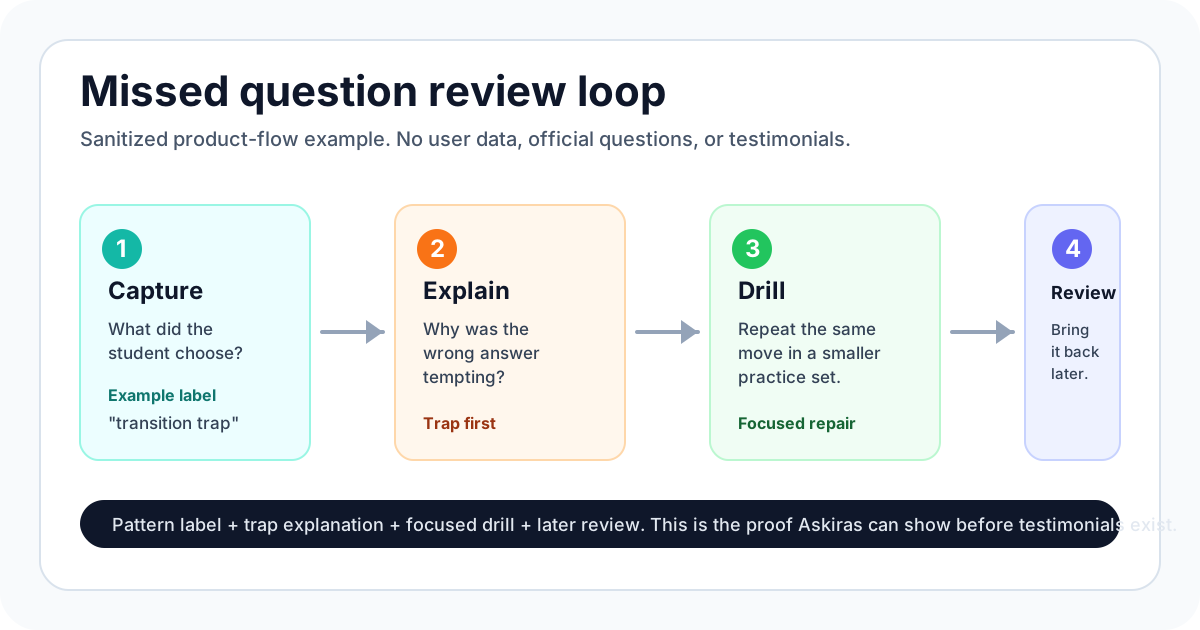
Askiras tries to name the missed task, explain why the tempting answer worked, assign a smaller focused drill, and bring the same move back later. The goal is not more volume by default; it is a clearer loop after the miss.
The short answer
Askiras is built around the moment after a student misses a question.
The useful question is not “how do we add more practice?” It is “what exactly went wrong, and what should the next session repeat?”
That is the product proof Askiras can show before public testimonials exist: the review method, the boundaries, and the workflow. It should not claim student outcomes, institution proof, or student quotes until real users opt in and the evidence is published.
The four-step loop
A good missed-question review loop is small enough to use while the mistake is still fresh.
- Capture the miss. Save the answer, the tempting choice, the time pressure, and the domain.
- Name the task. Label the miss as a grammar boundary, transition relationship, Desmos decision, LSAT flaw, AP evidence move, CPA REG blueprint area, or another specific pattern.
- Explain the trap. Say why the wrong answer looked plausible before explaining why the right answer works.
- Repair the move. Assign a short focused drill and bring the same pattern back later.
The key is the label. Without a label, review turns into rereading. With a label, the student knows what to watch for next time.
Sanitized product-flow examples
These examples are not testimonials, screenshots of user records, or official exam items. They are sanitized product-flow examples that show what the review loop is supposed to do.
| Domain | Miss label | What the explanation should clarify | Next focused action |
|---|---|---|---|
| SAT Reading and Writing | Transition trap | The wrong connector matched the topic but not the sentence relationship. | Drill contrast, continuation, example, and conclusion transitions. |
| SAT Math | Desmos decision | Graphing was useful only after translating the expression into the right function or equation. | Practice choosing graph, solve, or skip before starting the algebra. |
| LSAT Logical Reasoning | Flaw prephrase | The tempting answer described the subject, not the reasoning error. | Write conclusion, support, and bad move before reading choices. |
| AP Biology | Figure evidence | The answer named biology vocabulary without using the actual graph or control. | Write one claim with one data reference and one mechanism sentence. |
| AP Psychology | Evidence-Based Question | The response cited a source but did not connect it to the claim. | Practice claim, evidence, and reasoning as three separate sentences. |
| CPA REG | Blueprint-area miss | The miss was not “tax is hard”; it was entity taxation, procedure, property, or business law. | Sort the question by REG area before doing another mixed set. |
That is a narrower promise than a full course, giant question bank, or private tutor. It is also easier to verify: the page or trainer either names the miss clearly or it does not.
What a review answer should include
When Askiras explains a miss, the answer should include:
- the exact task the question asked for
- why the wrong answer was tempting
- what detail, rule, or relationship controlled the right answer
- one short next move the student can repeat
- a link back to the relevant guide or focused drill
For SAT, that might mean naming a sentence-boundary rule or a Desmos decision. For LSAT, it might mean naming the argument gap before answer choices rename it. For AP, it might mean separating evidence from background knowledge. For CPA REG, it might mean sorting the miss by blueprint area while keeping the page educational and not professional advice.
What the answer should not do
The review loop should not:
- reproduce protected official questions, answer choices, rationales, screenshots, or close paraphrases
- solve active graded schoolwork as a black box
- give tax, accounting, legal, licensing, or filing advice in CPA or Law contexts
- pretend that Askiras is official, endorsed, or affiliated with exam administrators
- promise a specific score, pass result, or measured improvement
- quote testimonials before real opted-in reviews exist
Those limits are product quality, not just legal copy. A student needs trust in the explanation, and overclaiming makes the explanation weaker.
Where screenshots fit next
The next proof layer should be real, sanitized product screenshots from live trainer flows:
- SAT missed-question review
- LSAT flaw drill review
- AP source, graph, FRQ, or scenario review
- CPA REG readiness or TBS review
Each screenshot should remove names, email addresses, IDs, exact user history, official or copied exam material, and anything that implies a score outcome. The caption should say what the workflow proves: pattern label, trap explanation, focused drill, later review, or support/cancel clarity.
Until those screenshots are captured and checked, Askiras should use sanitized flow panels and clear method descriptions instead of fake proof.
How paste and image help should work
Students naturally want to paste a confusing question, screenshot, graph, table, or answer explanation and ask, “What did I miss?”
That can be useful, but only with guardrails:
- Askiras should ask what the student is trying to understand, not just output an answer.
- The response should cite the current question context and the relevant Askiras guide pattern when available.
- Uploaded images should have explicit privacy, storage, moderation, and retention rules before broad launch.
- If the pasted material looks like official or proprietary content, Askiras should avoid reproducing it and shift to a general pattern explanation.
Free-form chat can help when it stays anchored to the active question and the student’s next move. It becomes weaker when it turns into an unbounded homework solver.
The proof standard
Before Askiras has testimonials, the right proof is operational:
- Does the public page explain the method plainly?
- Does the comparison page say when the other provider is better?
- Does the trainer tell the student why the trap worked?
- Does the follow-up drill repeat the same move?
- Does the product avoid official-content leakage and unsupported outcome claims?
That is the bar this page sets. Askiras should earn public proof by making the review loop visible, not by borrowing proof it does not have.
Frequently asked questions
Are these examples testimonials or real student records?
No. The examples on this page are sanitized product-flow examples. They do not include student data, outcome claims, institution marks, testimonials, official questions, or copied answer choices.
Does Askiras use official exam questions in the review flow?
No. Public Askiras examples and trainer practice should be original and pattern-focused. Official format facts can be cited, but protected questions, answer choices, rationales, screenshots, and close paraphrases should not be reproduced.
What proof can Askiras show before testimonials exist?
Askiras can show its methodology, public guide coverage, pricing, source boundaries, sample review flow, support expectations, and product workflow. It should not claim student outcomes or reviews until opted-in evidence exists.
Keep going in this exam
Other guides at Askiras
If you are also prepping another exam, these short guides cover the same "name the pattern, then practice" habit.