How to Review SAT Mistakes So They Stop Repeating
Most students miss the same SAT questions twice because they review too vaguely. Here is a cleaner way to do it.
Read it to name the pattern, then practice while it is still fresh.
Prepared by Askiras editorial team. These guides stay short on purpose: one pattern, one worked example, one clear next step into practice. How we build guides.
Uses public Digital SAT format and practice-strategy context; does not reproduce protected College Board questions.
College Board Digital SAT context, Askiras independence, and no unsupported outcome claims.
How should you review SAT mistakes?
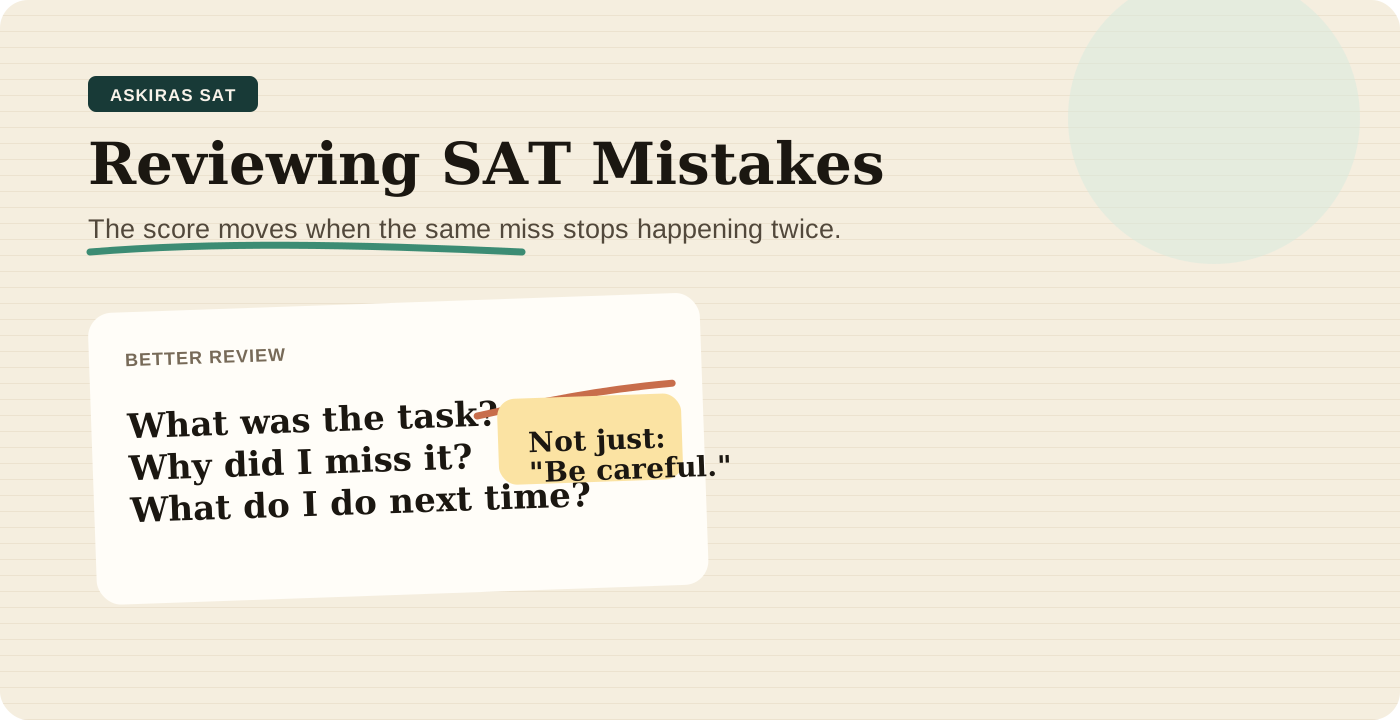
Review each SAT miss by naming the task, the exact error, the clue you skipped, and the action you will take next time. A useful miss log turns vague notes like 'careless' into repeatable review labels.
Bad review is the quiet reason scores stall
Many students do enough SAT practice to improve. They just do not review well enough to cash it in.
Their review sounds like this:
- “Need to be more careful.”
- “Silly mistake.”
- “I knew this one.”
That feels honest, but it is not useful.
Useful review tells you why the miss happened and what to do differently next time.
What a good review note sounds like
A strong note is short but specific.
Instead of:
Careless
Write:
I solved for x, but the question asked for 2x + 1.I picked an answer that matched the topic, not the inference task.I missed the comma splice because I never checked whether both sides were complete sentences.
That kind of note gives you something to fix.
Use four questions after every miss
Every time you miss a question, ask:
- What was the task?
- What did I do wrong?
- What clue did I miss?
- What will I do next time?
That is enough. You do not need a giant spreadsheet to review well.
A math example
Suppose the SAT asks:
If
3x + 4 = 19, what is the value of2x + 1?
You solve x = 5 and pick that answer.
Bad review:
Need to slow down.
Better review:
- Task: expression target
- Mistake: stopped after solving for x
- Missed clue: the question asked for
2x + 1, notx - Next time: circle the actual target before solving
That last line matters most.
An R&W example
Suppose the SAT asks which choice is most strongly supported, and you pick an answer that sounds plausible in real life but is not clearly supported by the passage.
Bad review:
Reading mistake
Better review:
- Task: inference
- Mistake: picked a reasonable guess instead of the answer with the strongest text support
- Missed clue: I could not point to a sentence that directly supported my choice
- Next time: force myself to match each contender to actual lines in the passage
That is the kind of note that changes your next test.
The mistake categories worth tracking
You do not need 25 categories. You need a few that recur.
For SAT math:
- wrong target
- translation / setup
- algebra slip
- pattern miss
- interpretation miss
Each of those maps to one of the recurring asks in the SAT math patterns guide, which is a useful place to look up what the underlying pattern actually was after a miss.
For SAT R&W:
- main idea vs detail
- inference leap
- evidence mismatch
- transition logic
- grammar rule miss
If you label misses this way for two weeks, the repeat problems become obvious.
Review correct guesses too
This matters more than students think.
If you guessed and got lucky, the underlying weakness is still there. The SAT does not care whether the score report calls it correct.
If you could not explain the answer cleanly, review it.
Lucky correct answers are often tomorrow’s wrong answers.
When to review
The best time is soon after the set, while the thinking is still fresh.
Good rhythm:
- quick note right after the set
- short second look later that day or the next day
- revisit the same mistake type again later in the week
That timing is why review works better than vague memory.
What not to do
Do not write novels
If your review takes longer than the original question every time, you will stop doing it.
Short beats elaborate. Specific beats long.
Do not only reread the explanation
Reading the official explanation can help, but it is not the same as explaining the miss in your own words.
If you cannot say what happened without copying the explanation, the lesson probably did not stick.
Do not mix every miss together
If your notes just say “math” or “reading,” nothing becomes visible. The point is to see the pattern inside the misses.
A simple review template
Use this:
- Question type:
- I chose:
- The trap was:
- Next time I should:
Example:
- Question type: grammar / sentence boundary
- I chose: comma splice answer
- The trap was: it sounded smooth, so I did not check whether both sides were complete sentences
- Next time I should: check sentence boundaries before judging style
That is enough to build a real feedback loop.
A weekly review routine
Try this for one week:
- After every drill, write notes for the misses and shaky guesses.
- At the end of the week, group the notes by pattern.
- Pick the two patterns that showed up most.
- Start the next week by drilling those two patterns first.
That is how review turns into score movement.
The SAT rarely beats students with brand-new mistakes. It usually beats them with the same old mistake happening again in slightly different clothes.
Frequently asked questions
Why doesn't my SAT score move even though I practice a lot?
Often because the review is too vague. Doing more questions does not help much if the same mistake pattern stays unnamed.
What should I write down after a missed SAT question?
Write the task, what you did wrong, what clue you missed, and what you should do next time.
Should I review questions I guessed correctly?
Yes. A lucky correct answer can hide the same misunderstanding as a wrong one.
Keep going in this exam
Other guides at Askiras
If you are also prepping another exam, these short guides cover the same "name the pattern, then practice" habit.