SAT Reading and Writing: 7 question patterns
Review 7 SAT Reading and Writing question patterns, common trap answers, and a faster way to name the task before choosing.
Read it to name the pattern, then practice while it is still fresh.
Prepared by Askiras editorial team. These guides stay short on purpose: one pattern, one worked example, one clear next step into practice. How we build guides.
Uses public Digital SAT format and practice-strategy context; does not reproduce protected College Board questions.
College Board Digital SAT context, Askiras independence, and no unsupported outcome claims.
What are the main SAT Reading and Writing question patterns?
SAT Reading and Writing usually repeats a small set of tasks: central idea, inference, evidence, vocabulary in context, transitions, grammar boundaries, and rhetorical choices. The fastest first move is to name the task before judging answer choices.
The R&W patterns that keep reappearing
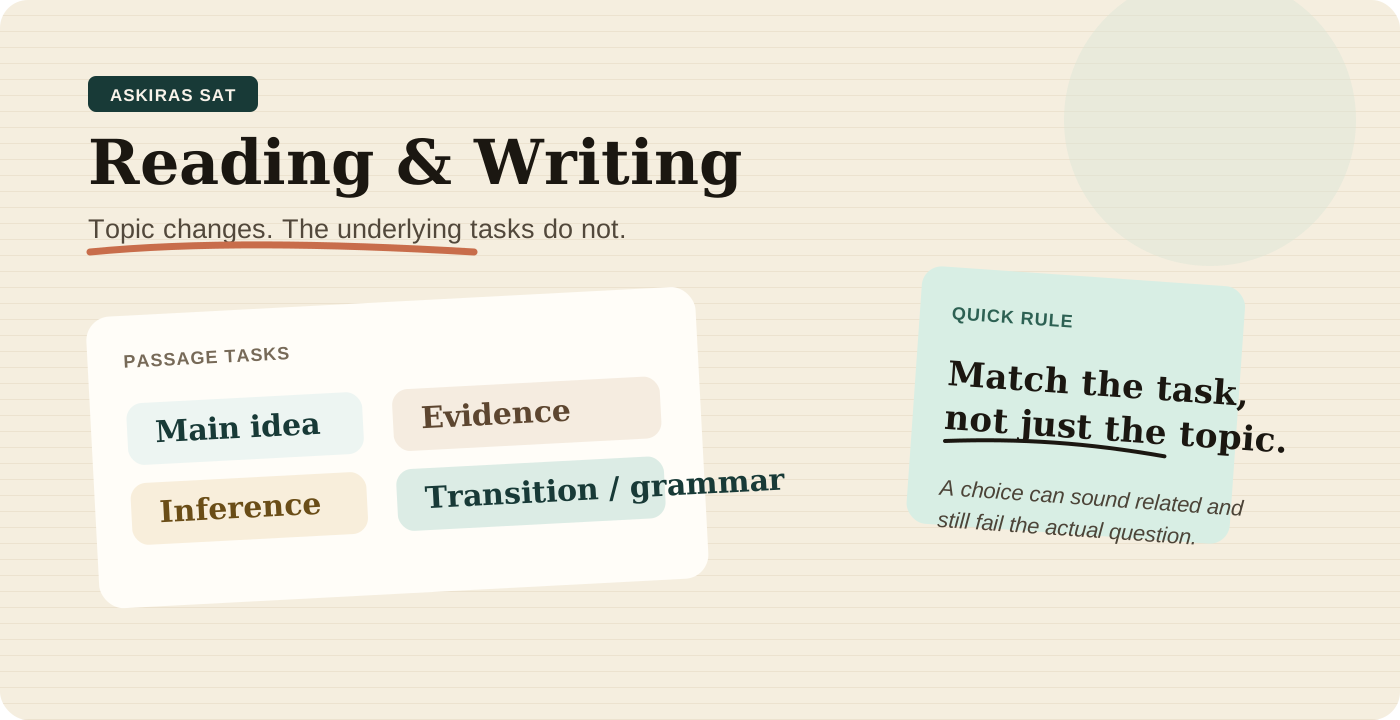
Reading & Writing looks varied because the passages change topics. The actual tasks repeat.
Usually the test wants one of a small set of moves: identify the main point, make the smallest justified inference, choose the best evidence, pick the right transition, or clean up the sentence.
The 7 most common R&W question patterns
1. The Central Idea Question
What it looks like: “Which choice best states the main idea of the text?”
The pattern: You need to identify the passage’s primary argument or point — not a supporting detail, not an inference, but the big picture.
How to solve it:
- Read the entire passage before looking at choices
- Ask: “If I had to summarize this in one sentence, what would it be?”
- The correct answer captures the whole passage, not just one paragraph
- Eliminate answers that are too narrow (only cover one detail) or too broad (go beyond what’s stated)
Common traps:
- The Detail Trap: An answer that accurately describes something in the passage but isn’t the main idea
- The Scope Trap: An answer that’s true but broader than what the passage actually discusses
- The Inference Trap: An answer that requires additional reasoning beyond what’s stated
2. The Inference Question
What it looks like: “Based on the text, which choice is most strongly supported?”
The pattern: The answer isn’t stated directly — you need to reason from evidence in the passage. But it must be strongly supported, not just plausible.
How to solve it:
- The correct answer is a small logical step from the text, not a large leap
- Find the specific sentence(s) that support each answer choice
- If you can’t point to specific text evidence, the inference is too big
- “Most strongly supported” means the one with the most direct textual basis
Common traps:
- The Reasonable Guess: An answer that makes sense in the real world but isn’t supported by this specific passage
- The Extreme Inference: An answer that requires two or three reasoning steps instead of one
3. The Evidence Question
What it looks like: “Which quotation from the text most effectively illustrates [claim]?”
The pattern: You need to match a specific quote to a specific claim. The challenge is that multiple quotes may be related to the claim but only one directly illustrates it.
How to solve it:
- Understand the claim first (what exactly needs to be supported?)
- For each quote, ask: “Does this directly show the claim, or is it merely related?”
- The best evidence is specific and concrete, not general
- Look for quotes that contain the mechanism or example of the claim
Common traps:
- The Topic Match: A quote that mentions the same topic as the claim but doesn’t support it
- The Partial Evidence: A quote that supports part of the claim but not all of it
4. The Vocabulary in Context Question
What it looks like: “As used in the text, ‘volatile’ most nearly means…”
The pattern: A common word used in a specific context. The correct answer is usually NOT the most common definition — it’s the meaning that fits this specific sentence.
How to solve it:
- Cover up the word and read the sentence. What word would you naturally put there?
- Plug each answer choice into the sentence. Which one makes the passage flow correctly?
- Pay attention to the surrounding sentences for context clues
- The most “obvious” definition is often wrong — that’s the trap
Example:
“The company’s volatile earnings made long-term planning difficult.”
- A) Explosive → common meaning but doesn’t fit
- B) Unpredictable → fits the context (earnings that fluctuate)
- C) Angry → wrong part of speech usage
- D) Evaporating → scientific meaning, doesn’t fit
5. The Text Structure Question
What it looks like: “Which choice best describes the overall structure of the text?”
The pattern: You need to characterize HOW the passage is organized, not WHAT it says. Think about the passage as an outline.
Common structures to recognize:
- Problem → Solution: Here’s an issue, here’s how it was/could be addressed
- Claim → Evidence: Here’s what I argue, here’s proof
- Comparison: Two things described side by side, similarities and differences
- Chronological: Events in time order
- Cause → Effect: Here’s what happened, here’s the result
- General → Specific: Broad claim narrowed with examples
How to solve it:
- Don’t read for content — read for architecture
- Note what each paragraph does (introduces, supports, qualifies, contrasts)
- The correct answer matches the passage’s organizational logic
6. The Transition Question
What it looks like: “Which choice completes the text with the most logical transition?”
The pattern: A sentence is missing a transition word or phrase. You need to choose the one that correctly signals the logical relationship between ideas.
Key relationships:
- Addition: Furthermore, Moreover, In addition, Similarly
- Contrast: However, Nevertheless, In contrast, On the other hand
- Cause/Effect: Therefore, Consequently, As a result, Thus
- Example: For instance, Specifically, In particular
- Concession: Although, Despite, Granted, While it is true that
How to solve it:
- Read the sentence before AND after the blank
- Determine the logical relationship: Does the next sentence agree, disagree, explain, or exemplify?
- Plug in each choice. Only one will create correct logical flow.
Common traps:
- The Sophisticated Wrong Answer: A fancy transition word that sounds academic but signals the wrong relationship (using “moreover” when the ideas contrast)
- The Double Contrast: Using a contrast word when the passage already has one (“Although X is true, however, Y is also true” — the “however” is redundant)
7. The Grammar Near-Miss
What it looks like: Standard English Conventions questions where one answer fixes the original error but introduces a new one.
The pattern: These questions test whether you can identify correct grammar, punctuation, and sentence structure. The trap is an answer that partially improves the sentence.
Most tested rules:
- Subject-verb agreement — especially with intervening phrases (“The box of chocolates is [not are] on the table”)
- Pronoun-antecedent agreement — singular vs plural, clear reference
- Comma splices — two complete sentences joined only by a comma (need semicolon, period, or conjunction)
- Semicolons — join two complete sentences (not a sentence and a fragment)
- Parallel structure — items in a list must use the same form
- Modifier placement — dangling and misplaced modifiers
How to solve it:
- Read the full sentence, not just the underlined portion
- Identify what error (if any) exists
- Check each answer choice for ALL grammar rules, not just the one you spotted
- “No change” is correct about 25% of the time — don’t avoid it
Example trap:
Original: “The scientist, along with her assistants, were conducting the experiment.”
- A) were conducting → subject-verb error (subject is “scientist,” singular)
- B) was conducting → correct (singular verb matches “scientist”)
- C) has been conducting → fixes agreement but changes tense unnecessarily
- D) are conducting → still plural, still wrong
General R&W Strategies
Process of Elimination
On hard R&W questions, eliminating wrong answers is more reliable than identifying the right one. Cross off answers that:
- Contain extreme language (“always,” “never,” “completely”)
- Go beyond the scope of the passage
- Address the right topic but the wrong aspect
The Two-Pass Strategy
- First pass: Answer questions you’re confident about (30-40 seconds each)
- Second pass: Return to flagged questions with remaining time
Passage Reading Approach
- For short passages (1-2 paragraphs): Read the whole thing first, then the question
- For questions with specific line references: Read 2-3 sentences around the reference
- Never answer from memory — always verify in the text
Transition Quick-Check
For transition questions, try inserting “but” and “and” mentally:
- If “but” works → contrast transition needed
- If “and” works → addition/continuation transition needed
- If neither → look for cause/effect or example relationship
How to use this guide
When you review a missed R&W question, do not just say “reading” or “grammar.”
Label the actual task:
- central idea
- inference
- evidence
- vocabulary in context
- structure
- transition
- grammar rule
That is how the section starts to feel teachable.
Frequently asked questions
Should I read the passage or the question first on SAT Reading & Writing?
For most short Digital SAT passages, reading the passage first works better because it gives you the full context before you judge the choices.
What is the biggest trap on SAT R&W?
Answers that match the topic but miss the task. A choice can talk about the same issue and still fail to support the main idea, inference, or transition.
Do I need separate strategies for reading and grammar?
Yes, but they still follow the same core rule: identify the task first. Some questions ask for meaning, others for structure, and others for sentence correctness.
Keep going in this exam
Other guides at Askiras
If you are also prepping another exam, these short guides cover the same "name the pattern, then practice" habit.