SAT Grammar Rules That Actually Show Up
SAT grammar rules practice for sentence boundaries, agreement, pronouns, modifiers, parallel structure, and punctuation traps.
Read it to name the pattern, then practice while it is still fresh.
Prepared by Askiras editorial team. These guides stay short on purpose: one pattern, one worked example, one clear next step into practice. How we build guides.
Uses public Digital SAT format and practice-strategy context; does not reproduce protected College Board questions.
College Board Digital SAT context, Askiras independence, and no unsupported outcome claims.
What SAT grammar rules should I practice first?
Practice SAT grammar by rule family: sentence boundaries first, then subject-verb agreement, pronoun clarity, parallel structure, modifiers, commas around extra information, and colons or semicolons. Review each miss by naming the rule, not by rereading a whole grammar handbook.
The SAT grammar section is smaller than it looks
Students often talk about SAT grammar like it is an endless list of rules. It is not.
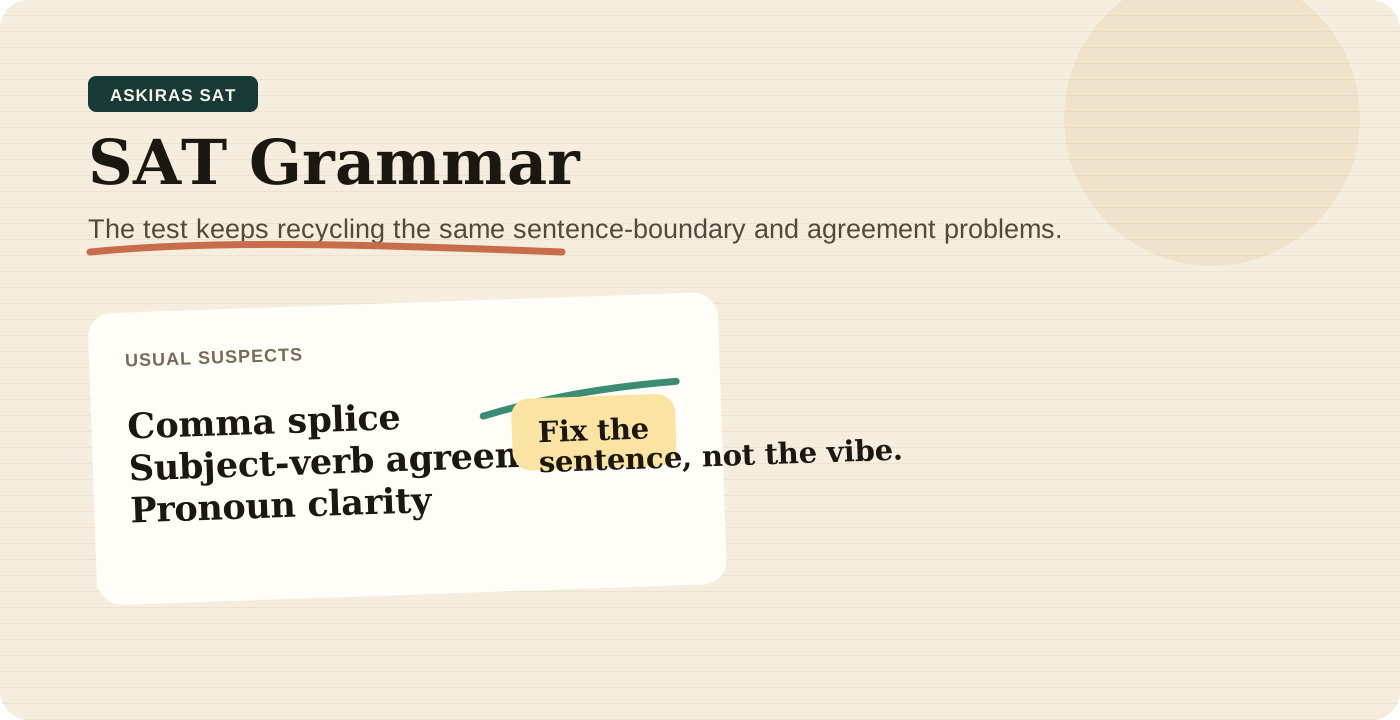
The test keeps circling back to the same sentence problems:
- where a sentence should stop
- which verb matches the subject
- what a pronoun is referring to
- whether a list stays parallel
- whether a modifier is attached to the right thing
If you know those well, a big chunk of the section stops feeling random.
Start with the rule that causes the most damage
1. Sentence boundaries
This is the big one.
The SAT loves to test whether two complete ideas are joined correctly.
Common wrong versions:
- comma splice
- run-on
- fragment
Quick example:
The students finished the project, they presented it the next day.
That is wrong because both sides are complete sentences. A comma by itself is not enough.
Better fixes:
The students finished the project, and they presented it the next day.The students finished the project; they presented it the next day.The students finished the project. They presented it the next day.
If you learn one thing cold, make it this:
Two complete sentences need a stronger connector than a comma.
2. Subject-verb agreement
The SAT makes this look harder than it is by stuffing words between the real subject and the verb.
Example:
The box of old textbooks near the windows is heavy.
The subject is box, not textbooks.
That is the pattern:
- find the real subject
- ignore the interrupting phrase
- match the verb to the subject, not the nearest noun
This also matters with words like:
- each
- every
- neither
- one
Those are usually singular even when the sentence contains plural nouns nearby.
3. Pronoun clarity and agreement
The SAT wants pronouns to do two jobs:
- match the noun in number
- point clearly to the right noun
Example:
When Maya texted Elena, she was already at the station.
Who is she?
Maya or Elena?
That is the problem. Even if the sentence sounds normal, the pronoun is unclear.
The SAT often rewards the choice that repeats the noun rather than the one that sounds smoother.
Clarity beats elegance here.
4. Parallel structure
If a sentence starts a pattern, the rest of the list should stay in that pattern.
Bad:
The program helps students review concepts, solving problems, and to build confidence.
The forms do not match.
Better:
The program helps students review concepts, solve problems, and build confidence.
The SAT likes this because it is easy to miss if you read too quickly.
When you see a list, compare the grammatical shape of each item.
5. Modifiers
Modifiers should sit next to the thing they describe.
Bad:
Running down the hallway, the backpack bounced behind Jordan.
That sentence accidentally makes it sound like the backpack was running.
Better:
Running down the hallway, Jordan felt the backpack bounce behind him.
This rule sounds small, but the SAT uses it to test whether you are reading closely.
Ask:
Who is actually doing the action in the opening phrase?
If the sentence answers that badly, the modifier is misplaced.
6. Commas around extra information
The SAT often tests whether a phrase is essential or nonessential.
If the phrase is extra and removable, commas usually belong around it.
Example:
My brother, who lives in Seattle, is visiting next week.
The phrase who lives in Seattle is extra.
You could remove it and still know which brother the speaker means.
But if the phrase is necessary to identify the noun, commas may be wrong.
The SAT is really asking:
Is this phrase defining the noun, or just adding extra information?
7. Colons and semicolons
Students often memorize these badly.
The simpler version:
- semicolon = joins two complete sentences
- colon = introduces or explains what comes next
Semicolon example:
The museum extended its hours; attendance rose the next month.
Colon example:
The experiment revealed one clear pattern: sleep mattered more than screen time.
If what comes after the punctuation is not the right grammatical shape, the punctuation is probably wrong.
The grammar trap the SAT uses over and over
It gives you one answer that fixes the obvious issue but introduces a new one.
That is why “sounds better” is not enough.
You need to check the whole sentence again after every choice:
- Did the sentence boundary become correct?
- Does the verb still agree?
- Is the pronoun now clear?
- Did the sentence stay parallel?
The right answer survives all of those checks.
SAT grammar rules practice questions
Use these as rule-identification practice. The goal is not to memorize these sentences. The goal is to name the rule before you look for the fix.
Practice 1: Sentence boundary
Wrong:
The exhibit opened on Friday, the first tickets sold out by noon.
What is being tested?
Sentence boundary. Both sides can stand alone, so a comma by itself is not strong enough.
Better:
The exhibit opened on Friday, and the first tickets sold out by noon.
Review tag: comma splice.
Practice 2: Subject-verb agreement
Wrong:
The list of required lab materials are on the website.
What is being tested?
Subject-verb agreement. The subject is list, not materials.
Better:
The list of required lab materials is on the website.
Review tag: nearest-noun trap.
Practice 3: Pronoun clarity
Wrong:
When Priya emailed Nora after the meeting, she attached the revised chart.
What is being tested?
Pronoun clarity. The reader cannot tell whether she means Priya or Nora.
Better:
When Priya emailed Nora after the meeting, Priya attached the revised chart.
Review tag: unclear antecedent.
Practice 4: Parallel structure
Wrong:
The internship required students to analyze data, writing reports, and present findings.
What is being tested?
Parallel structure. The verbs in the list need the same grammatical shape.
Better:
The internship required students to analyze data, write reports, and present findings.
Review tag: list mismatch.
Practice 5: Modifier placement
Wrong:
Designed to reduce energy use, the city installed new lights in the library.
What is being tested?
Modifier placement. The city was not designed to reduce energy use; the lights were.
Better:
The city installed new lights designed to reduce energy use in the library.
Review tag: misplaced modifier.
How to turn grammar rules into practice
Do short SAT grammar practice sets in two passes.
First pass: answer normally. Second pass: label every question before checking the explanation.
Use these labels:
- sentence boundary
- subject-verb agreement
- pronoun clarity
- parallel structure
- modifier placement
- commas around extra information
- colon or semicolon
If you cannot label the question, that is the review problem. More volume will not fix it until the rule family is visible.
A better way to study SAT grammar
Do not review grammar as one giant category. Sort misses by rule.
For example:
- sentence boundary
- subject-verb
- pronoun clarity
- parallel structure
- modifier
- punctuation with extra information
That turns grammar from “I keep missing writing questions” into something fixable.
A short drill plan
Take 12 grammar questions and label each one by rule before checking the answer.
After every miss, write one line:
I missed a comma splice.I matched the verb to the nearest noun.I picked the smoother pronoun instead of the clearer one.
That is how the section gets easier.
You do not need a giant grammar course. You need to stop missing the same sentence problems on repeat.
Frequently asked questions
Do I need to memorize a giant grammar handbook for the SAT?
No. The SAT keeps returning to a smaller set of sentence-boundary, agreement, pronoun, and modifier problems.
What grammar rule shows up the most?
Sentence boundaries are one of the biggest ones: comma splices, fragments, and wrong punctuation between complete ideas.
Should I trust what sounds right?
Only partly. Your ear can help, but the SAT often hides errors in long sentences. You still need to know the rule being tested.
Keep going in this exam
Other guides at Askiras
If you are also prepping another exam, these short guides cover the same "name the pattern, then practice" habit.