LSAT Logical Reasoning: How to See the Pattern Faster
LSAT Logical Reasoning gets easier when you can name the task, spot the gap, and stop letting the choices do the thinking.
Read it to name the pattern, then practice while it is still fresh.
Prepared by Askiras editorial team. These guides stay short on purpose: one pattern, one worked example, one clear next step into practice. How we build guides.
Uses public LSAT question-type strategy context; does not reproduce protected LSAC questions.
LSAC LSAT context, Askiras independence, and no unsupported outcome claims.
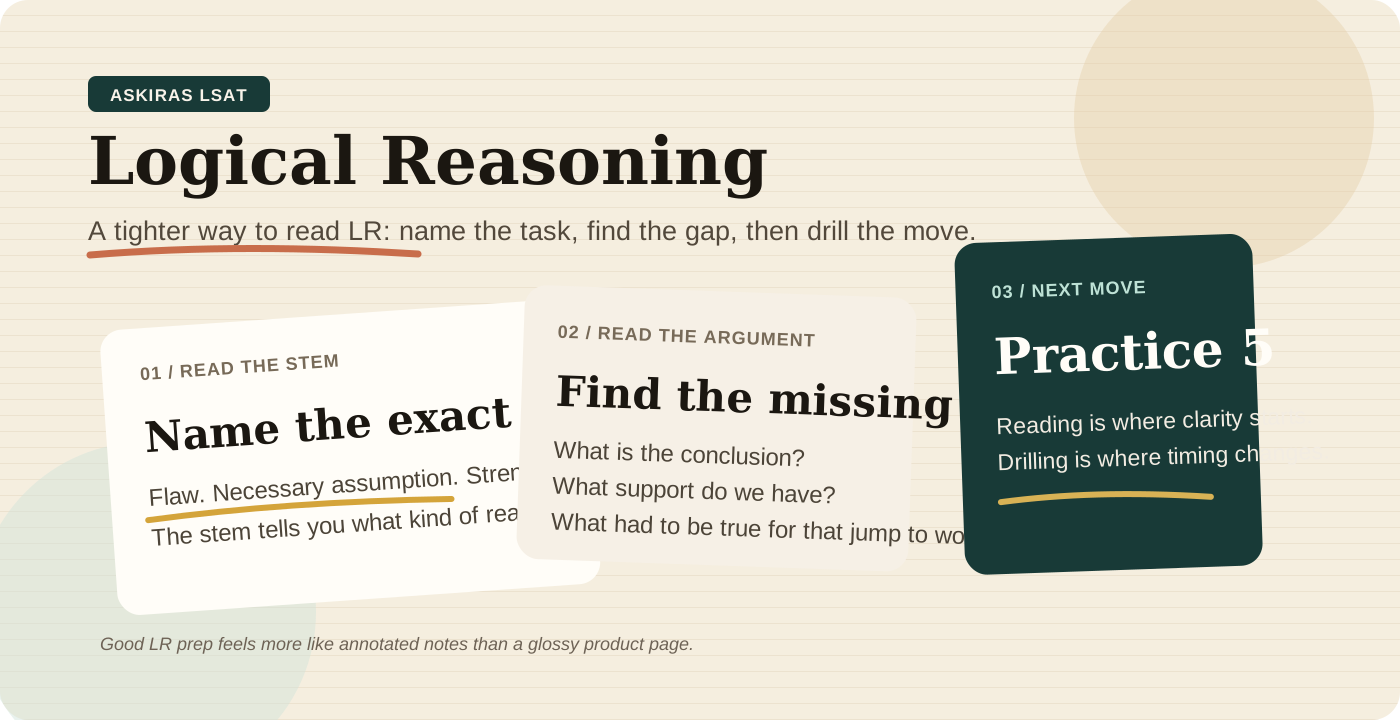
How do you improve LSAT Logical Reasoning?
Improve LSAT Logical Reasoning by naming the question family, finding the conclusion, spotting the gap, and reviewing the trap. Speed usually follows from recognizing repeated argument patterns, not from rushing.
If LSAT Logical Reasoning feels slippery, that is normal
Logical Reasoning feels slippery because the topics keep changing while the underlying moves stay the same.
That is the useful part. The section is less mysterious than it first looks. It is repetitive.
The test keeps asking the same families of questions:
- What is the argument really claiming?
- What assumption is quietly holding the whole thing up?
- Where does the reasoning break?
- What would make the conclusion more believable?
- What would make it weaker?
Once you start seeing those patterns, LR gets calmer. You stop treating every question like a brand-new puzzle and start recognizing the shape underneath it.
That is the real job of LR prep:
- recognize the question type fast
- know what the right answer must do
- know what the wrong answers usually do
What LR is actually testing
At its core, LR is testing whether you can do four things under time pressure:
- Separate conclusion from support.
- Notice what the author assumed without saying.
- Distinguish a real answer from an answer that merely sounds smart.
- Move without panicking when the wording gets dense.
That is why rereading theory pages for hours rarely fixes LR. Improvement usually comes from a tighter loop:
- learn the pattern
- watch it happen in a real stimulus
- practice it yourself
- review the miss while the mistake is still fresh
The fastest way to identify the question family
The stem usually tells you the task if you read it literally.
Flaw
The question wants the reasoning error.
Typical stem language:
- the reasoning is vulnerable to criticism because it
- the argument is flawed because it
- which of the following most accurately describes a flaw
The fastest move on flaw is to prephrase the bad reasoning step in plain English before reading the choices. The five recurring patterns are in LSAT flaw questions: plain-English prephrase.
Necessary assumption
The question wants something the argument must rely on.
Typical stem language:
- the argument depends on assuming
- which of the following is an assumption required by the argument
- the conclusion follows only if which of the following is assumed
The negation test is the cleanest filter — see LSAT necessary assumption questions for the worked examples.
Strengthen
The question wants new information that helps the argument.
Typical stem language:
- which of the following, if true, most strengthens the argument
- most supports the conclusion
Find the gap first, then pick the answer that closes it. See LSAT strengthen questions.
Weaken
The question wants new information that damages the argument.
Typical stem language:
- which of the following, if true, most weakens the argument
- casts the most doubt on the conclusion
Weaken answers attack the support-to-conclusion move, not the topic. The four gap moves are in LSAT weaken questions: 4 gap moves.
Must be true / inference
The question wants the answer most strongly supported by the stimulus.
Typical stem language:
- if the statements above are true, which of the following must also be true
- which of the following is most strongly supported
A better way to study LR
Most students spread themselves too thin. They do mixed sets, miss questions, shrug, and move on.
A better approach is narrower:
Step 1: Study by question family
Do not just say, “I got 14 out of 25.” Say:
- I am late on flaw questions.
- I still confuse strengthen and necessary assumption.
- I over-pick broad answers on inference questions.
That gives you something fixable.
Step 2: Learn the wrong-answer patterns
Most LR misses are not random. They repeat.
Common wrong-answer patterns:
- answers that sound relevant but do not affect the conclusion
- answers that strengthen a premise instead of the argument’s gap
- answers that are true in the real world but unsupported by the stimulus
- answers that are too strong, too broad, or slightly off task
Step 3: Review for mechanism, not just outcome
Do not stop at “the right answer was C.” Ask:
- Why did C work?
- What gap in the argument did it address?
- Why did I think B looked tempting?
If you do not answer those three questions, you usually have not really reviewed the problem.
Worked example: seeing the gap before reading the choices
Read this like an LR student, not like a casual reader:
A city council member argues that the city should extend subway service into the northern district. She notes that traffic congestion in the district has worsened over the last three years. Therefore, extending subway service would reduce commute times for northern-district residents.
Before you ever read the answer choices, pause.
What do we know?
- congestion worsened
- the proposal is to extend subway service
- the conclusion is that commute times would go down
What is the gap?
The argument assumes the subway extension would actually shift enough people away from car travel, and that the extension would serve the relevant commuters efficiently enough to reduce commute time.
That means:
- a strengthen answer will support that shift
- a weaken answer will make the extension less likely to help
- a necessary assumption answer will be something the council member has to believe for the conclusion to hold
- a flaw answer might describe the jump from “there is congestion” to “this proposal will solve it”
This is the core LR move: predict the gap before the choices start steering your thinking.
The three biggest LR mistakes
1. Reading for topic instead of structure
Students get pulled into whether they agree with the subject matter.
The LSAT does not care whether the policy, science claim, or moral principle is true in real life. It cares whether the conclusion is supported by the reasoning in front of you.
2. Letting the answer choices do the thinking
If you wait for the options to define the problem, you are already behind.
You do not need a perfect prediction. You just need a rough one:
- what is the conclusion
- what is the support
- what is missing
That is enough to make the right answer easier to recognize and the tempting answers easier to reject.
3. Studying LR as one giant bucket
LR is too broad to improve efficiently that way.
If your review does not sort misses by pattern, you will keep having the same bad day in different clothes.
What this looks like under time pressure
A lot of students understand LR in review and then lose the thread in a timed section. That usually happens for one of two reasons:
You are reading every stimulus from zero
When that happens, the section feels like 25 unrelated events.
Pattern recognition fixes that. Once you can say, “This is a causal jump,” or “This is a sampling problem,” the section stops feeling like 25 unrelated events.
You are still deciding what the task is after reading the choices
That costs time. The more often you can identify the family before answer-choice evaluation, the more energy you keep for actual judgment.
That is why narrow drilling works. It makes the task familiar, not just the topic.
A practical weekly plan
If LR is your weak section, a simple plan beats an ambitious plan you never repeat.
Three days per week
- pick one question family
- do 8 to 12 questions in that family
- review every miss in writing
One day per week
- do a mixed timed set
- note which family slowed you down
One short review block
- revisit recent misses
- summarize the trap in one sentence
Example:
- “I picked an answer that sounded plausible but did not actually weaken the conclusion.”
- “I treated a necessary assumption question like a strengthen question and chose an answer that helped, but was not required.”
That sentence is more valuable than a color-coded spreadsheet.
Where to start if you feel behind
Start with the high-frequency, high-transfer question types:
- flaw
- strengthen
- weaken
- necessary assumption
- must be true / inference
These families teach the core architecture of arguments. Once you get sharper there, the rest of LR usually becomes easier to organize.
Frequently asked questions
How do I get faster at LSAT Logical Reasoning?
Get more precise before you try to get faster. Speed usually appears after you start recognizing conclusions, gaps, and wrong-answer patterns faster.
Should I study LSAT Logical Reasoning as one big category?
No. Studying by question family makes review more precise because you can name the task, review the trap, and repeat that pattern under time pressure.
What is the best first LR group to focus on?
Start with flaw, strengthen, weaken, necessary assumption, and inference. Those question families teach the core architecture of arguments and transfer well to the rest of LR.
Keep going in this exam
Other guides at Askiras
If you are also prepping another exam, these short guides cover the same "name the pattern, then practice" habit.