LSAT Flaw Questions: Prephrase the Bad Move
LSAT flaw questions get clearer when you find the conclusion, support, and bad reasoning move before reading abstract answer choices.
Read it to name the pattern, then practice while it is still fresh.
Prepared by Askiras editorial team. These guides stay short on purpose: one pattern, one worked example, one clear next step into practice. How we build guides.
Uses public LSAT question-type strategy context; does not reproduce protected LSAC questions.
LSAC LSAT context, Askiras independence, and no unsupported outcome claims.
How do you answer LSAT flaw questions?
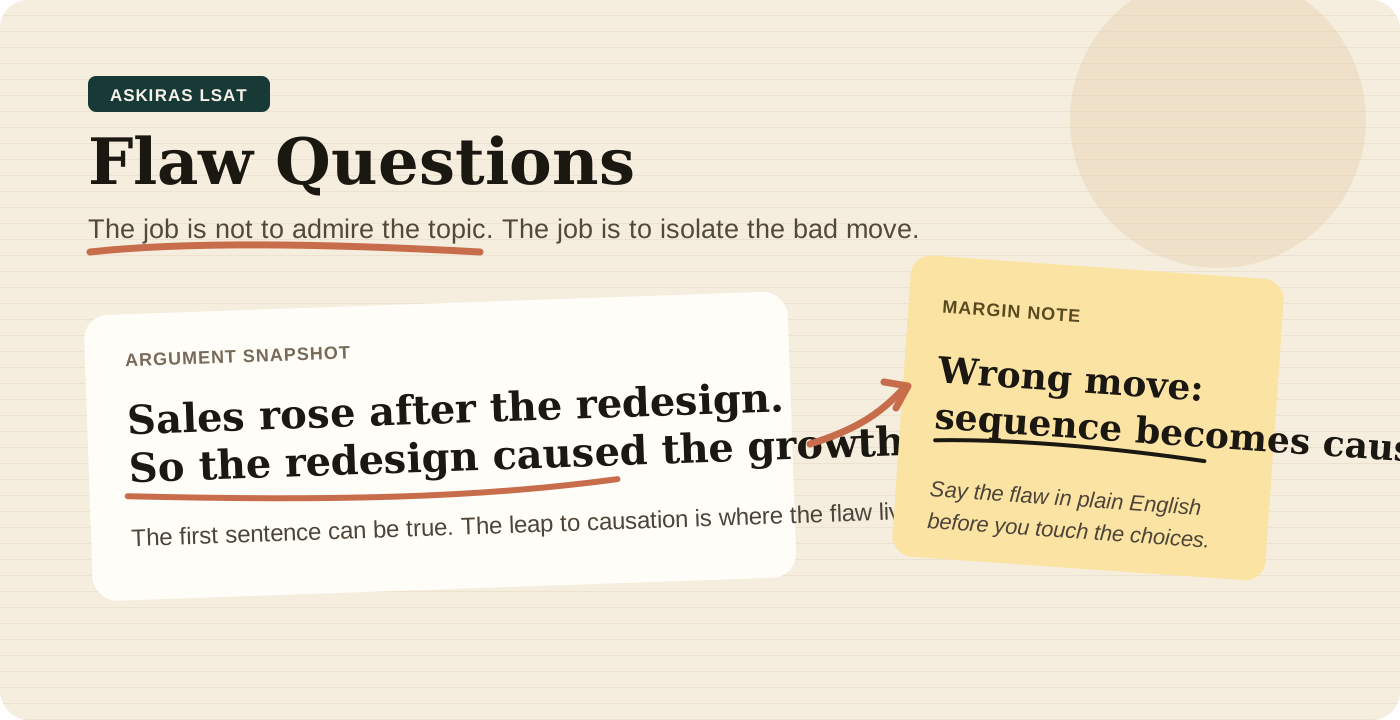
Find the conclusion, find the support, then prephrase the bad move between them before reading the answer choices. The right answer must describe the argument's reasoning error, not just criticize the topic.
Quick answer: how to answer LSAT flaw questions
For an LSAT flaw question, first find the author’s conclusion, then the support, then the bad move from support to conclusion. Put that bad move in plain English before reading the choices. The credited answer should match the reasoning error, not merely sound skeptical or introduce a new fact.
Source/update note: Last reviewed June 10, 2026 against LSAC’s Logical Reasoning overview, which lists identifying flaws in arguments as one of the skills tested and says specialized logical terminology is not required.
Flaw questions get easier when you stop treating them like trivia
A flaw question is not asking you to memorize a museum of formal fallacies. It is asking:
What is wrong with the move from the evidence to the conclusion?
If you can answer that in plain English before reading the choices, the wrong answers have less room to rename the argument for you. The test gets harder when you let the answer choices tell you what the flaw was supposed to be.
What a flaw answer must do
A correct flaw answer describes the author’s reasoning error.
It does not merely:
- restate a premise
- disagree with the conclusion
- introduce outside facts
- sound vaguely critical
It has to describe the actual bad move.
The fastest approach
1. Find the conclusion
Ask:
What is the author trying to get me to believe?
2. Find the support
What facts or observations are being used to get there?
3. Describe the gap in your own words
Before looking at the answers, say something simple:
- “They assumed correlation meant causation.”
- “They treated one example like proof about the whole group.”
- “They ruled out alternatives too quickly.”
That prediction does not need to sound official. It just needs to be directionally right.
Worked example
A nutrition blogger argues that because several of her friends felt more energetic after cutting out dairy, dairy is the main cause of low energy for most adults.
Conclusion:
- dairy is the main cause of low energy for most adults
Support:
- several friends felt more energetic after cutting out dairy
Likely flaw:
- the argument generalizes from a tiny and unrepresentative sample
- it also ignores other explanations for the energy change
Now imagine the answer choices trying to rename the problem for you.
Tempting wrong answer
“It fails to define what counts as low energy.”
That sounds analytical. But it is not the core problem. The core problem is the jump from a few anecdotes to a broad causal claim.
Better answer
“It draws a broad conclusion about most adults from a small number of personal cases.”
That is the actual bad move.
Common flaw patterns worth recognizing
Anecdote to general rule
One person, one company, one city, one study, one story. Then suddenly:
- all people
- all companies
- all cities
- the whole market
Correlation to causation
Two things move together, so the author assumes one caused the other.
No alternative explanations
The argument notices one possible cause and acts as if it were the only cause.
Necessary vs sufficient confusion
The argument mistakes:
- something required for the outcome
for:
- something that guarantees the outcome
Sampling flaw
The sample is biased, too small, or not representative, yet the conclusion gets treated as population-wide.
Relative vs absolute confusion
The author treats a percentage increase as proof of a large real-world effect when the base numbers may still be tiny.
Why flaw questions feel hard
They feel hard because the wrong answers are often written in abstract language.
Students think:
“I kind of understood the stimulus, but now the answer choices all sound like philosophy.”
That is normal.
The fix is to translate the stimulus into a blunt sentence before you enter answer-choice land.
Examples:
- “They acted like one success story proves the policy works.”
- “They assumed the only difference between the two groups was the thing they care about.”
- “They treated lack of evidence as evidence of absence.”
Plain-English predictions make abstract answer choices much easier to judge.
A second mini example
A city report notes that neighborhoods with more public trees have lower summer emergency-room visits for heat exhaustion. Therefore, planting more trees will by itself solve the city’s summer heat-health problem.
What is wrong?
The report shows a relationship, but the conclusion turns that into a single-cause solution.
Possible missing considerations:
- those neighborhoods may differ in shade, income, housing quality, or access to cooling centers
- planting more trees may help, but “will by itself solve” is much stronger than the evidence supports
If you can say that before reading the answers, the credited choice becomes much easier to spot.
The two most common mistakes on flaw questions
1. Picking an answer that is critical but not accurate
Some answers attack the argument from the side. They sound intelligent, but they do not describe the reasoning used.
2. Picking an answer that is too extreme
If the answer says the author “proves,” “completely ignores,” or “assumes without any evidence” when the argument is more moderate, slow down.
Precision wins these questions.
How to review flaw questions well
After a missed flaw question, write three lines:
- The conclusion was:
- The support was:
- The author’s bad move was:
If line 3 is fuzzy, the review is incomplete.
The goal of flaw review is not just to know why the credited answer won. It is to name the broken reasoning move cleanly enough that you can recognize it faster next time.
If your miss came from a hidden assumption instead of a visible flaw, read LSAT necessary assumption questions next. If the issue is how new evidence changes the argument, move to LSAT strengthen questions or LSAT weaken questions.
A short drill plan that actually helps
If flaw questions are a weak point, do not just sprinkle them into mixed sets and hope.
Try this instead:
- do 8 flaw questions in a row
- prephrase the flaw every time before looking at the answers
- write one sentence after every miss saying what bad move the argument made
- repeat the same family two days later
That is how flaw questions stop feeling random.
Frequently asked questions
Do I need to memorize formal fallacy names to solve flaw questions?
No. Plain-English precision matters more. You can learn the classic labels later, but first you need to describe the bad move accurately.
Why do flaw answer choices all sound abstract to me?
Because the LSAT often rewrites a simple reasoning mistake in formal language. The best defense is to describe the flaw in blunt prose before you read the choices.
Are flaw questions worth prioritizing?
Yes. They are one of the core LR families and they train the same structural reading habits that help with strengthen, weaken, and assumption questions.
Keep going in this exam
Other guides at Askiras
If you are also prepping another exam, these short guides cover the same "name the pattern, then practice" habit.