LSAT Sufficient Assumption Questions: Make the Conclusion Follow
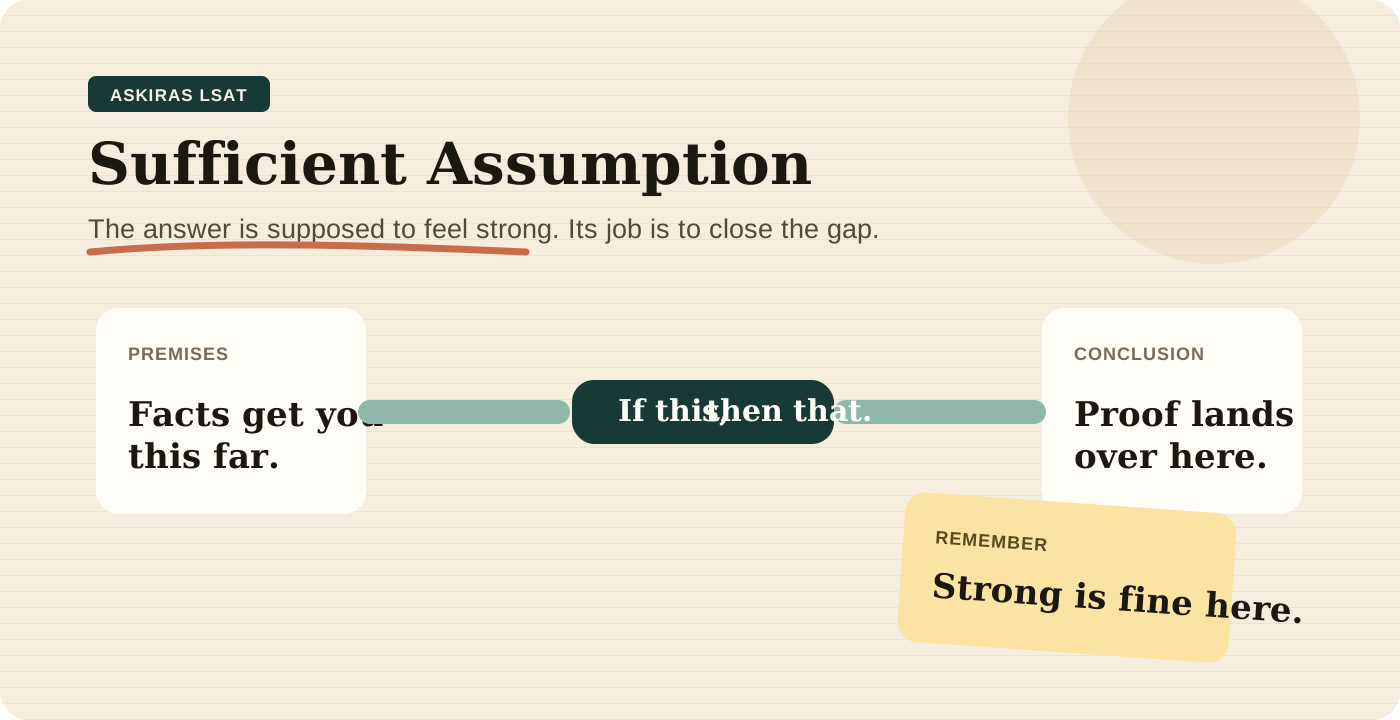
Sufficient assumption questions are proof questions. The right answer feels strong because its job is to close the gap.
Read it to name the pattern, then practice while it is still fresh.
Prepared by Askiras editorial team. These guides stay short on purpose: one pattern, one worked example, one clear next step into practice. How we build guides.
Uses public LSAT question-type strategy context; does not reproduce protected LSAC questions.
LSAC LSAT context, Askiras independence, and no unsupported outcome claims.
Sufficient assumption questions are proof questions
This question family is easier when you stop treating it like a “best support” task.
It is not asking what would help the argument a little. It is asking what would make the conclusion follow if the answer were added to the premises.
That is a much stricter job.
Worked example
A school principal argues that the district should adopt a new tutoring program because students in a pilot group improved their math scores after using it.
What is the argument trying to prove?
- the district should adopt the new tutoring program
What do we actually know?
- a pilot group improved after using it
That is not enough by itself. Lots of things improve in a pilot and then fail when scaled.
A sufficient assumption answer would need to make the leap airtight. For example:
- if a tutoring program raises scores in a representative pilot group, then adopting it districtwide will raise districtwide math scores
That is a very strong statement. But on this question type, strong is not a flaw. Strong is often exactly what you need.
If that answer is true, the conclusion follows. That is the bar.
What the question is really asking
The hidden question is:
What extra statement would turn this into a valid argument?
So the right answer usually does one of these jobs:
- bridges a missing link
- turns a conditional into a guaranteed conclusion
- blocks the only objection that would stop the conclusion from following
It does not merely make the argument nicer. It seals the gap.
How to solve them fast
1. Find the conclusion
Do not start with the answer choices.
Ask:
- What is the author trying to prove?
If you cannot say that clearly, you are not ready to evaluate the options.
2. Find the gap
What is missing between the premise and the conclusion?
In the school example:
- pilot improvement does not automatically prove districtwide improvement
That is the gap.
3. Look for the answer that makes the conclusion unavoidable
You are not looking for the prettiest answer. You are looking for the one that, if true, makes the conclusion follow.
If an answer only helps a little, it is probably not sufficient.
4. Be comfortable with strong language
Sufficient assumption answers are often broader, firmer, or more conditional than students expect.
That is fine. The LSAT is not asking for a humble answer. It is asking for an enough answer.
A second quick example
A restaurant owner says the restaurant should stay open later because more customers arrive after 8 p.m.
What would be sufficient?
Not:
- some customers like late hours
- staying open later would probably help
Those are too weak.
A sufficient answer would sound more like:
- if the restaurant stays open later, the number of extra late customers will exceed the added operating costs
That is enough to justify the move. It may be a little ugly. It does not matter.
Common traps
Answers that only strengthen
Students often pick an answer that makes the argument better but not complete.
Helpful is not the same as sufficient.
Answers that are merely necessary
A statement can be required without being enough.
If the argument still does not follow after adding the answer, it is not the right one.
Answers that talk around the gap
Some answers sound adjacent to the issue but never actually close the reasoning.
They may mention the right people, the right policy, or the right trend. That is not enough.
Answers that are too shy
On sufficient assumption questions, the right answer is often more absolute than students want.
That is normal. The job is to guarantee the conclusion, not to merely suggest it.
The easiest way to check contenders
Take the answer and ask:
If this is true, does the conclusion now have to be true?
If the answer is no, keep moving.
You do not need a fancy test. You need a blunt one.
How this differs from strengthen
Strengthen questions ask for the best support. Sufficient assumption questions ask for enough support.
That difference matters.
A strengthen answer can be partial. A sufficient assumption answer cannot be partial if the conclusion still hangs open.
Think of it this way:
- strengthen = pushes the argument
- sufficient assumption = closes the deal
Review method
When you miss one, write down three things:
- The conclusion was:
- The missing link was:
- The credited answer made the conclusion follow by:
That third line matters. If you cannot name why the answer was enough, you probably still do not see the structure cleanly.
Short drill plan
If sufficient assumption questions are costing you points:
- do 6 to 10 questions in one sitting
- prephrase the missing link before reading the choices
- ask of each contender, “Does this actually make the conclusion follow?”
- rewrite one miss in plain English without LSAT jargon
That is usually enough to start seeing the shape faster.
The goal is not to admire the answer choices. The goal is to know which one completes the proof.
Frequently asked questions
What does a sufficient assumption question ask for?
It asks for an answer that, if true, makes the conclusion follow. The answer does not need to be subtle. It needs to be enough.
How is this different from a necessary assumption question?
Necessary assumptions are required for the argument to survive. Sufficient assumptions are strong enough to lock the conclusion in.
Do sufficient assumption answers have to sound realistic?
No. They can be extreme or conditional. Realistic is not the standard. Sufficient is the standard.
Keep going in this exam
Other guides at Askiras
If you are also prepping another exam, these short guides cover the same "name the pattern, then practice" habit.