LSAT Strengthen Questions: Support the Conclusion, Not the Topic
A cleaner way to do LSAT strengthen questions: find the gap, then pick the answer that really helps the conclusion.
Read it to name the pattern, then practice while it is still fresh.
Prepared by Askiras editorial team. These guides stay short on purpose: one pattern, one worked example, one clear next step into practice. How we build guides.
Uses public LSAT question-type strategy context; does not reproduce protected LSAC questions.
LSAC LSAT context, Askiras independence, and no unsupported outcome claims.
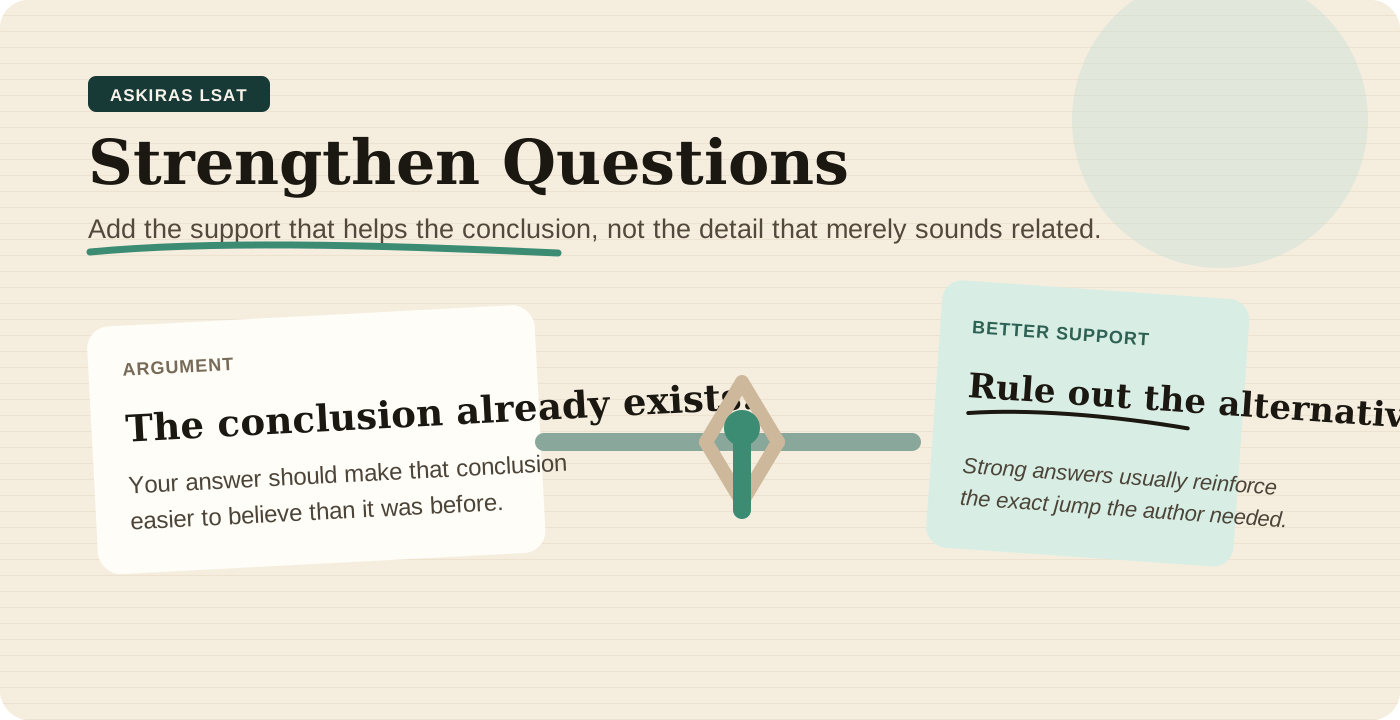
Strengthen questions are usually won in the gap
Students miss strengthen questions when they read for subject matter instead of structure.
The right answer is not the most interesting fact in the answer set. It is the one that best supports the jump from the premises to the conclusion.
If you can identify that jump, strengthen questions become much more manageable.
What a strengthen answer actually does
It can:
- support a key assumption
- rule out an alternative explanation
- show that the evidence is more representative than it first seemed
- make the causal claim more believable
It does not need to prove the conclusion with certainty. It just needs to move the argument in the right direction more than the other options do.
Worked example
A school’s principal argues that moving first-period classes 20 minutes later will improve student performance, because students in later-starting extracurricular programs report feeling more alert in the morning.
Conclusion:
- moving first-period classes later will improve student performance
Support:
- students in later-starting extracurricular programs report feeling more alert
Gap:
The argument assumes that the alertness effect would translate to the academic setting and that the extracurricular group is meaningfully comparable to the broader student body.
A good strengthen answer might:
- show that students who sleep longer after later starts tend to perform better academically
- show that the extracurricular group and the general student body have similar sleep patterns
- rule out some other reason the extracurricular students felt more alert
A bad answer might:
- praise the school
- say students enjoy later mornings
- mention transportation logistics without touching academic performance
Relevant is cheap. It has to help the conclusion.
The fastest method
1. Find the conclusion
What is the author trying to prove?
2. Name the gap
Why does the conclusion not fully follow yet?
3. Ask what would make that gap smaller
You are not looking for the biggest fact in the room. You are looking for the fact that best repairs the weak point.
Three strengthen patterns that show up constantly
1. Alternative explanation removal
The argument says X caused Y. The right answer weakens a competing explanation.
2. Sample credibility improvement
The argument generalizes from a sample. The right answer makes the sample look more representative.
3. Missing-link support
The argument relies on an unstated bridge. The right answer reinforces that bridge.
The most common wrong-answer pattern
Topical but not structural
This is the classic trap.
The answer mentions the same people, same policy, same company, same study, same issue. So it feels relevant.
But it does not support the conclusion.
Ask:
If this answer were true, would I believe the conclusion more?
If the honest answer is “not really,” move on.
Mini example
Stimulus idea:
A company should adopt a four-day workweek because employees in a pilot program reported higher job satisfaction.
Tempting wrong answer:
- “Employees in the pilot program also said they liked their managers.”
Same topic, same people, still weak.
Better strengthen answer:
- “Employees in the pilot program completed at least as much work as comparable employees on traditional schedules.”
That actually helps the conclusion that the policy is a good idea.
Why strengthen questions feel deceptively easy
The language of the stem is simple. “Which of the following most strengthens the argument?” sounds straightforward.
The difficulty is that several answers may be compatible with the topic. Only one of them really helps the argument’s weak point.
That is why prephrasing the gap matters more here than students expect.
A second quick example
A neighborhood coalition argues that adding a bike lane will reduce local pollution because bike lanes encourage residents to drive less.
What kind of answer would strengthen this?
Something that confirms the behavioral link or blocks an obvious alternative explanation.
Examples:
- in similar neighborhoods, bike-lane additions led to measurable drops in short car trips
- a survey found many residents would switch from driving to biking if the route were safer
A weak topical answer:
- residents support more environmentally friendly policies
That may sound aligned with the issue, but it does not do much to support the actual conclusion.
How to get faster at strengthen questions
Do not try to get faster by reading the choices faster. Get faster by spotting the gap sooner.
A short prephrase helps:
- “I need something that rules out another cause.”
- “I need something that shows the sample is representative.”
- “I need something that connects this evidence to the broader claim.”
Once that sentence is in your head, the choices become much easier to screen.
Review method
After a miss, write:
- What was the conclusion?
- What was the weak point?
- Why did the credited answer strengthen that specific weak point?
- Why did my answer only sound relevant?
That review is what retrains your instincts.
A simple weekly strengthen routine
If strengthen questions are eating time or costing accuracy, do not only see them in mixed sets.
Try a narrower loop:
- do one short strengthen set
- label the gap before looking at choices
- say whether the credited answer removed an alternative explanation, supported a bridge, or improved the sample
- write one sentence about why your chosen answer failed
This sounds small, but it changes how quickly you start seeing what kind of support the argument is actually asking for.
Frequently asked questions
Does the right strengthen answer have to prove the conclusion?
No. It only has to help the conclusion more than the other choices do.
What is the most common wrong-answer pattern on strengthen questions?
A topical answer that talks about the same issue but does not actually support the conclusion.
How do I get faster at strengthen questions?
Get faster at identifying the gap. Once you know what kind of support the argument needs, the answer choices are much easier to screen.
Keep going in this exam
Other guides at Askiras
If you are also prepping another exam, these short guides cover the same "name the pattern, then practice" habit.