AP World Exam Guide: What to Expect and What to Practice
AP World feels huge because the class is huge. The exam is not. Start with the digital format, the writing tasks, and the moves that keep repeating.
Read it to name the pattern, then practice while it is still fresh.
Prepared by Askiras editorial team. These guides stay short on purpose: one pattern, one worked example, one clear next step into practice. How we build guides.
Uses public AP course and exam context; does not reproduce protected College Board prompts.
College Board AP context, Askiras independence, and no unsupported outcome claims.
How should I start studying AP World?
Start by learning the exam tasks, not by rereading the whole course. AP World rewards source reading, comparison, contextualization, and evidence use, so practice MCQ stimuli, SAQs, and DBQ structure early.
If AP World feels too big, start with the shape of the course
AP World feels impossible when the course and the exam blur together.
The class is huge. The exam is not.
Students usually get buried when they try to memorize everything at the same temperature. A better start is to learn the structure of the exam, then study the historical moves it keeps rewarding.
The 2026 AP World exam at a glance
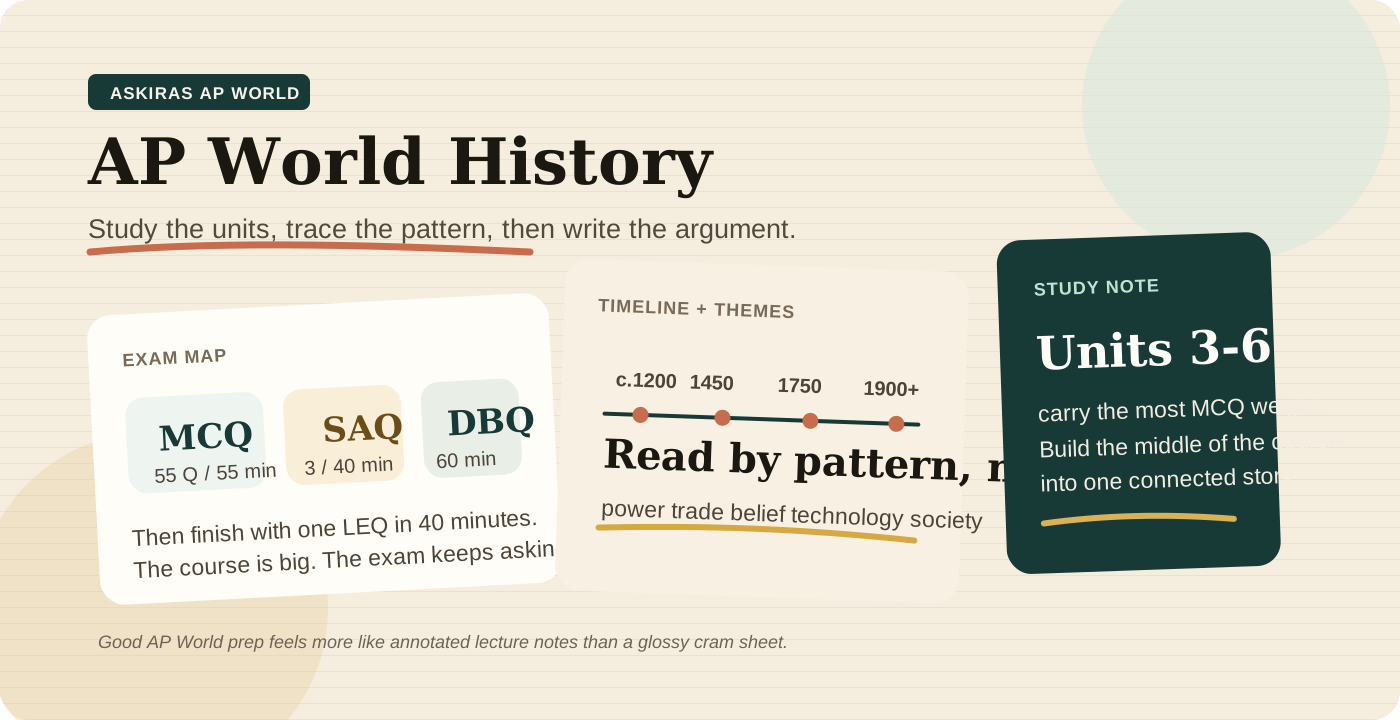
The official AP World History: Modern exam is fully digital in 2026 and will be given on May 7, 2026. It is administered in Bluebook and has two big parts:
Section I
- Multiple Choice: 55 questions in 55 minutes, worth 40% of the score
- Short Answer: 3 questions in 40 minutes, worth 20% of the score
The multiple-choice section is stimulus-based, which means you are often reading a short excerpt, image, map, or chart and then answering several questions tied to it.
Section II
- Document-Based Question (DBQ): 1 question in 60 minutes, including a 15-minute reading period, worth 25%
- Long Essay Question (LEQ): 1 question in 40 minutes, worth 15%
AP World is not just testing what you know. It is testing whether you can:
- read sources under time pressure
- pull outside knowledge into the right moment
- write historically defensible arguments without losing the thread
What AP World is really rewarding
The course covers the period from c. 1200 to the present across nine units. But the exam is not rewarding random fact collection.
The students with the cleanest study loop stop asking, “How do I memorize more?” and start asking, “What kind of historical move is this question asking me to make?”
Across the exam, the recurring moves look like this:
- identify what changed and what stayed the same
- explain why a development happened
- compare regions or empires
- connect a source to a broader historical pattern
- use evidence to support a claim instead of dropping facts on the page
Treat facts as building material, not the final goal. The goal is always argument, comparison, causation, or context.
Study the units and the themes together
This is the single most useful AP World shift.
Do not study Unit 3, then Unit 4, then Unit 5 as three separate memory boxes. Study each unit through the bigger patterns that keep resurfacing.
For example, when you review a unit, ask:
- how is power organized here?
- how are trade networks changing?
- what beliefs or ideologies are shaping behavior?
- what technologies or environmental realities are pushing change?
- who benefits and who loses in the social order?
That makes the course easier to hold because it turns isolated facts into reusable lenses.
A student who also sees recurring questions about state-building, trade, cultural exchange, military power, and social hierarchy has something stronger: a structure for retrieval.
Which units deserve the most attention
You do not need to panic-study every unit equally.
Units 3 through 6 each account for 12-15% of the multiple-choice section. That middle stretch matters a lot:
- Unit 3: Land-Based Empires
- Unit 4: Transoceanic Interconnections
- Unit 5: Revolutions
- Unit 6: Consequences of Industrialization
The remaining units are still important, but each is in the 8-10% range:
- Unit 1: The Global Tapestry
- Unit 2: Networks of Exchange
- Unit 7: Global Conflict
- Unit 8: Cold War and Decolonization
- Unit 9: Globalization
Those units train exactly the kinds of comparison and causation moves that show up everywhere.
How to pace each section without rushing yourself into bad decisions
Multiple choice: one minute per question
That sounds clean on paper, but the real challenge is the stimulus.
You are not just answering 55 separate questions. You are repeatedly:
- reading a source
- deciding what kind of source it is
- locating the historical setting
- answering the question without drifting into outside assumptions
The best pacing rule is not “go faster.” It is:
Read the stimulus for purpose.
Ask:
- who or what produced this?
- what claim or pattern is it showing?
- what historical context makes it make sense?
That is faster than rereading because you never decided what mattered.
Short answer: be direct, not decorative
Three SAQs in 40 minutes means you do not have time to warm up into your answer.
A strong SAQ usually does three things:
- answers the question directly
- uses a specific piece of evidence
- explains the evidence in one clean sentence
DBQ: use the reading period like a strategist
The DBQ gives you 60 minutes total, including a 15-minute reading period. That reading time is not optional fluff. It is where the essay is really won.
Use it to:
- identify the prompt’s task
- group the documents into 2-3 usable buckets
- decide what outside evidence fits the argument
- write a thesis that actually answers the question
If your plan is weak, the drafting stage turns messy. If your plan is clear, the essay gets calmer fast.
LEQ: choose the prompt you can support, not the one that sounds familiar
Pick the prompt where you can do three things with confidence:
- make a specific claim
- support it with concrete examples
- explain why those examples prove the claim
The best LEQ prompt is not the most famous topic. It is the one you can actually argue.
A better AP World study plan
If you are preparing for May 7, build your review around four loops.
1. Build a chronological spine
Make sure you can move through the nine units without major gaps.
- what the unit is about
- which states, networks, or ideas dominate it
- what changed from the previous era
2. Layer themes on top of the units
Once the timeline is there, add the recurring lenses:
- power
- trade
- belief
- technology
- society
- environment
That is what makes retrieval faster. You stop hunting for a fact in the dark and start recalling it through a category.
3. Practice source reading, not just content review
AP World is full of students who know more than their scores show because they do not practice with the kind of sources the exam actually uses.
4. Review your writing by rubric behavior
Do not review an essay by asking only, “Was this good?”
Ask:
- did I answer the prompt directly?
- did I use evidence specifically?
- did I explain the evidence instead of dropping it?
- did I show context or complexity where it made sense?
That kind of review changes your next essay. General vibes do not.
What to do in the final stretch
In the last two weeks, the goal is not to relearn world history. It is to make your exam decisions cleaner.
Prioritize:
- timed multiple-choice sets with real stimuli
- short, deliberate SAQ practice
- one or two DBQs where you focus on planning well
- LEQ selection practice so you do not freeze on test day
Also make sure you know the digital workflow. If the exam is fully digital, then part of preparation is removing avoidable surprises from the Bluebook experience and timing rhythm.
What to do next
If this guide feels useful, the next move is not another overview. It is targeted practice.
Start with the part of AP World that currently creates the most drag for you:
- if you know content but miss MCQs, work on source reading
- if you know the story but freeze in writing, work on SAQs and thesis-building
- if you feel overloaded, build the unit-and-theme map first
The class is still big. But the exam is narrower than the course itself. It keeps rewarding the same habits:
- see the pattern
- place the evidence
- make the claim
- explain why it matters
That is the version of AP World worth preparing for.
Frequently asked questions
Is AP World mostly about memorizing names and dates?
No. You still need factual knowledge, but the exam rewards whether you can place evidence in context, compare developments across regions, and make historical arguments with sources.
Which AP World units deserve the most study time?
Units 3 through 6 deserve extra time because they each carry 12-15% of the multiple-choice section, while Units 1-2 and 7-9 are each in the 8-10% range.
What is the most important AP World writing skill to improve first?
Start with clarity and specificity. A clean thesis, direct use of evidence, and a habit of explaining why the evidence matters are more useful than trying to sound sophisticated.
Keep going in this exam
Other guides at Askiras
If you are also prepping another exam, these short guides cover the same "name the pattern, then practice" habit.