How to Build a DBQ in 45 Minutes
The AP World DBQ gets easier when you group the docs fast, pick one argument, and stop trying to cover everything.
Read it to name the pattern, then practice while it is still fresh.
Prepared by Askiras editorial team. These guides stay short on purpose: one pattern, one worked example, one clear next step into practice. How we build guides.
Uses public AP course and exam context; does not reproduce protected College Board prompts.
College Board AP context, Askiras independence, and no unsupported outcome claims.
How do you write an AP World DBQ?
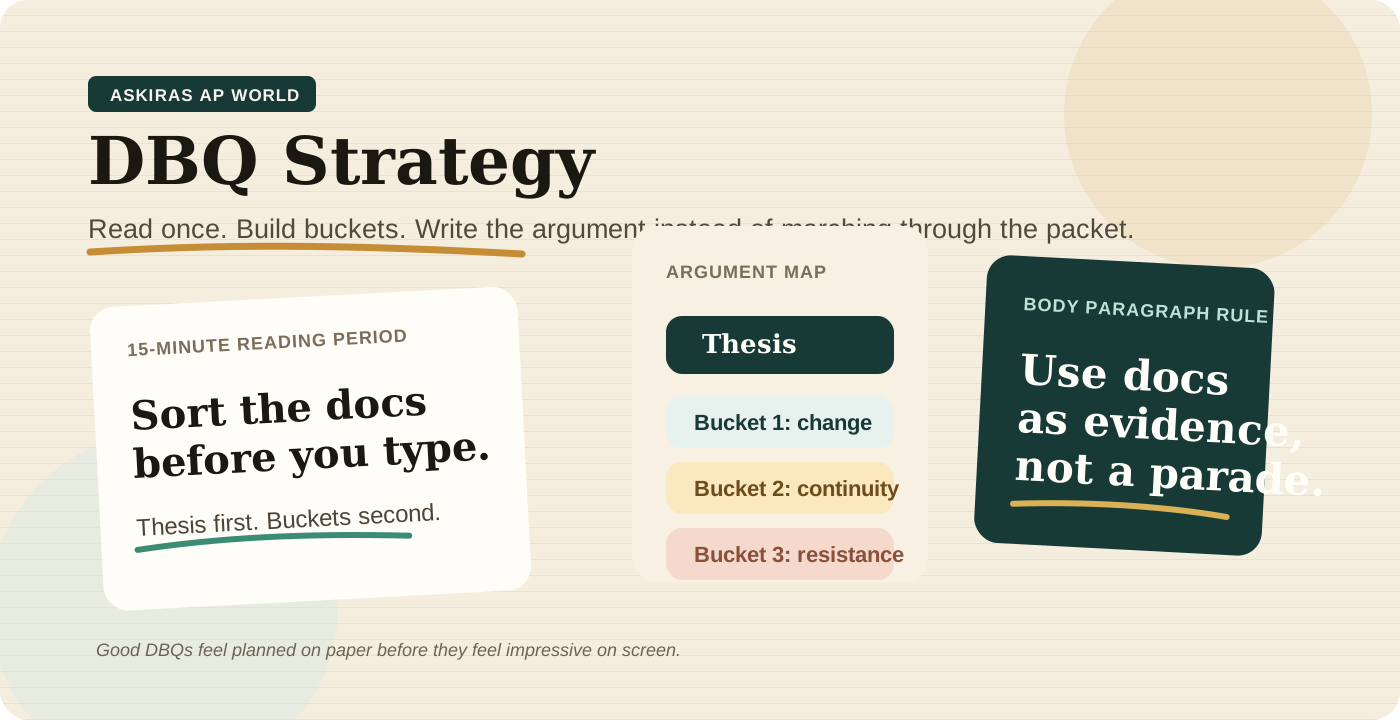
Write an AP World DBQ by reading the documents for argument groups first, choosing one defensible thesis, then using documents as evidence instead of summarizing them one by one. The plan matters before the prose does.
The DBQ is won before the essay feels underway
The DBQ feels like a writing problem. Most of the time it is a planning problem.
The current AP World exam still includes a DBQ, and the 2026 exam on May 7 is fully digital. That matters because typed essays can create a fake sense of progress.
You can produce a lot of words and still not build a clean argument.
Read the documents once, decide what the argument actually is, then write only what serves that argument.
The College Board’s current format still gives you one DBQ with a recommended 60 minutes, including a 15-minute reading period, and the set includes seven documents. That is enough time to build something strong. It is not enough time to discover your essay halfway through paragraph three.
Fast example first
Imagine a prompt like this:
Evaluate the extent to which industrialization changed labor systems from c. 1750 to 1900.
A student who panics might start summarizing documents one by one:
- one factory image
- one reformer’s speech
- one owner’s argument
- one worker complaint
That usually turns into a tour of the packet, not an essay.
A better start is this thesis:
Industrialization changed labor systems by expanding factory wage labor and tighter workplace discipline, but it did not replace coercion entirely, since empires and states still relied on forms of forced or highly controlled labor.
That thesis already creates structure. Now the documents can be grouped under an argument instead of a pile:
- documents showing new factory discipline
- documents showing continuity of coercive labor
- documents showing resistance or reform
That is the shift that makes the DBQ manageable.
What the DBQ is actually rewarding
Students often imagine the DBQ rewards memory first. It rewards historical control:
- can you make a defensible argument
- can you use documents as evidence instead of summary
- can you add relevant knowledge without losing the thread
The documents are raw material for one line of reasoning.
Use the reading period to build the frame
The 15-minute reading period is not for decorating the packet. It is for making decisions.
A practical reading-period workflow:
- Read the prompt slowly enough to catch the task.
- Decide what the essay is mostly about: change, continuity, causation, comparison, or extent.
- Read the documents with one short label in mind for each.
- Sort them into two or three useful groups.
- Draft a thesis before you start full body writing.
That label can be blunt. For example:
- “new labor discipline”
- “old coercion survives”
- “reform and backlash”
Blunt labels are good because they turn into topic sentences fast.
Do not write a document parade
The most common DBQ failure is the document parade.
It sounds like this:
- Document 1 says …
- Document 2 says …
- Document 3 says …
The problem is structural. That pattern makes the essay feel reactive. The documents control the writing instead of the argument controlling the documents.
A better paragraph sounds more like this:
Industrialization increased discipline over wage labor, especially in factory settings. One document from a factory owner praises punctuality and supervision as necessary for efficiency, while another worker account describes fines and rigid schedules. Together, they show that new industrial labor was not just about wages. It was also about tighter control of time and behavior.
That paragraph is doing more than summary. It is using documents to prove a claim.
Outside evidence should help, not show off
Students often treat outside evidence like a random fact drop. That usually weakens the essay.
Outside evidence works best when it extends a paragraph you are already making.
Using the industrialization example, notice the difference:
Weak move:
Also, Karl Marx wrote about workers.
Better move:
Critiques such as Marx and Engels’s analysis of industrial society help show that factory labor was widely understood as a new system of class discipline, not just a neutral economic improvement.
Or, if your paragraph is about coercion continuing:
Systems such as indentured labor after abolition help show that industrial-era economies still depended on controlled labor even as wage work expanded.
Outside evidence should not interrupt the paragraph. It should make the paragraph harder to deny.
A pacing split that actually works
You do not need a magical minute-by-minute plan, but you do need shape.
A practical split inside the recommended 60 minutes:
- reading and grouping first
- fast thesis before body writing
- body paragraphs written from the strongest buckets
- final minutes to clean transitions and fix anything vague
Do not spend the whole reading period trying to understand every possible angle. Once you have a defensible line of argument, move.
The mistakes that keep making DBQs feel harder than they are
1. Writing the introduction before knowing the argument
If your introduction is still vague, your thesis usually is too. You do not need a dramatic opening. You need the line of reasoning.
2. Treating every document as equal
Some documents are central. Some are support. Some work best as contrast.
3. Copying document language instead of explaining it
Quoted language can look serious while hiding weak analysis. Short paraphrase plus explanation is usually stronger.
4. Dumping outside evidence wherever there is empty space
Outside evidence only helps if it clearly belongs to the claim being argued.
5. Discovering the real essay too late
If paragraph one argues change, paragraph two argues continuity, and paragraph three drifts into a different topic, the essay loosens.
A second worked outline
Take a different kind of prompt:
Evaluate the extent to which states used ideology to strengthen rule from c. 1450 to 1750.
Before writing, you might sort the packet like this:
- documents showing religion or belief systems used for legitimacy
- documents showing bureaucracy or military power mattered more than ideology alone
- documents showing ideology worked differently across empires
Now the essay has tension. It is not just “states used ideology.” It becomes:
States did use ideology to strengthen rule, but ideology worked best when it was tied to administrative and military systems rather than standing alone.
That gives you something to prove.
How to practice DBQs without writing full essays every time
Full DBQs matter, but not every practice session needs one.
A good short drill is:
- Take a DBQ prompt and packet.
- Give yourself only the reading period.
- Write the thesis.
- Sort the documents into two or three buckets.
- Add one piece of outside evidence to each bucket.
Then, on another day, write only one body paragraph from that plan.
The right DBQ mindset
The DBQ is not an invitation to prove how much history you know. It is a test of whether you can turn evidence into a controlled historical argument under time.
That is why the essay usually improves when you get a little stricter:
- fewer stray facts
- fewer document summaries
- clearer topic sentences
- cleaner outside evidence
Read once. Sort with purpose. Write the argument, not the archive.
Frequently asked questions
Should I quote the DBQ documents directly?
Usually only briefly, if at all. The stronger move is to paraphrase what a document shows and explain why it matters for your argument.
Do I need to use every document the same way?
No. Read all of them, but use them selectively. Some documents will anchor major body paragraphs, while others work better as support or contrast.
What should I do during the DBQ reading period?
Sort the documents by argument, decide what your thesis will be, and identify one or two pieces of outside evidence that genuinely strengthen that line of argument.
Keep going in this exam
Other guides at Askiras
If you are also prepping another exam, these short guides cover the same "name the pattern, then practice" habit.