How to Study AP World Without Drowning in Content
Most AP World panic leads to rereading. A better plan is themes, retrieval, and practice that actually looks like the exam.
Read it to name the pattern, then practice while it is still fresh.
Prepared by Askiras editorial team. These guides stay short on purpose: one pattern, one worked example, one clear next step into practice. How we build guides.
Uses public AP course and exam context; does not reproduce protected College Board prompts.
College Board AP context, Askiras independence, and no unsupported outcome claims.
How should you study AP World?
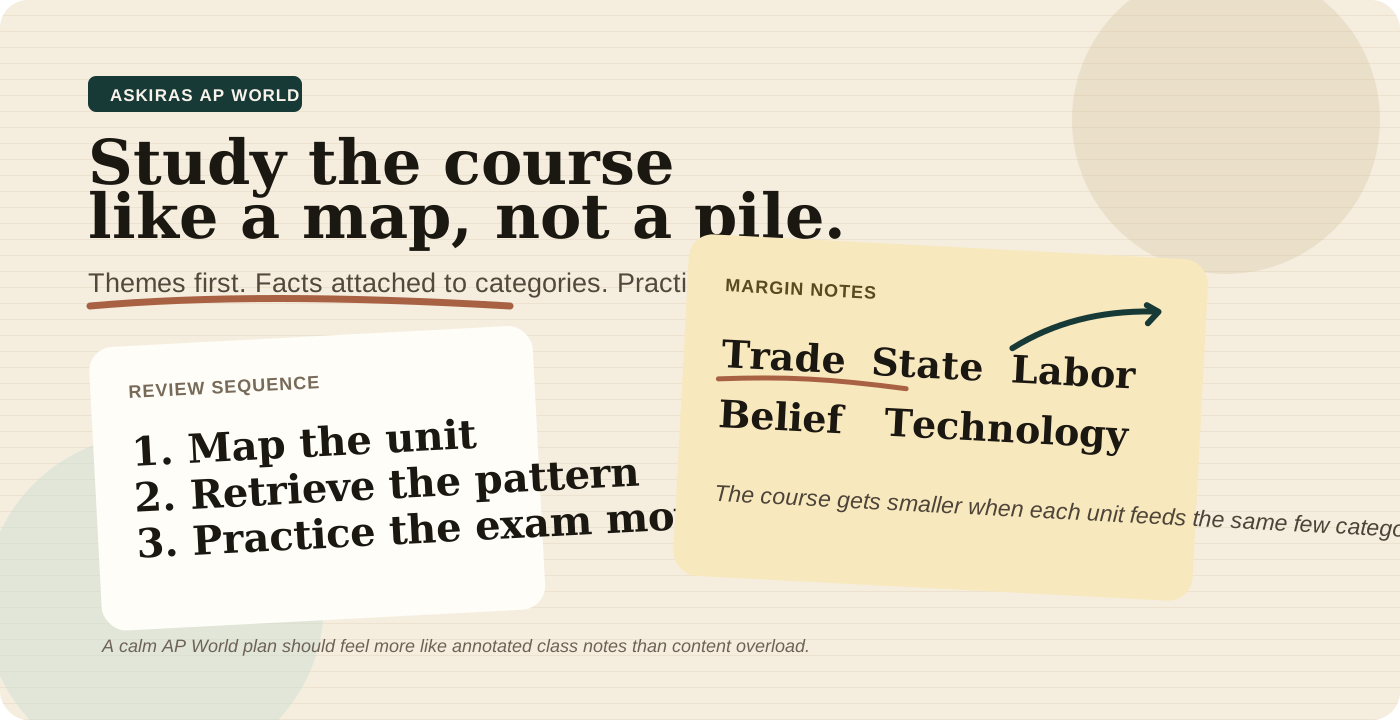
Study AP World by turning units into themes, then practicing retrieval, stimulus-based MCQs, SAQs, DBQs, and LEQs. Do not reread the whole course at one speed; map the pattern, anchor it with facts, and practice the exam task.
AP World feels impossible when you study it like a pile of units
AP World panic usually creates the same study plan: reopen the notes, highlight more, and hope the course feels smaller.
It usually does not.
What actually helps is a cleaner map.
Because the 2026 AP World exam is fully digital on May 7, your job is not just to remember facts. You also need to read sources on screen, move through stimulus-based multiple-choice sets, and write clear SAQ, DBQ, and LEQ responses under time.
That means your study plan has to do two things at once:
- organize the course so it stops feeling infinite
- prepare you for the actual exam moves
Fast example first
Suppose you are reviewing Unit 5 and feel behind on revolutions. The bad version of review sounds like this:
- French Revolution
- Haitian Revolution
- Latin American revolutions
- Industrial Revolution
- Congress of Vienna
That looks like content, but it does not give you a way to think.
The better version sounds like this:
- What pressures were breaking old political systems?
- Which groups used Enlightenment ideas, and which were left out?
- How did industrialization change labor, production, and imperial power?
- What kinds of states tried to restore order afterward?
Now the facts have rails. Instead of five unrelated piles, you have a pattern: ideology, social hierarchy, production, state response.
That is how AP World gets smaller.
The main rule: study in themes, then anchor with facts
You still need facts. But facts should serve a category.
A simple working set of categories is enough:
- state building and legitimacy
- trade and exchange
- labor systems
- technology and production
- culture and belief
- social hierarchy and resistance
- continuity versus change
When you review a unit, ask:
What does this unit add to those categories?
For example:
-
Unit 3 is not just “land empires”
-
it is also taxation, military power, bureaucracy, religion, and trade control
-
Unit 4 is not just “transoceanic connections”
-
it is also labor extraction, maritime networks, imperial competition, and cultural mixing
That framing matters because AP World questions rarely reward isolated recall for long. They reward students who can place a fact inside a bigger process.
Build a three-layer study system
Layer 1: rebuild the course map
For each unit, make a one-page sheet with:
- the main developments
- the biggest turning points
- one or two concrete examples for each theme
The page should feel slightly incomplete. That is fine. Its job is orientation, not perfection.
Layer 2: train retrieval
Close the notes and ask:
- What changed in this unit?
- What stayed the same?
- Which states grew stronger?
- Which labor systems expanded or changed?
- Which technologies or trade routes changed incentives?
If you cannot answer in your own words, the content is not stable yet.
If your study process has you constantly staring at notes, you are still in the shallow end.
Layer 3: train exam shape
By this point, you should shift hard into the actual forms of the test:
- stimulus-based MCQs
- SAQs
- DBQ structure
- LEQ categories
Why? Because content that feels solid in a notebook can still collapse inside an exam task.
A student can “know Unit 4” and still miss multiple-choice questions because they read the source too loosely. Another can know the topic and still write a DBQ that never turns evidence into argument.
Sequence your review instead of rotating randomly
A lot of AP World studying becomes unplanned rotation: “today Unit 2, tomorrow Unit 7, then maybe some DBQ practice.”
A better weekly sequence looks like this:
Day 1: rebuild one unit map
Short notes. No perfection. Just get the terrain back.
Day 2: retrieve and compare
Without notes, explain the unit through two or three themes. Then compare it to one earlier unit.
Example:
- How is industrial labor different from coerced plantation labor?
- How is nineteenth-century imperialism different from earlier land-based empire building?
Day 3: do exam-shaped practice on that content
- one short MCQ set
- one SAQ or a DBQ planning drill
Day 4: review mistakes by category
Do not just write “missed because careless.” Sort misses like this:
- I did not know the context
- I knew the fact but misread the source
- I knew the evidence but could not build the claim
- I confused two similar developments
That tells you what to fix next.
Stop rereading when you are anxious
This is the most common AP World trap.
When students feel behind, they reopen the textbook or the review sheet and start reading again from the top. It feels safe because nothing is being tested.
But rereading hides the exact thing the exam will expose: whether you can retrieve and use the content.
If you want a safer middle step, do this:
- read a page of notes
- close it
- write five lines from memory
- compare and patch only the missing parts
That still feels structured, but it forces the brain to do work.
Study by confusion type, not just by unit
Some students are weak in Unit 1 and strong in Unit 6. But many students have a different real weakness:
- they confuse similar empires
- they lose cause-and-effect chains
- they miss changes in labor systems
- they cannot place a source in historical context fast enough
Those are cross-unit problems, and they show up on the exam constantly.
So part of your review should be category drills:
- compare labor systems across periods
- compare state-building methods across regions
- compare how belief systems legitimized power
- compare how trade changed social structure
Prepare for the digital version on purpose
In 2026, AP World is fully digital, so part of your prep should be digital too.
Practice:
- reading sources on screen instead of only on paper
- moving through stimulus sets without rereading from zero
- typing concise SAQ answers
- outlining DBQ claims before drafting
If screen reading slows you down, that is not a personality flaw. It is a trainable issue.
What the final stretch should look like
If the exam is close, do not panic and try to consume the whole course again.
Use a narrower plan:
- one unit map refresh per day
- one short retrieval block
- one piece of exam-shaped practice
- one mistake review block
That is enough.
You are trying to become more organized, faster at recognition, and clearer under pressure.
The next useful move
If AP World still feels huge, do not respond by making your notes bigger. Respond by making your categories sharper.
Start with one unit. Map it by theme. Then do one source-based MCQ set and see where the structure breaks.
That is where AP World finally starts to shrink.
Frequently asked questions
Do I need to memorize every detail from every AP World unit?
No. You need enough factual control to recognize patterns, support claims, and place documents in context. The winning move is organized recall, not hoarding trivia.
How should I divide AP World study time between content review and practice?
Start with a short content pass to rebuild the map, then spend most of your time on retrieval, stimulus-based multiple choice, and timed writing practice. Practice exposes the gaps faster than rereading does.
Does the 2026 digital AP World exam change how I should prepare?
Yes. The exam on May 7, 2026 is fully digital, so you should practice reading sources on screen, moving quickly through stimulus sets, and writing clear responses without relying on handwritten momentum.
Keep going in this exam
Other guides at Askiras
If you are also prepping another exam, these short guides cover the same "name the pattern, then practice" habit.