SAT Math: The Patterns That Keep Showing Up
The SAT math patterns that keep showing up, the traps that waste time, and the shortcuts that actually help.
Read it to name the pattern, then practice while it is still fresh.
Prepared by Askiras editorial team. These guides stay short on purpose: one pattern, one worked example, one clear next step into practice. How we build guides.
Uses public Digital SAT format and practice-strategy context; does not reproduce protected College Board questions.
College Board Digital SAT context, Askiras independence, and no unsupported outcome claims.
What SAT math patterns should I practice first?
Start with translation, linear equations, systems, ratios, function behavior, and Desmos decision-making. Many SAT math misses happen because the student solves cleanly after setting up the wrong job.
The math patterns that keep coming back
SAT math feels broader than it is. The stories change, but the underlying asks repeat.
If you can name the pattern quickly, you stop wasting time rediscovering the problem from scratch.
The 8 most common math question patterns
1. The Interpretation Trap
What it looks like: “What does the value 50 represent in the equation C = 25m + 50?”
The pattern: You’re given an equation modeling a real-world situation and asked what a specific number means. The equation is simple — the challenge is translating math to English.
How to solve it:
- Identify which part of the equation the number belongs to (coefficient, constant, variable)
- The constant term (y-intercept) = the starting value when the variable is 0
- The coefficient = the rate of change per unit
- The variable = what’s changing
Common trap: Confusing the coefficient with the constant. If C = 25m + 50, the monthly cost is 25 (coefficient of m), not 50.
Example:
A phone plan costs $35 per month plus a $75 activation fee. The total cost C for m months is C = 35m + 75. What does 35 represent?
- A) The activation fee → No, that’s 75
- B) The total cost after one month → No, that’s 35(1) + 75 = 110
- C) The monthly cost → Yes
- D) The number of months → No, that’s m
2. The Intermediate Value Trap
What it looks like: “What is the value of 3x + 6?” (when the question gives you enough to find x, and 3x + 6 is not what most students compute first)
The pattern: The question asks for an expression, not a single variable. Students solve for x, then forget to plug it into the expression — or they report x itself as the answer.
How to solve it:
- Read the question twice. What exactly is it asking for?
- Sometimes you can find the expression directly without solving for individual variables
- If the question asks for x + y and gives you two equations, try adding the equations
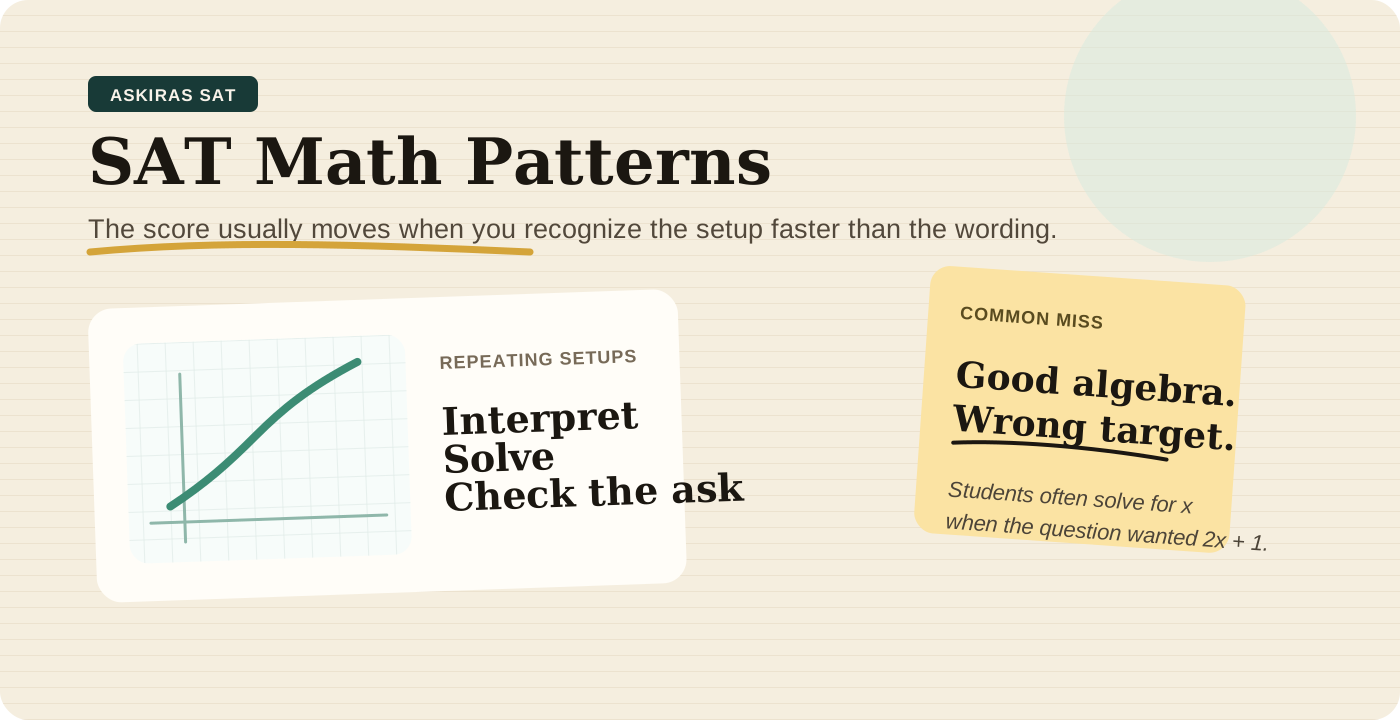
Common trap: Solving for x and choosing that as your answer when the question asked for 2x + 1.
3. The System Shortcut
What it looks like: Two equations, asked for a combined expression like x + y or xy.
The pattern: The question is designed so that adding, subtracting, or manipulating the two equations gives you the answer directly — without solving for individual variables.
How to solve it:
- Before solving for x and y separately, ask: can I add/subtract these equations to get what I need?
- Look for elimination opportunities
- If asked for x + y, adding equations that eliminate a variable is often fastest
Example:
3x + 2y = 16 and 5x - 2y = 0. What is x + y? Add the equations: 8x = 16, so x = 2. Substitute: 5(2) - 2y = 0, y = 5. x + y = 7
4. The Percent Change Chain
What it looks like: “A price increases by 20%, then decreases by 20%. What is the net change?”
The pattern: Sequential percentage changes don’t cancel out. A 20% increase followed by a 20% decrease is NOT zero net change — it’s a net decrease.
How to solve it:
- Convert to multipliers: +20% = ×1.20, -20% = ×0.80
- Multiply: 1.20 × 0.80 = 0.96 = 4% decrease
- Never add/subtract percentages applied to different bases
Common trap: “20% up then 20% down = 0% change.” Wrong. The 20% decrease applies to the larger number.
5. The Formula Rearrangement
What it looks like: “Solve for r in terms of the other variables: A = P(1 + rt)”
The pattern: You need to isolate a specific variable from a multi-variable formula. The math isn’t hard — it’s the same operations as solving for x — but students get confused when there are multiple letters.
How to solve it:
- Treat every letter except your target as if it were a number
- Apply inverse operations step by step
- Check: does your answer make sense when you plug in simple values?
Step by step: A = P(1 + rt)
- A/P = 1 + rt
- A/P - 1 = rt
- (A/P - 1)/t = r
- Simplify: r = (A - P)/(Pt)
6. The Statistics Question
What it looks like: Questions about mean, median, standard deviation, or margin of error — often in a survey or experiment context.
Key facts to know:
- Mean shifts when you add/remove values
- Median is resistant to outliers
- Standard deviation measures spread — a dataset of {5, 5, 5} has SD = 0
- Margin of error decreases as sample size increases (by sqrt(n))
- Doubling sample size does NOT halve margin of error — it reduces by factor of √2
Common trap: Confusing “larger sample = more accurate” (true) with “larger sample = proportionally more accurate” (false — diminishing returns).
7. The Quadratic in Disguise
What it looks like: Equations that don’t look quadratic but become quadratic with substitution.
Examples:
- x^4 - 5x^2 + 4 = 0 → let u = x^2, get u^2 - 5u + 4 = 0
- √(x) - 3 = x - 9 → square both sides, solve quadratic, check for extraneous solutions
- 2^(2x) - 5(2^x) + 6 = 0 → let u = 2^x
How to solve it:
- Look for repeated patterns: x^4 and x^2, or e^(2x) and e^x
- Substitute to reduce to a standard quadratic
- Solve the quadratic, then substitute back
- Always check for extraneous solutions when you squared something
8. The Geometry Setup
What it looks like: A word problem requiring you to set up a geometric relationship before computing.
Common setups:
- Similar triangles (proportional sides)
- Circle inscribed in/circumscribed around a shape
- Right triangle from a real-world scenario (ladder against wall, shadow problems)
- Area/volume with one dimension expressed in terms of another
How to solve it:
- Draw a diagram (even a rough one)
- Label all known values
- Identify the geometric relationship (Pythagorean theorem, similar triangles, area formula)
- Set up the equation, then solve
Common trap: Using the slant height instead of the actual height (cones, pyramids), or mixing up radius and diameter.
General Math Strategies
The Backsolving Technique
When answer choices are numbers, plug them into the question to see which works. Start with B or C (middle values) to determine direction.
The Pick-a-Number Strategy
For “which expression is equivalent” questions with variables, pick simple values (x = 2, y = 3) and evaluate each choice. Only one will match.
The Estimation Check
After solving, sanity-check your answer. If a question asks about a 10% discount on a $200 item and your answer is $280, something went wrong.
Read the ask before you solve
For word problems, identify what the question wants before you build the setup. This prevents a common SAT mistake: doing correct math for the wrong target.
If the problem asks for the meaning of a coefficient, do not solve for a variable. If it asks for an expression, do not stop after finding x.
The algebra is often not the hard part. The ask is.
How to use this guide
If math is the section costing you points, do not review it as one giant bucket.
Sort your misses by pattern:
- translation / interpretation
- expression target
- system shortcut
- percent chain
- formula rearrangement
- statistics
- disguised quadratic
- geometry setup
That is how SAT math starts feeling familiar instead of random.
Frequently asked questions
Should I use Desmos on every SAT math question?
No. Use it where it genuinely saves time or reduces error. For simple arithmetic or direct algebra, mental math is often faster.
What is the most common SAT math mistake?
Solving the wrong problem. Students often do the algebra correctly and still answer for x when the question asked for 2x + 1 or a contextual meaning.
Is SAT math mostly about hard content?
Not usually. A lot of lost points come from recurring patterns, translation mistakes, and setup errors rather than advanced concepts.
Keep going in this exam
Other guides at Askiras
If you are also prepping another exam, these short guides cover the same "name the pattern, then practice" habit.