SAT Hard Math Questions: The Types That Usually Cost Points
A pattern-first field guide to hard SAT math questions: how to spot the disguise, choose the first move, and turn misses into focused drills.
Read it to name the pattern, then practice while it is still fresh.
Prepared by Askiras editorial team. These guides stay short on purpose: one pattern, one worked example, one clear next step into practice. How we build guides.
Uses public Digital SAT format and practice-strategy context; does not reproduce protected College Board questions.
College Board Digital SAT context, Askiras independence, and no unsupported outcome claims.
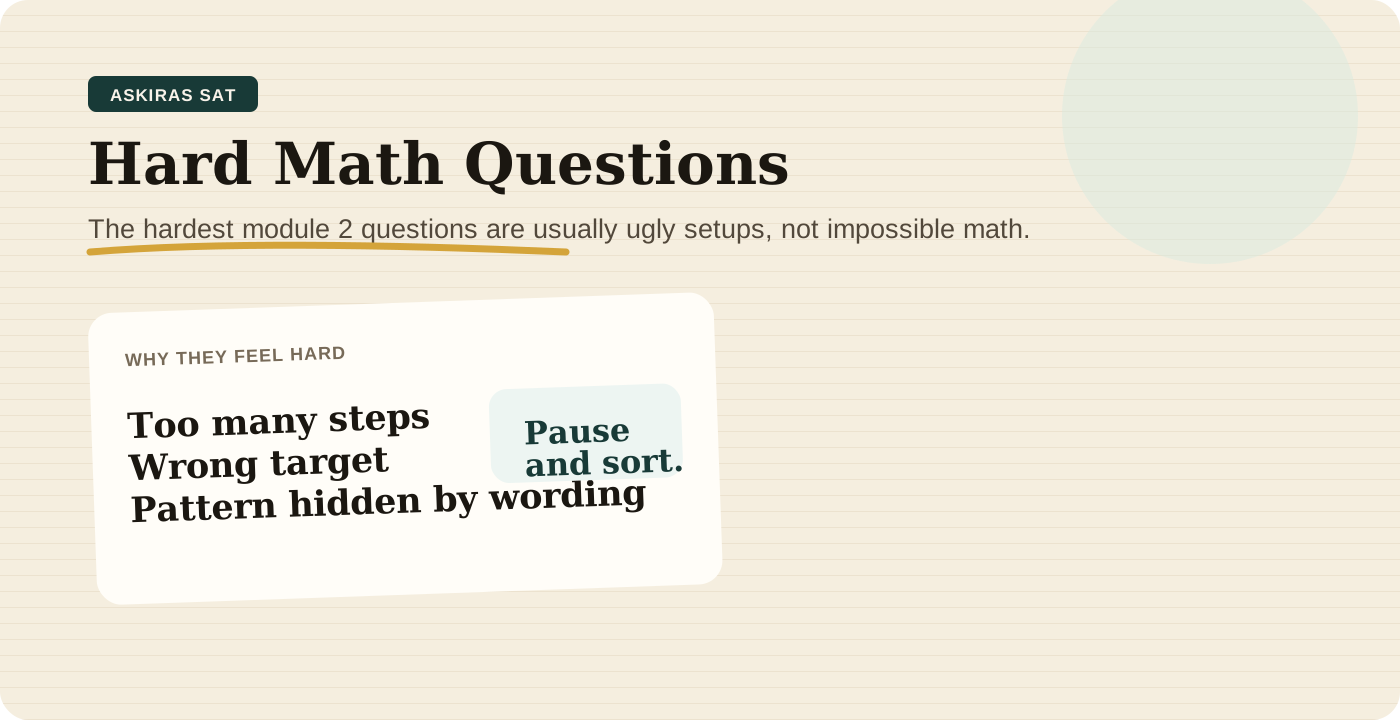
Hard SAT math is a sorting problem first
The hardest Digital SAT math questions usually do not ask for new math. They ask whether you can stay calm long enough to sort the question before you start grinding.
That is the Askiras read on module 2: the test often hides a familiar pattern inside a messier surface. A “hard” question might be a quadratic wearing an exponent costume, a system that asks for x + y instead of x, or a geometry problem where the only real move is spotting the right triangle.
The mistake is treating all of that as one giant bucket called “hard math.” That makes review useless. In the Askiras SAT trainer, the point of a miss is not just “wrong.” The point is the tag: disguised quadratic, word-model setup, wrong target, function interpretation, geometry relationship. The tag tells you what to drill next.
Use this guide as a field guide, not a textbook chapter. For each type below, your job is to learn the first move, the trap, and the review note you should write after a miss.
The reusable Askiras hard-question template
Use this template on any hard math question before you solve. It is short on purpose; under time pressure, a long checklist turns into decoration.
- Name the target. What exactly is being asked:
x,2x + 1, a coefficient, a range, a graph feature, a unit in context? - Name the disguise. Does the question look like algebra, modeling, interpretation, geometry, or calculator work?
- Choose the first move. Substitute, define variables, add equations, convert to multipliers, draw the hidden triangle, or graph in Desmos.
- Solve only after the setup is clean. If you are doing arithmetic before you know the target, you are paying the SAT’s time tax.
- Tag the miss. After practice, write the miss as a pattern:
wrong target,repeated expression,unit conversion,hidden similar triangles, notcareless.
That last step is where guide reading turns into score movement. One tagged miss becomes a focused drill. Five vague misses become a mood.
Mini diagnostic: sort before you solve
Try this without rushing:
If
2^(2x) - 5(2^x) + 6 = 0, what is the least possible value ofx?
The surface looks like exponents. The structure is a quadratic.
Let u = 2^x. Then 2^(2x) = (2^x)^2 = u^2, so the equation becomes:
u^2 - 5u + 6 = 0
Factor:
(u - 2)(u - 3) = 0
So u = 2 or u = 3. Substitute back:
2^x = 2, sox = 12^x = 3, sox = log_2(3), a little bigger than 1
The least possible value is 1.
The lesson is not “memorize this one.” The lesson is “when the same expression appears in two powers, rename it.” In trainer review, this miss should not be tagged as “exponents.” It should be tagged as disguised quadratic / repeated expression, because that is the move you need to drill.
Type 1: Disguised quadratics
Spot it when: you see a repeated expression in two powers, like x^4 with x^2, 2^(2x) with 2^x, or (x + 3)^2 with (x + 3).
First move: rename the repeated expression. Use u, a, or a short phrase. Then solve the simpler quadratic before substituting back.
SAT trap: students solve the u equation and forget what u represented. The answer choices often include the intermediate value because the test knows you are tired.
Tiny example: If x^4 - 13x^2 + 36 = 0, let u = x^2. Then u^2 - 13u + 36 = 0, so (u - 9)(u - 4) = 0. If the question asks for possible values of x^2, the answers are 4 and 9. If it asks for positive values of x, the answers are 2 and 3. Same work, different target.
Askiras drill loop: after a miss, open a short math drill and watch for repeated-expression tags. Do not do ten random math questions yet. Do three disguised-quadratic questions and force yourself to write the substitution line first.
Review tag: disguised quadratic / substituted expression.
Type 2: Multi-step word models
Spot it when: the problem gives a rate, fixed fee, total, percent mixture, or “for every” relationship before asking for one specific value.
First move: write two plain-English lines before the equation: variable = what, in what units and target = what the question asks for. Then build the model.
SAT trap: the algebra is often easy after setup, so students rush into solving and answer the wrong thing. A common miss: solving for the number of months when the question asks for total cost after that many months.
Tiny example: A tutoring plan charges $35 to start and $18 per session. The total cost after s sessions is 35 + 18s. If a student has paid $179 total and the question asks how many sessions remain after the first 2 sessions have already happened, solve 35 + 18s = 179 to get s = 8, then answer 8 - 2 = 6. If you bubble 8, your algebra was fine and your target read was not.
Askiras drill loop: when the trainer marks a miss as a word-model or wrong-target error, review the explanation once, then write your own one-line model before starting the next question. The drill is not “more word problems”; it is “define target before algebra.”
Review tag: word model / wrong target.
Type 3: Function interpretation
Spot it when: the question asks what a number, coefficient, intercept, or parameter means in context.
First move: stop calculating. Read the units around the function. A constant is often a starting amount; a coefficient is often a rate; a parameter can shift the whole graph.
SAT trap: students turn interpretation into computation because computation feels safer. The question asks what 0.6 means, and they start plugging in values of x.
Tiny example: In f(t) = 38 + 0.6t, where f(t) is the water level in centimeters after t minutes, 0.6 means the water level increases by 0.6 centimeter per minute. It does not mean the water level after 1 minute; that would be 38.6.
Askiras drill loop: after an interpretation miss, do a mixed set slowly enough to label each function part before solving. In the two-question public SAT demo, practice saying the task out loud: “This is asking what the number means, not asking me to solve.”
Review tag: function interpretation / units.
Type 4: Systems with a twist
Spot it when: there are two equations, but the question asks for x + y, x - y, 4x, a price combo, or another expression built from the solution.
First move: write the target expression above the system. Ask whether adding, subtracting, or scaling the equations gives the target faster than solving for both variables.
SAT trap: full solving feels productive, but it can be slower and more error-prone. Worse, students sometimes stop at x or y when the question asked for a combination.
Tiny example: If 3x + 2y = 17 and x - 2y = 3, adding the equations gives 4x = 20. If the question asks for 4x, you are done. You do not need x, and you definitely do not need y.
Askiras drill loop: for system misses, write the target expression before touching the equations. In the full SAT trainer, treat repeated system-twist misses as their own drill until your first move is target-first, not solve-everything-first.
Review tag: system twist / target expression.
Type 5: Percent and probability chains
Spot it when: the question stacks changes: increase then decrease, two discounts, conditional probability, replacement, or comparisons with different bases.
First move: turn each percent into a multiplier or each probability into an explicit fraction. Keep the base visible.
SAT trap: mental shortcuts break when the base changes. A 20 percent increase followed by a 20 percent decrease is not “back to where you started.”
Tiny example: A value increases by 20 percent and then decreases by 20 percent. The multiplier is 1.20 * 0.80 = 0.96, so the final value is 96 percent of the original. The total change is a 4 percent decrease, not 0.
Askiras drill loop: after a percent-chain miss, drill two or three questions where you write only the multipliers first. Then solve. The habit you are building is “change percent language into math before trusting intuition.”
Review tag: percent chain / changing base.
Type 6: Geometry with a hidden setup
Spot it when: the diagram or wording quietly depends on similar triangles, a tangent-radius relationship, a right triangle, circle symmetry, or one length written in terms of another.
First move: name the hidden relationship before using formulas. Draw the right triangle, mark equal angles, write the similarity ratio, or label the radius.
SAT trap: geometry formulas become a distraction. Students compute an area, circumference, or slope because those formulas are familiar, even though the question is built on one missing relationship.
Tiny example: If a segment from the center of a circle meets a tangent line at the point of tangency, those two segments are perpendicular. If the radius is 5 and the tangent segment from the tangency point to an outside point is 12, the center-to-outside-point distance is 13 by the 5-12-13 right triangle. The key move was not a circle formula; it was the tangent-radius relationship.
Askiras drill loop: after a geometry setup miss, rewrite the explanation as one sentence: “The hidden relationship was ___.” Then do another geometry drill looking only for that first relationship before calculating.
Review tag: geometry setup / hidden relationship.
Desmos rule: use it when it changes the job
Desmos is a tool, not a panic button. On hard questions, use it when graphing or table values change the job from “derive” to “see.”
Use Desmos when:
- you need an intersection
- the answer is a visible graph feature
- the model is already written and you want to verify it
- messy arithmetic is hiding a simple relationship
Stay with hand work when:
- the question asks for a symbolic expression
- the main task is interpretation
- the setup is faster than typing
- you have not named the target yet
The Askiras version: decide what Desmos is doing for you before you open it. If the answer is “making me feel busy,” stay out of it.
After a miss, write the useful sentence
Hard-question review should sound like this:
I missed the repeated expression, so I did not substitute.I solved for x, but the target was 4x.I treated 20% up then 20% down as net zero.I used a circle formula before seeing the tangent made a right triangle.
That is the sentence you want in the Askiras mistake log. It is short, specific, and drillable.
Bad review says:
CarelessHard mathNeed to slow down
Those might be true emotionally. They are useless instructionally.
A 20-minute practice block for hard math
Do this when hard module 2 math feels noisy:
- Pick one type from this guide.
- Do three focused questions in that type.
- For every miss or shaky correct answer, write the review tag.
- If the same tag appears twice, do three more of that type before returning to mixed practice.
- End with one mixed mini-set so you still practice recognizing the type cold.
That is the loop this guide is meant to feed: read the pattern, try it in practice, tag the miss, drill the repeated tag. You can start with the two-question public SAT demo or use the full SAT trainer when you want the mistake log and focused review loop to carry the pattern forward.
Hard SAT math is not random. It is familiar math with one extra layer of disguise. Your job is to name the disguise before it spends your time for you.
Frequently asked questions
Are hard SAT math questions mostly in module 2?
Usually yes, especially in the harder second module. But the main issue is not just difficulty. It is that the setup gets less obvious.
What makes SAT math questions feel hard?
Usually one of three things: too many steps, a hidden pattern, or a question that asks for something different from what you solved.
Should I panic if a math question looks unfamiliar?
No. Many hard SAT math questions are just familiar patterns in uglier clothing. Slow down long enough to sort the type.
Keep going in this exam
Other guides at Askiras
If you are also prepping another exam, these short guides cover the same "name the pattern, then practice" habit.