SAT Prep: What Actually Helps
Build a realistic SAT prep plan with baseline tests, focused mistake review, timed practice, and fewer low-value study habits.
Read it to name the pattern, then practice while it is still fresh.
Prepared by Askiras editorial team. These guides stay short on purpose: one pattern, one worked example, one clear next step into practice. How we build guides.
Uses public Digital SAT format and practice-strategy context; does not reproduce protected College Board questions.
College Board Digital SAT context, Askiras independence, and no unsupported outcome claims.
What actually helps with SAT prep?
Useful SAT prep starts with a baseline, then narrows practice around repeated miss patterns. Mix official full-test rehearsal with shorter review loops: identify the task, drill the pattern, write why the miss happened, and repeat under time.
What a good SAT plan looks like
Most SAT plans fail for a simple reason: they confuse activity with progress.
Students read notes, watch videos, take random tests, and feel busy. Then the score barely moves.
Good prep is narrower:
- diagnose the weak pattern
- drill that pattern
- review the miss while it is still fresh
- repeat it under timing pressure
First decision: what kind of SAT prep problem do you have?
Before you add more study hours, label the bottleneck. The fix for a math-modeling miss is different from the fix for a grammar rule miss or a review-habit miss.
| Signal from your last practice section | Better next move |
|---|---|
| You knew the algebra but spent too long setting it up | Practice translating word problems and graph checks with the SAT Desmos practice guide. |
| You missed transitions or sentence placement under time | Drill the relationship words in the SAT transition questions guide. |
| You lost points to punctuation, agreement, or modifiers | Review the tested patterns in SAT grammar rules that actually show up. |
| Your wrong answers repeat but you cannot name why | Use the SAT mistake-review loop before taking another full practice test. |
Why some SAT prep sticks and some doesn’t
Spaced Repetition
The most powerful study technique, backed by over a century of cognitive science research. Instead of cramming, you review material at increasing intervals: 1 day, 3 days, 1 week, 2 weeks, 1 month.
Why it works: Each retrieval strengthens the memory. The spacing forces your brain to reconstruct the knowledge, which builds durable recall.
How to use this: Turn misses into review cards. Revisit newer misses sooner and older stable misses later.
Your job: Do your reviews. Even 10 minutes a day of review is more effective than 2 hours of cramming before the test.
Active Recall vs. Passive Review
Passive: Re-reading notes, highlighting, watching videos. Feels productive but creates an illusion of learning.
Active: Attempting problems before looking at solutions, explaining concepts in your own words, testing yourself. Uncomfortable but effective.
The uncomfortable truth: If studying feels easy, you’re probably not learning much. The struggle of retrieval — that feeling of “I know this but can’t quite get it” — is where learning happens.
The Testing Effect
Taking practice tests isn’t just assessment — it’s one of the most effective forms of learning. Every time you retrieve an answer (right or wrong), you strengthen the neural pathways for that knowledge.
Implication: Drilling questions is not separate from studying. It is the studying.
Month-by-Month Study Plan
6 Months Before Test Day
Goal: Establish your baseline and identify weak areas.
- Take one full-length official practice test under real conditions
- Score it. Note your section scores and which question types you missed
- Categorize your mistakes:
- Didn’t know the concept (need to learn)
- Knew the concept but made an error (need practice)
- Ran out of time (need pacing work)
- Set a target score based on your college goals
4-5 Months Before
Goal: Build knowledge in weak domains.
- Study the concepts behind your most-missed question types
- Use pattern guides like the SAT math patterns that keep showing up to understand recurring SAT archetypes
- Do 10-20 practice questions daily (quality over quantity)
- Review every wrong answer — understand why you got it wrong, not just what the right answer is
2-3 Months Before
Goal: Build speed and accuracy under pressure.
- Start timing your practice sessions
- Take 1-2 full practice tests per month
- Focus on your weakest domain first in each study session (willpower is highest)
- Use spaced repetition for review cards (10-15 min/day)
1 Month Before
Goal: Polish and build confidence.
- Take 1-2 more full practice tests (aim for 4-6 total before test day)
- Review all your mistake cards
- Focus on pacing — practice finishing each module with 2-3 minutes to spare
- No new concepts — just reinforcement
Test Week
Goal: Rest and logistics.
- Light review only — 15-20 minutes max
- Confirm your test center, ID, and admission ticket
- Get your sleep schedule aligned (8+ hours for 3 nights before)
- Prepare your bag: ID, admission ticket, calculator, snacks, water
- No cramming the night before. Seriously.
A weekly loop that actually works
If you want a plan that survives real school life, keep it simple:
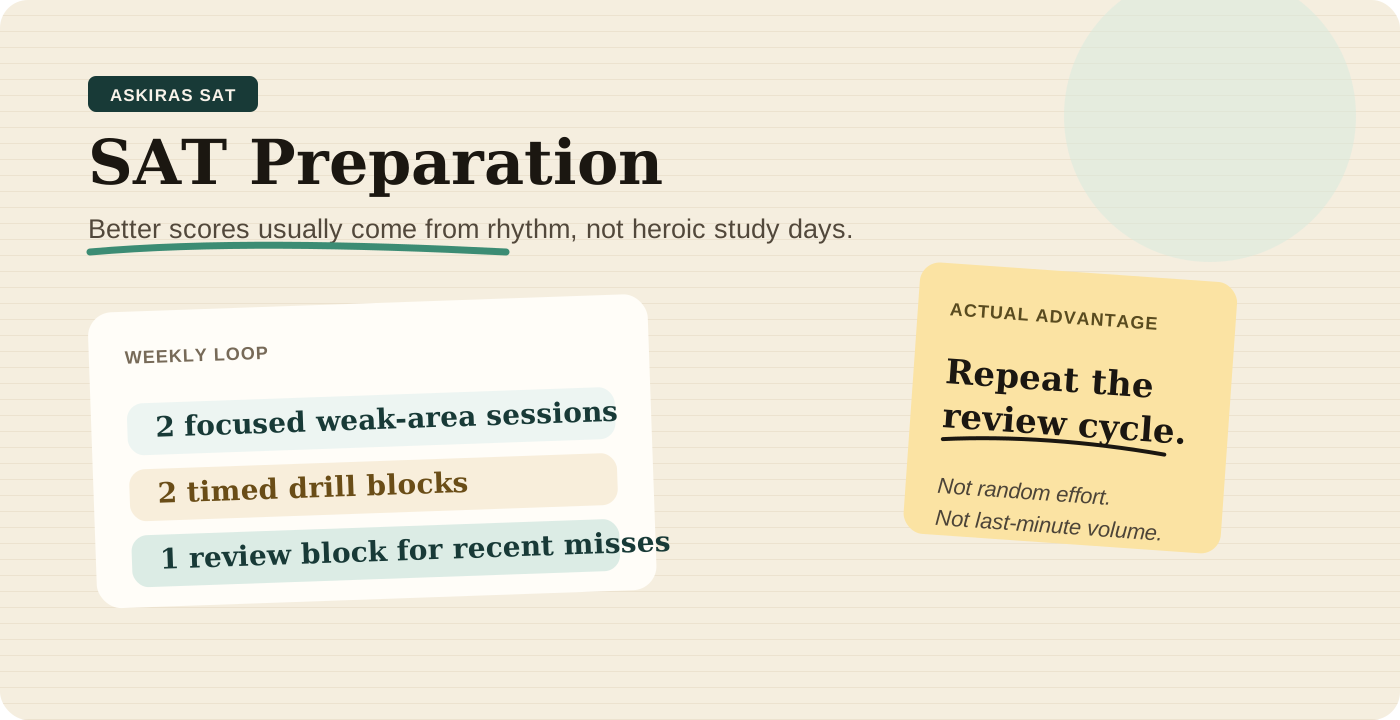
- 2 focused sessions on your weakest domain
- 2 short timed modules or drill sets
- 1 review block for recent misses
- 1 full practice test every 2 to 3 weeks
That is enough to build momentum without turning SAT prep into a second full-time job.
Domain-Specific Tips
Math: Algebra & Advanced Math (70% of Math section)
Highest-impact skills to practice:
- Solving systems of equations (3-4 questions per test)
- Interpreting equations in context (2-3 questions)
- Quadratic forms: standard, vertex, factored (2-3 questions)
- Function notation and transformations (2-3 questions)
Calculator strategy: The digital SAT allows a calculator (including Desmos) on all math questions. Use it for:
- Graphing to verify answers
- Systems of equations (graph both, find intersection)
- Checking your algebra by plugging in values
Don’t use it for: Simple arithmetic where mental math is faster. Reaching for the calculator on 3 × 7 wastes time.
Reading & Writing: Information & Ideas (26% of R&W)
Highest-impact skills:
- Identifying the main idea vs. supporting details
- Making inferences supported by specific text evidence
- Vocabulary in context (not definitions — meanings in specific sentences)
Passage strategy:
- Read the passage FIRST, then the question (don’t skim)
- Digital SAT passages are shorter (1-2 paragraphs) — you have time to read carefully
- Note the author’s tone and purpose as you read
Reading & Writing: Standard English Conventions (26% of R&W)
The grammar rules to check first:
- Subject-verb agreement (the subject, not the nearest noun, determines the verb)
- Comma rules (FANBOYS, introductory phrases, non-essential clauses)
- Semicolons connect two complete sentences
- Pronoun agreement and clarity (singular antecedent = singular pronoun)
- Parallel structure (items in a list use the same grammatical form)
Quick check method: Read the sentence out loud (in your head). If it sounds wrong, it probably is. Then identify the specific rule being tested.
Common Mistakes to Avoid
1. The Familiarity Trap
“I’ve seen this type of question before, so I know how to do it.” Overconfidence from familiarity leads to careless errors. Treat every question as new.
2. The Sunk Cost Trap
Spending 4 minutes on a hard question because you’ve already invested 2 minutes. If you’re stuck after 90 seconds on R&W or 2 minutes on math, flag it and move on.
3. The Second-Guessing Trap
Changing your answer without a clear reason. Only change if you find a specific error in your reasoning: a sentence boundary you missed, a word in the question stem, or a line in the passage that rules out your first choice.
4. The Difficulty Illusion
The digital SAT doesn’t order questions by difficulty within a module. Easy and hard questions are mixed. Don’t assume a question is hard just because it’s near the end.
5. The Practice Test Obsession
Taking 15 practice tests without reviewing your mistakes. Two tests with thorough review beats ten tests with no review.
What improvement depends on
Askiras does not publish audited student-outcome ranges yet, so this guide should not promise a point increase.
The direction is still practical:
- lower starting scores often have more basic skill gaps to repair
- higher scores usually need narrower timing and trap-choice cleanup
- repeated miss patterns are more useful than vague weak-area labels
- two reviewed practice sections usually teach more than five unreviewed ones
If you want a realistic next step, use your latest practice section to identify the two miss types that repeated. Fix those before adding more random volume.
Frequently asked questions
How many full SAT practice tests should I take?
Usually 4 to 6 before test day is enough if you review them carefully. More tests without good review usually adds less value.
How much should I study each week?
For most students, 30 to 45 focused minutes on most days beats one long weekend cram session.
What SAT prep habit should I fix first?
Fix repeated error patterns first. Targeted review and timed repetition are more useful than doing random sets without naming the miss.
Keep going in this exam
Other guides at Askiras
If you are also prepping another exam, these short guides cover the same "name the pattern, then practice" habit.