LSAT Main Point Questions: Find the Author's Point Fast
Main point questions get easier when you track the author's point, separate setup from conclusion, and ignore answer choices that repeat supporting details.
Read it to name the pattern, then practice while it is still fresh.
Prepared by Askiras editorial team. These guides stay short on purpose: one pattern, one worked example, one clear next step into practice. How we build guides.
Uses public LSAT question-type strategy context; does not reproduce protected LSAC questions.
LSAC LSAT context, Askiras independence, and no unsupported outcome claims.
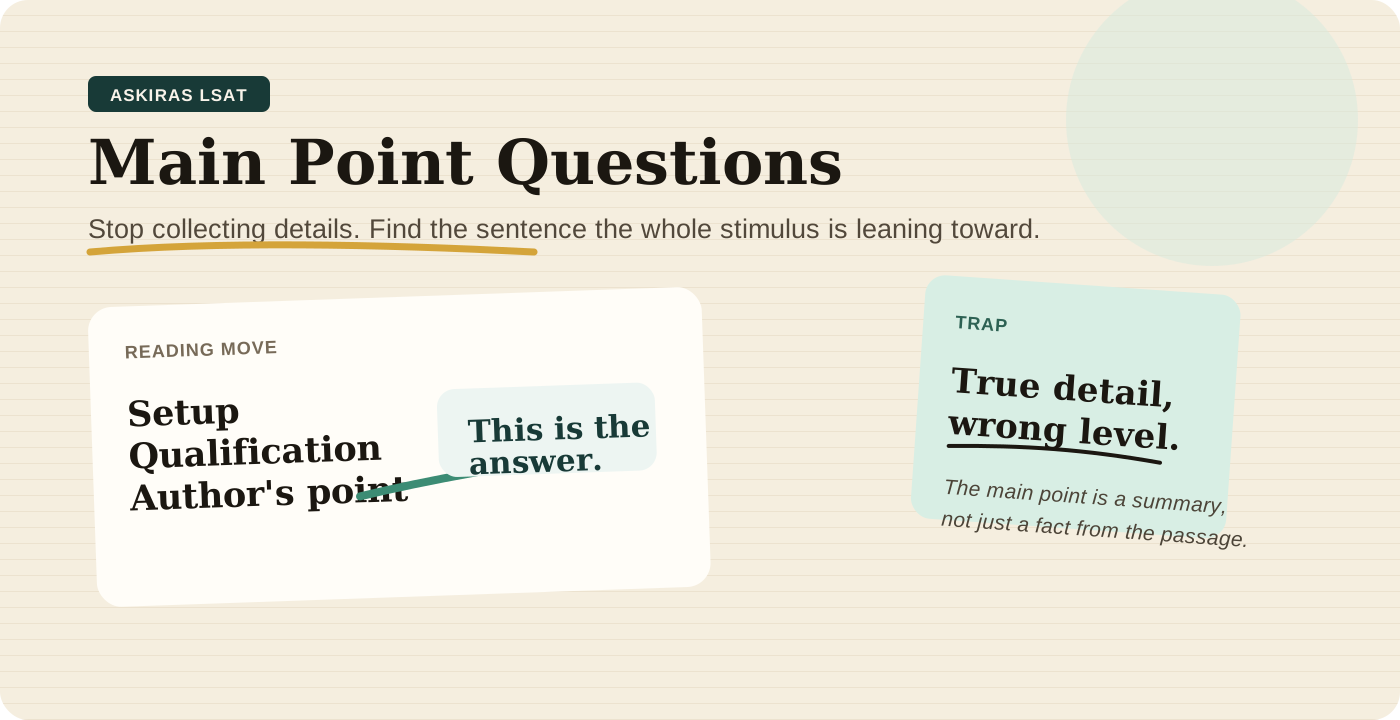
Main point questions are mostly reading discipline
These questions look simple until the answer choices start blending together. The trick is that the LSAT rarely asks for a detail. It asks for the point the author is actually making.
That means you need to read for structure, not just topic.
If a stimulus mentions several facts, the question is usually not, “What fact was mentioned?” It is, “What was the author trying to say with those facts?”
Start with a real example
A researcher notes that people often blame social media for shorter attention spans. But studies on focus suggest that the bigger issue may be constant task-switching across devices, not social media alone. The researcher concludes that discussions of attention problems should focus less on a single app and more on broader digital habits.
What is the main point?
Not:
- social media is harmless
- task-switching is the only cause of attention problems
- studies on focus are complicated
The point is:
- attention problems should be discussed in terms of broader digital habits, not just one app
That is the level you want: central, specific, and complete.
How main point questions differ from inference questions
This is where students get sloppy.
An inference question asks what is most strongly supported. A main point question asks what the author is mainly saying.
That means the main point answer can be a little broader than a single line of text, but it should still stay close to the author’s emphasis.
The right answer usually:
- captures the central claim
- ignores side examples
- avoids exaggeration
- sounds like a summary, not a new argument
A simple method
1. Find the topic
What is this passage about?
2. Find the pivot
Where does the author move from setup to argument?
3. Find the repeated emphasis
What idea keeps showing up in different wording?
4. State the point in your own words
If you cannot say it in one sentence, you probably do not have it yet.
Do not worry if your sentence is plain. Plain is good. Plain is often right.
A second example with a more typical LSAT structure
Some critics argue that city bike lanes waste space because many residents do not use bikes. The passage responds that bike lanes can still matter because they change how a whole street functions, improve safety, and support transportation options beyond daily cyclists.
What is the point?
The passage is not mainly about bike lane paint, traffic engineering, or the number of cyclists in a given city.
The point is:
- bike lanes should be judged by their broader effect on street function and transportation options, not only by how many people ride bikes every day
That is a main point answer.
Common wrong-answer patterns
Detail trap
An answer repeats one sentence from the stimulus and ignores the larger message.
If the passage mentions safety, that does not mean “safety” is the main point.
Half-right trap
An answer gets the topic right but leaves out the author’s actual claim.
That is one of the most common misses on this family.
Scope trap
An answer goes farther than the passage does.
If the author says “broader digital habits matter,” the answer should not jump to “social media is not a problem at all.”
Tone trap
Some answers preserve the content but miss the author’s stance.
If the passage is cautious, a confident answer is probably too strong.
What to do when two choices both look close
Check these three things:
Which one covers the whole passage?
The main point should account for the important parts, not just the first paragraph.
Which one is more specific to the author’s actual claim?
Generic summaries are often tempting and wrong.
Which one avoids extra claims?
If a choice adds a stronger position than the stimulus supports, cut it.
This is why main point questions often come down to restraint. The right answer usually feels a little less flashy than the tempting one.
Why these questions are easier than they feel
The stimulus is giving you the answer in pieces.
Your job is not to invent a clever interpretation. Your job is to compress the passage accurately.
That is good news, because compression is trainable.
The more you practice summarizing the author’s point in one sentence, the faster you will spot the answer that matches it.
The review habit that helps most
When you miss one, write:
- topic
- pivot
- main point
If your third line is too broad, too narrow, or too detailed, that is the error.
For example:
- Topic: bike lanes
- Pivot: critics vs response
- Main point: judge bike lanes by their broader street-level effects, not just daily rider count
That kind of review turns a vague miss into a clear pattern.
A practical drill plan
Do a short set the right way:
- take 8 main point questions
- after each stimulus, say the main point out loud before looking at the choices
- underline the sentence that carries the author’s central claim
- for every miss, write why the chosen answer was too narrow, too broad, or too detail-heavy
Repeat the same question family two days later. If your summary gets cleaner, the choices will get easier.
The final test
Before you click an answer, ask:
- Does this sound like the author’s point, or just one fact?
- Does it fit the whole stimulus?
- Would I be comfortable using this as a one-sentence summary?
If the answer is yes, you are probably in the right neighborhood.
Main point questions reward the student who stays disciplined long enough to see the actual structure.
Frequently asked questions
Is the main point the same as the conclusion?
Usually yes, but not always. The main point is the passage's central claim, while some stimuli include smaller subclaims or examples around it.
What is the biggest trap on main point questions?
Picking a choice that mentions a true detail but misses the author's actual point.
Should I read the answer choices first on main point questions?
No. Read the stimulus first, track the author's point in your own words, then use the choices to confirm it.
Keep going in this exam
Other guides at Askiras
If you are also prepping another exam, these short guides cover the same "name the pattern, then practice" habit.