Digital SAT format: scoring, modules, and timing
Digital SAT format explained in 98 questions: scoring, adaptive module routing, built-in Desmos, and the starter moves that matter first.
Read it to name the pattern, then practice while it is still fresh.
Prepared by Askiras editorial team. These guides stay short on purpose: one pattern, one worked example, one clear next step into practice. How we build guides.
Uses public Digital SAT format and practice-strategy context; does not reproduce protected College Board questions.
College Board Digital SAT context, Askiras independence, and no unsupported outcome claims.
What is the Digital SAT format?
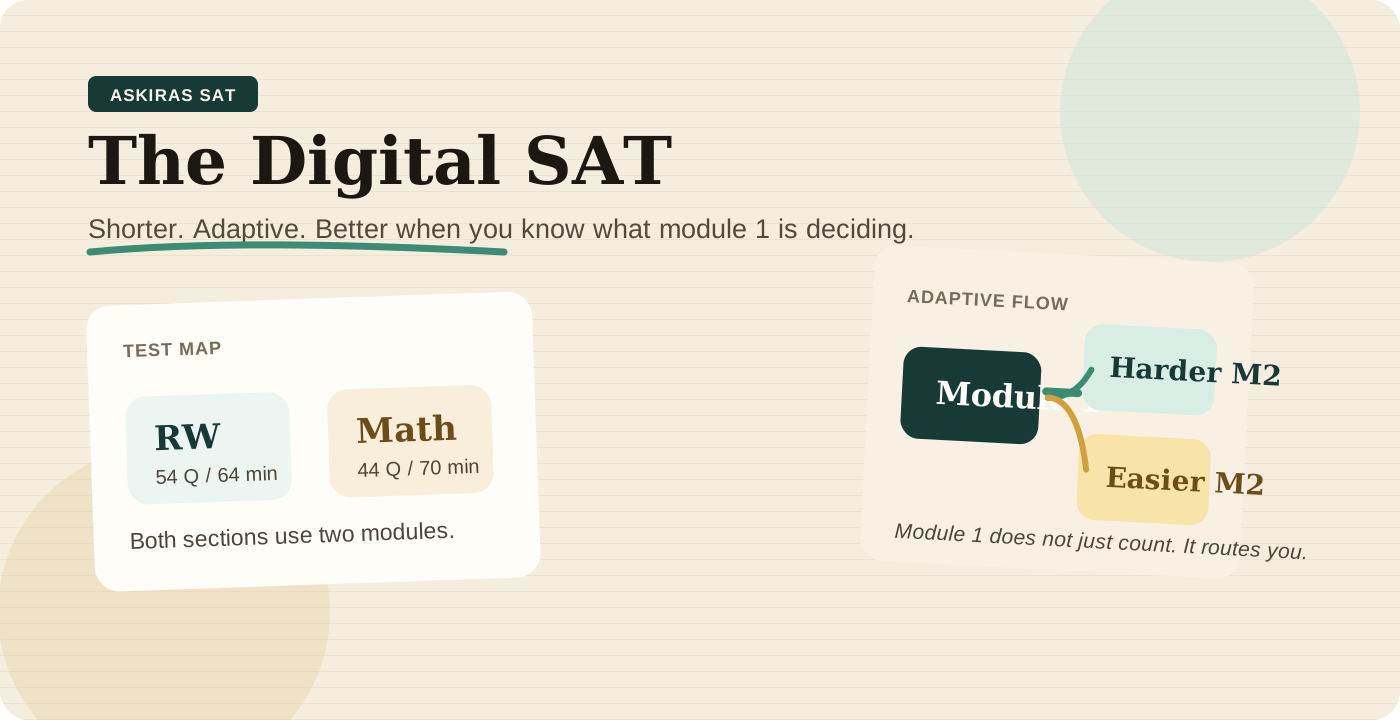
The Digital SAT is a shorter adaptive test in Bluebook with two Reading and Writing modules and two Math modules. Module 1 performance helps route the second module, so early accuracy, pacing, and fast pattern recognition matter more than old paper-test volume.
If you have not looked at the SAT in a while, start here
The biggest current fact is simple: the SAT is now a shorter, fully digital, adaptive test delivered in the Bluebook app.
That changes how students should prepare. The old mental model of a long paper test with one fixed difficulty curve is gone. The new version rewards clean early accuracy, faster pattern recognition, and calmer pacing.
The SAT is still split into two sections:
- Reading and Writing (RW) — 54 questions, 64 minutes
- Math — 44 questions, 70 minutes
Total: 98 questions in 2 hours 14 minutes. Scores range from 400 to 1600 (200-800 per section).
How the Digital SAT Works
Adaptive Testing
The Digital SAT uses a multistage adaptive format. Each section has two modules:
- Module 1 (medium difficulty) — Your performance here determines Module 2.
- Module 2 (harder or easier) — Routed based on Module 1 results.
If you do well in Module 1, you get a harder Module 2 with access to higher scores. If you struggle, Module 2 is easier but caps your maximum score lower.
This means Module 1 performance matters enormously — every question counts toward routing.
Section Breakdown
| Section | Module 1 | Module 2 | Total | Time |
|---|---|---|---|---|
| Reading & Writing | 27 Qs / 32 min | 27 Qs / 32 min | 54 Qs | 64 min |
| Math | 22 Qs / 35 min | 22 Qs / 35 min | 44 Qs | 70 min |
Time Per Question
- R&W: ~71 seconds per question
- Math: ~95 seconds per question
These averages hide important variation. Easy questions should take 30-45 seconds, freeing time for hard ones that may need 2-3 minutes.
What changed when the SAT went digital
If you last saw the SAT in paper form, three changes matter most:
- the whole test is shorter
- each section routes you after module 1
- math allows calculator use throughout
A simple routing example:
- Student A performs strongly in Math module 1 and is sent to the harder module 2.
- Student B misses more early questions and is routed to the easier module 2.
- Both students can still score well, but Student A keeps access to a higher score ceiling.
That is the practical takeaway: module 1 does not just count. It also shapes the difficulty of what comes next.
What the SAT Actually Tests
Reading & Writing Domains
Information and Ideas (26%) Reading comprehension at its core. Can you understand what a passage says, draw reasonable inferences, and identify supporting evidence? Passages come from literature, science, social science, and history.
Craft and Structure (28%) Beyond what a passage says — how and why. Vocabulary in context, understanding an author’s purpose, analyzing text structure, and comparing perspectives across texts.
Expression of Ideas (20%) Revision and editing skills. Choosing effective transitions, combining sentences, and improving the clarity and flow of written text.
Standard English Conventions (26%) Grammar, punctuation, and usage. Subject-verb agreement, pronoun clarity, comma rules, semicolons, sentence structure (fragments, run-ons), and parallel construction.
Across those four R&W domains, the SAT keeps reusing the same seven question shapes — see SAT Reading and Writing: 7 question patterns for the recurring asks and the moves that handle each.
Math Domains
Algebra (35%) Linear equations and inequalities, systems of equations, functions and their graphs, interpretation of equations in context. This is the heaviest-weighted domain.
Advanced Math (35%) Quadratic and polynomial functions, exponential and radical expressions, rational expressions, and complex numbers. Equally weighted with algebra.
Problem Solving and Data Analysis (15%) Ratios, percentages, proportional reasoning, probability, statistics (mean, median, standard deviation), margin of error, and data interpretation from tables and graphs.
Geometry and Trigonometry (15%) Area, volume, circles, triangles, coordinate geometry, trigonometric ratios, and the unit circle. Lowest weight but still 6-7 questions.
Across those four domains, the SAT keeps reusing a small set of question shapes. For a tour of the recurring asks worth recognizing on sight, see the SAT math patterns that keep showing up.
Scoring
| Score Range | Percentile (approx.) | Interpretation |
|---|---|---|
| 1400-1600 | 95th-99th+ | Highly competitive (Ivy League range) |
| 1200-1390 | 75th-94th | Competitive (top state schools) |
| 1000-1190 | 40th-74th | Average to above average |
| 800-990 | 10th-39th | Below average |
The national average is approximately 1030 (2024 data). A 1200+ opens doors to most schools; 1400+ is competitive at elite institutions.
Superscoring
Most colleges “superscore” — they take your highest Reading & Writing score and highest Math score across all test dates. This means you should take the SAT more than once and focus on improving your weaker section.
Digital SAT vs. ACT
| Feature | Digital SAT | ACT |
|---|---|---|
| Duration | 2h 14min | 2h 55min (+ 40min essay) |
| Sections | 2 (RW + Math) | 4 (English, Math, Reading, Science) |
| Adaptive | Yes (2-stage) | No |
| Calculator | All math | Some sections |
| Science | No dedicated section | Yes |
| Scoring | 400-1600 | 1-36 (composite) |
Which to take? If you’re strong at science and fast reading, the ACT may favor you. If you prefer adaptive testing and shorter passages, the Digital SAT is a better fit. Most students should try both with a practice test.
Preparation Strategy
Timeline
- 6+ months out: Diagnostic test, identify weak areas
- 3-6 months: Focused skill building in weak domains
- 1-3 months: Timed practice tests, review mistakes
- Final weeks: Light review, test logistics, rest
What Actually Works
- Adaptive drilling — Focus on your weakest skills, not random practice
- Mistake review — Every wrong answer is a learning opportunity. Understand why you got it wrong.
- Timed practice — Build pace awareness, especially in module 1
- Spaced repetition — Turn missed questions into review cards and revisit them at increasing intervals
- Official practice tests — Take 2-3 full-length tests under real conditions
What Doesn’t Work
- Memorizing vocabulary lists (the SAT tests words in context now)
- Cramming the night before
- Doing thousands of questions without reviewing mistakes
- Ignoring time management
If you want one rule to remember, make it this: the Digital SAT rewards targeted repetition more than generic effort.
Frequently asked questions
Does module 1 matter more than module 2 on the Digital SAT?
Both modules count, but module 1 has extra practical importance because it determines whether you see the harder or easier second module.
Should I take the SAT more than once?
Usually yes. Superscoring means many students benefit from multiple attempts, especially if one section is clearly lagging.
Is the Digital SAT easier because it is shorter?
It is shorter and cleaner, but not automatically easier. The adaptive format makes early accuracy more important.
Keep going in this exam
Other guides at Askiras
If you are also prepping another exam, these short guides cover the same "name the pattern, then practice" habit.