LSAT Weaken Questions: 4 Ways to Attack the Gap
LSAT weaken questions get easier when you find the gap first. Learn 4 ways to attack an argument and avoid common trap answers.
Read it to name the pattern, then practice while it is still fresh.
Prepared by Askiras editorial team. These guides stay short on purpose: one pattern, one worked example, one clear next step into practice. How we build guides.
Uses public LSAT question-type strategy context; does not reproduce protected LSAC questions.
LSAC LSAT context, Askiras independence, and no unsupported outcome claims.
How do you answer LSAT weaken questions?
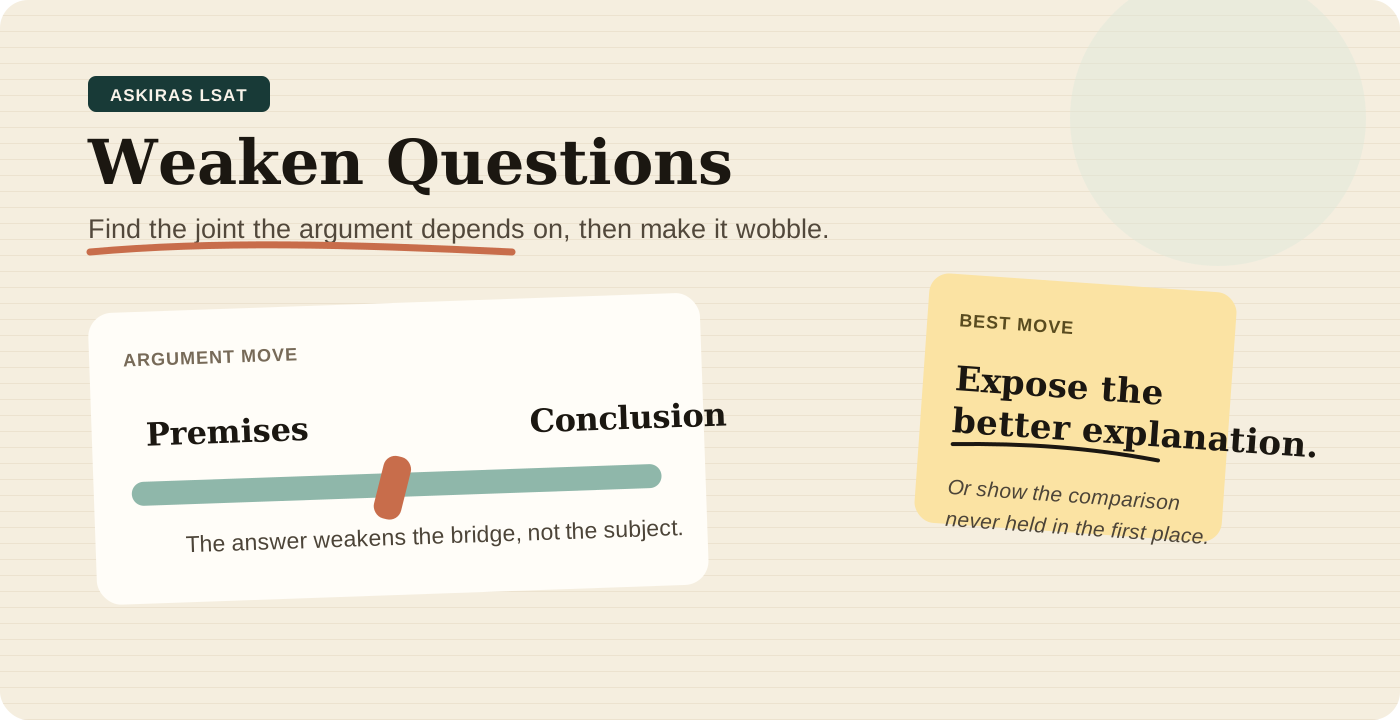
For LSAT weaken questions, identify the conclusion, the support, and the hidden gap between them. The right answer does not need to destroy the argument; it only needs to make the conclusion less supported than it was.
What an LSAT weaken question is
LSAT weaken questions appear in the Logical Reasoning section. They give you a short argument and ask which answer choice, if true, would most undermine it. Variations of the prompt include:
- “Which one of the following, if true, most weakens the argument?”
- “Which one of the following, if true, most seriously calls into question the conclusion?”
- “Each of the following, if true, weakens the argument EXCEPT…”
If the question stem asks you to attack the conclusion, it is a weaken question. That is the only family on Logical Reasoning where the right answer is supposed to make the argument worse.
Weaken questions are easier when you stop trying to “attack” everything
A weaken question is not asking for a random criticism. It is asking for the piece of information that makes the conclusion less believable.
That distinction matters. Many wrong answers are negative in tone but useless in function. They complain about the topic, nitpick a detail, or introduce a new issue. The credited answer does something narrower: it hits the argument where it needs support.
If you can say what the argument is trying to prove, what evidence it uses, and what hidden step connects the two, weaken questions stop feeling slippery.
Fast example first
A school district argues that its new after-school tutoring program improved math performance because students who attended tutoring scored higher on the next quiz than students who did not.
What is the argument doing?
- Conclusion: the tutoring program improved math performance
- Support: tutoring attendees scored higher than non-attendees
What is the gap?
- Maybe the tutoring students were already stronger
- Maybe the students who signed up were more motivated
- Maybe the quiz was easier for one group
- Maybe something else changed at the same time
A good weaken answer does not need to prove the whole argument false. It just needs to make one of those alternatives more plausible.
For example:
- the tutoring students were placed in the program because they had already shown higher math ability
That weakens the conclusion because it gives a cleaner explanation for the score difference.
What a weaken answer actually has to do
The right answer usually does one of four jobs:
1. Offer an alternative explanation
The result happened for some other reason.
2. Break the causal chain
The thing the argument thinks caused the result did not really do it.
3. Undercut a comparison
The groups, situations, or time periods were not comparable.
4. Limit the scope
The conclusion goes too far beyond what the evidence supports.
You do not need to memorize those labels. You just need to notice the move the answer is making.
Step-by-step: how to solve a weaken question
Use this sequence every time:
1. Find the conclusion
What is the author trying to convince me of?
2. Find the support
What facts are they using?
3. Find the weak joint
What has to be true for that support to reach the conclusion?
4. Predict the kind of damage that would hurt most
If the argument is causal, a better cause hurts. If it is comparative, a bad comparison hurts. If it is a sampling argument, a bad sample hurts.
That prediction does not need to be elegant. It just needs to be useful.
A second worked example
A restaurant owner claims that adding more vegan items to the menu increased total lunch traffic because orders went up after the new items were added.
The reasoning looks simple, but it hides a trap.
The owner is assuming the menu change caused the traffic increase. But maybe the lunch rush grew because:
- a nearby office reopened
- the weather improved
- a local review site featured the restaurant
- another competitor closed
A strong weaken answer might say:
- a new office building opened across the street during the same week the menu changed
That matters because it gives a separate reason lunch traffic might have increased.
Notice what the answer is not doing. It is not arguing that vegan items are bad. It is not debating restaurant strategy. It is just showing that the conclusion is too confident.
Common wrong-answer traps on weaken questions
Topic match without logical impact
An answer can mention the same subject and still do nothing.
If the stimulus is about tutoring, an answer about school budgets may sound relevant and still miss the point entirely.
Weakening the premise instead of the conclusion
Some answers make a premise less impressive but leave the argument standing.
That is not enough. You want to damage the bridge, not just scratch the plank.
Overly dramatic language
If an answer says the conclusion is “completely impossible” or the evidence is “worthless,” slow down.
LSAT weakens are often subtle. Big language is usually a trap.
A real-world fact that is not tied to the stimulus
True in life is not the same as useful here.
The answer has to connect to the argument you actually read.
The best review habit
After every missed weaken question, write one sentence:
- What was the argument assuming?
- What new fact would have made that assumption less safe?
If you can answer that cleanly, the next question in the family gets easier.
If you cannot, you probably reviewed the answer choices but not the logic.
A short drill plan that works
Do this for one week:
- complete 10 weaken questions in a row
- before looking at the choices, write the gap in one plain sentence
- mark the answer type after each miss: alternative cause, bad comparison, scope issue, or other
- redo the same set 48 hours later and check whether your prephrase got sharper
That kind of narrow repetition matters more than doing a huge mixed set once.
The quick test for the right answer
When you are torn between two choices, ask:
- Which one makes the conclusion less believable?
- Which one attacks the exact reasoning move instead of the topic?
- Which one would an author of this argument care about?
The right answer usually wins on all three.
Weakening is not about being clever. It is about being precise.
Frequently asked questions
What is the biggest mistake on weaken questions?
Picking an answer that sounds critical but misses the actual gap in the reasoning. The best weaken answer attacks the support-to-conclusion move.
Do weaken answers have to destroy the argument?
No. They only need to make the conclusion less believable than the other choices do.
Why do some weaken answers look like irrelevant side facts?
Because the LSAT often weakens by exposing an overlooked alternative explanation, a bad comparison, or a missing condition. That can look indirect, but it should still hit the argument's core move.
Keep going in this exam
Other guides at Askiras
If you are also prepping another exam, these short guides cover the same "name the pattern, then practice" habit.