AP CSA Multiple Choice: The Patterns That Keep Showing Up
AP CSA multiple choice stops feeling random when you sort it into repeatable patterns: tracing, loop bounds, data-structure moves, and method behavior.
Read it to name the pattern, then practice while it is still fresh.
Prepared by Askiras editorial team. These guides stay short on purpose: one pattern, one worked example, one clear next step into practice. How we build guides.
Uses public AP course and exam context; does not reproduce protected College Board prompts.
College Board AP context, Askiras independence, and no unsupported outcome claims.
AP CSA multiple choice gets easier when every problem stops feeling brand new
The names change. The variables change. The story around the code changes.
The patterns do not change that much.
That is the shift that makes AP CSA multiple choice feel less random. Instead of reading every question from zero, start asking:
- Which pattern is this?
- What usually goes wrong here?
- What value or state do I need to track?
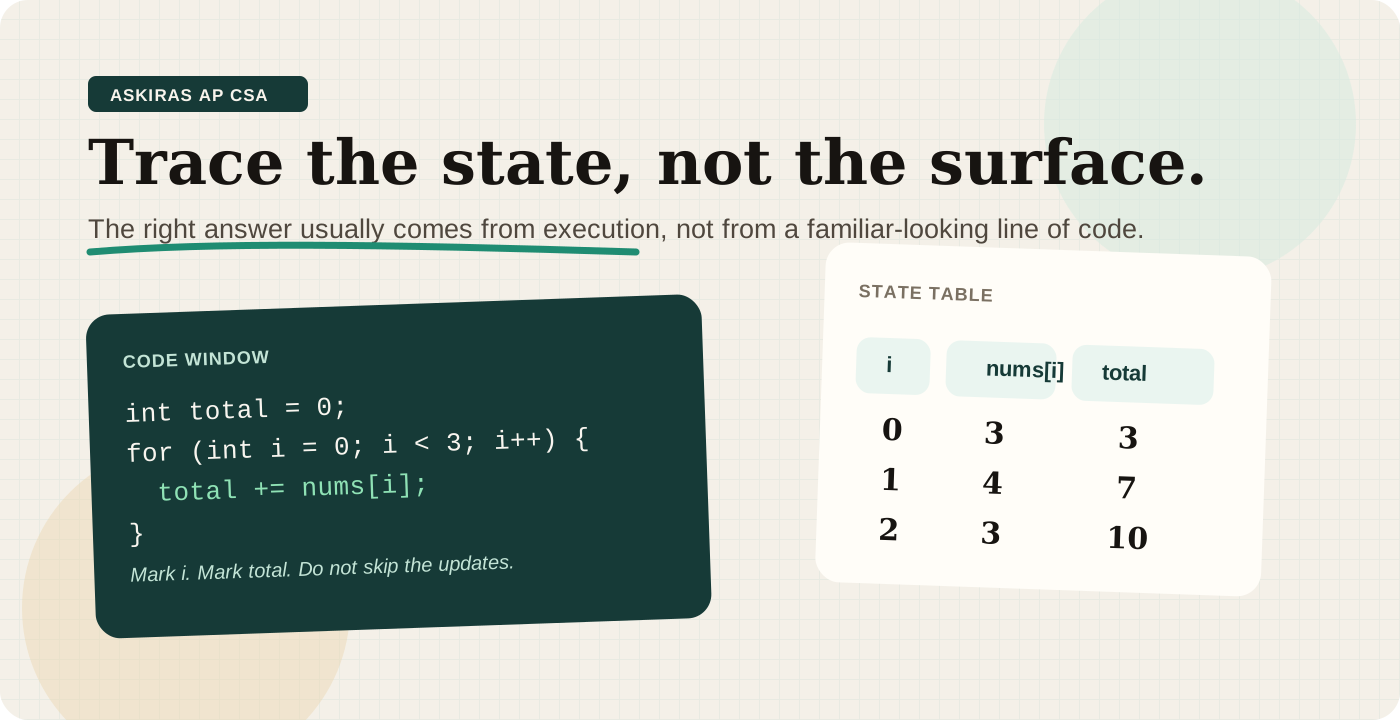
Start with a state table, not a guess
Look at this:
int sum = 0;
for (int i = 0; i < 4; i++) {
    sum += i;
}
System.out.println(sum);
If you guess from memory, you may think “probably 10.” If you trace it, you get:
- start:
sum = 0 i = 0->sum = 0i = 1->sum = 1i = 2->sum = 3i = 3->sum = 6
Then the loop stops.
That is the AP CSA habit in one small example: track the code that actually runs.
Pattern 1: Output tracing
The question gives you code and asks what it prints, returns, or stores.
Your job is to track:
- current variable values
- loop passes
- branch choices
- method output
The trap is reading the code like a summary instead of an execution.
What helps
- write down changing values
- mark when the condition is checked
- notice whether output happens before or after an update
Common miss
Students know the broad idea but miss the exact order.
That is how 024 turns into 0246, or a sum of 6 turns into 10.
Pattern 2: Loop bounds and off-by-one errors
This is one of the biggest AP CSA buckets.
You keep seeing variations of:
i < ni <= n- start at
0 - start at
1 - last valid index versus number of elements
Small example:
for (int i = 0; i < word.length(); i++) {
    System.out.println(word.charAt(i));
}
This is safe because the last valid index is word.length() - 1, and the loop stops before i reaches word.length().
If that < becomes <=, the last pass tries to access one index too far.
Common miss
Students remember the idea of the loop and stop checking the actual condition. But AP CSA loves the exact boundary.
Pattern 3: Return value versus side effect
This is where students often know what a method does in English but not what it does in code.
Ask:
- Does the method return a value?
- Does it change an object or collection?
- Does it do both?
For example:
list.size()returns a numberlist.add(x)changes the listlist.set(i, x)changes the list and returns the old element
If you blur those together, multiple-choice questions get messy fast.
Common miss
Picking the answer that describes the right idea but the wrong mechanism. For example:
- thinking
add(index, value)replaces instead of inserts - thinking a method prints something when it actually returns it
Pattern 4: Branch logic and Boolean order
AP CSA loves code that looks simple until you slow down.
Students miss points here when they do not track:
- which condition is tested first
- whether later branches can still run
- whether the condition is inclusive or exclusive
Example mindset:
if (score >= 90) {
    grade = "A";
} else if (score >= 80) {
    grade = "B";
}
The order matters. Once the first condition is true, the second never runs.
Common miss
Reading the branches like separate facts instead of one control-flow chain.
Pattern 5: Arrays and ArrayList traversal
This is one of the heaviest current exam areas.
You need to keep straight:
- arrays use
length ArrayListusessize()- arrays use brackets like
arr[i] ArrayListuses methods likelist.get(i)
You also need to watch mutation.
Example:
list.remove(1);That removes the item at index 1, and everything after it shifts down.
That shift is the whole question sometimes.
Common miss
Students track the removed value but forget the index movement after the removal.
Pattern 6: Removing while iterating
This deserves its own category because it causes so many avoidable misses.
If you move forward through an ArrayList and remove an item, the next element slides into the current index.
Then the loop increments, and you accidentally skip it.
That is why backward loops show up so often in collection questions.
Practical rule
If the code removes from an ArrayList, slow down immediately.
Ask:
- Is the loop going forward or backward?
- What happens to the indexes after a removal?
- Could the next item get skipped?
Pattern 7: 2D array row and column logic
The current AP CSA framework puts a lot of weight on data collections, and 2D arrays are part of that. The same row/column traps also drive most of FRQ 4, which is broken down in AP CSA FRQ 3 and 4: ArrayList and 2D array strategy.
Most 2D array misses are not “advanced.” They come from mixing up:
- number of rows:
grid.length - number of columns:
grid[0].length - row-major order
- column-based traversal
Small example:
for (int r = 0; r < grid.length; r++) {
    for (int c = 0; c < grid[r].length; c++) {
        total += grid[r][c];
    }
}
This is row-major. The outer loop picks the row. The inner loop moves across the columns.
Common miss
Using grid.length as if it were both dimensions.
That only works by accident on square grids.
Pattern 8: The AP Java Quick Reference pattern
Some multiple-choice questions are really asking whether you know what the allowed methods do.
That means being comfortable with things like:
String.substringString.indexOfArrayList.addArrayList.removeArrayList.set
The exam does not reward memorizing every library detail. It does reward not freezing when a standard method appears.
Common miss
Students see a familiar method name, assume they know it, and skip the exact behavior.
Do not do that.
add, set, and remove are not interchangeable.
If those execution mistakes are familiar, the broader fix is rebalancing study time toward tracing and short FRQ reps; the AP CSA study strategy guide lays out a weekly version of that.
A practical protocol for AP CSA multiple choice
When a question looks noisy, do this:
- identify the pattern
- mark the variables that change
- trace only the lines that matter
- check the last valid index or final loop pass
- answer from the execution, not from intuition
That protocol is boring. That is why it works.
What to review after a bad multiple-choice set
Do not review by saying:
- “I need to be more careful.”
That is too fuzzy.
Review like this:
- I lost track of the last loop pass.
- I confused
lengthandsize(). - I forgot
removeshifts the remaining elements. - I mixed up row count and column count.
- I treated a return-value question like a side-effect question.
Those are real categories. And real categories are fixable.
Frequently asked questions
What is the most common AP CSA multiple-choice mistake?
Students often stop tracing too early. They understand the idea of the code, but they do not track the exact variable values, loop bounds, or state changes all the way to the end.
Should I hand-trace AP CSA code on scratch paper?
Yes, at least during practice. A tiny state table for variables, indexes, or accumulators is often the difference between a calm answer and a guess.
Do AP CSA multiple-choice questions mostly test weird syntax tricks?
Not usually. Most of the section is built on normal Java patterns: loops, conditions, methods, arrays, ArrayLists, and 2D arrays. The pressure comes from execution, not from obscure syntax.
Keep going in this exam
Other guides at Askiras
If you are also prepping another exam, these short guides cover the same "name the pattern, then practice" habit.