How to Study AP CSA Without Getting Stuck in Syntax
Most AP CSA panic leads to rereading notes. A better plan is code tracing, short writing reps, and review by pattern instead of topic.
Read it to name the pattern, then practice while it is still fresh.
Prepared by Askiras editorial team. These guides stay short on purpose: one pattern, one worked example, one clear next step into practice. How we build guides.
Uses public AP course and exam context; does not reproduce protected College Board prompts.
College Board AP context, Askiras independence, and no unsupported outcome claims.
AP CSA gets messy when your study plan becomes “look at more Java”
A lot of AP CSA stress creates the same fake plan:
- reread the notes
- skim old assignments
- watch a review video
- feel briefly better
- freeze again when the next code question appears
That cycle feels productive because it keeps you near the material. It does not do much if your tracing and writing still fall apart under pressure.
The AP CSA exam rewards students who can do three things under time:
- trace code carefully
- write small correct methods
- review misses in a way that stops them from repeating
So the plan should look less like “cover more topics” and more like “build cleaner execution.”
A quick example of the wrong study habit
Suppose you miss this:
int count = 0;
for (int i = 0; i < nums.length; i++) {
    if (nums[i] % 2 == 0) {
        count++;
    }
}
Many students review it like this:
- “Need to remember loops.”
That is too vague to help.
A better review sounds like this:
- I lost track of the loop index.
- I forgot that
i < nums.lengthstops before the first invalid index. - I should have traced the value of
countonly when the condition was true.
That tells you what skill broke.
The main rule: trace before you type
AP CSA panic often makes students want to write more code immediately. But if your tracing is messy, your writing will usually be messy too.
A better order is:
- read code
- explain code
- write code
If you can explain what each line is doing, your brain starts storing patterns instead of fragments.
Tracing is not extra. It is the base layer.
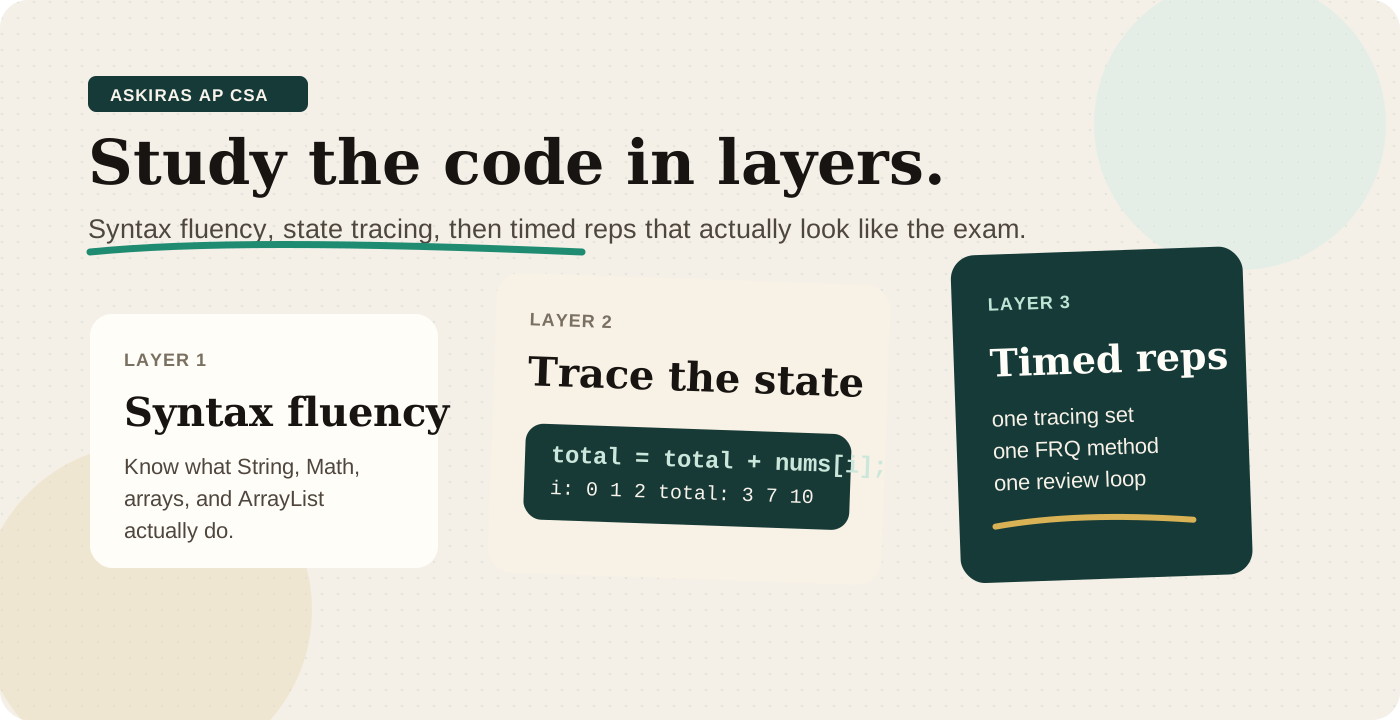
Build your AP CSA study around three layers
Layer 1: get the building blocks out of the fog
You do not need to memorize the whole Java language. You do need the recurring AP CSA pieces to feel ordinary.
That includes:
- variables and assignment
- method calls
ifstatementsforandwhileloops- arrays
ArrayList- 2D arrays
- constructors and fields
At this layer, the goal is recognition.
When you see:
list.size()arr.lengthgrid.lengthgrid[0].length
you should know what each one means without a long pause.
If basic symbols are still costing you energy, do short reps until they stop doing that.
Layer 2: train code tracing like a real skill
This is where most score movement happens.
Take short code segments and force yourself to answer:
- What are the variables before the loop?
- What changes each iteration?
- What stays fixed?
- What does the method return?
- Does this line mutate data or just read it?
Do this on paper or in a plain text note sometimes. Do not always lean on running the code.
The exam does not give you an IDE to rescue vague thinking.
Layer 3: write small exam-shaped code
Once tracing gets cleaner, start writing short methods and FRQ chunks.
Not giant projects. Not decorative side quests.
Write the kinds of things AP CSA keeps asking for:
- count something
- filter something
- update an object
- traverse an
ArrayList - compute a row or column result in a 2D array
- build a small class from a spec
This is where understanding turns into usable output.
A better weekly AP CSA plan
If you are studying consistently, a practical week can look like this.
Day 1: code tracing set
Do a short run of multiple-choice style tracing questions.
Focus on:
- output
- loop behavior
- condition order
- method effects
Do not move too fast. The whole point is to slow down enough for the pattern to show itself.
Day 2: one topic, one pattern
Pick one repeated trouble spot, like:
- off-by-one loops
ArrayList.remove- 2D array dimensions
- constructor versus method behavior
Then do 5 to 8 small problems only on that pattern.
That is much better than mixing everything together when your errors are still clustered.
Day 3: one FRQ chunk
Write one real AP-style method or class piece.
Examples:
- a method that counts or sums
- a constructor plus one method
- an
ArrayListtraversal - a 2D array row or column method
The goal is not volume. It is finishing something cleanly.
Day 4: review mistakes by mechanism
This is the day most students skip, which is why the same mistakes keep coming back.
Do not just mark answers wrong. Write the reason in plain language:
- I used
lengthwhere I neededsize(). - I removed from the front of the list and skipped the next item.
- I wrote a condition that excluded the last value.
- I returned a local variable instead of updating the field.
That one sentence makes the next practice set better.
Stop studying AP CSA as one giant bucket
Your confusion is usually clustered in a few repeatable places:
- loops
- method contracts
- mutation
- data traversal
- class state
Once you see that, your review gets sharper.
Instead of saying:
- “I am bad at AP CSA”
you can say:
- “I am mostly losing points on loop bounds and list mutation.”
That is a real study plan.
Review by pattern, not by chapter
You can absolutely use textbook chapters or class units for organization. But for score improvement, pattern review is stronger.
Useful pattern buckets include:
- output tracing
- branch logic
- return versus print
- field versus parameter
size()versuslength- forward removal in
ArrayList - row versus column in 2D arrays
If five misses land in the same bucket, that is good news. Your problem is not random.
The Java Quick Reference should feel familiar, not mysterious
You do not need to memorize every method on it by brute force. But you should know how to use the parts that show up constantly.
That includes:
StringmethodsArrayListmethods- constructor patterns
If the Quick Reference still feels like a surprise object on exam day, you waited too long.
Practice with it enough that it feels ordinary.
A simple rule for FRQ practice
Before writing code, translate the prompt.
Ask:
- What must this method return?
- What should change in the object or collection?
- What data is already provided?
- What boundary case can break the logic?
Students often lose FRQ points because they start coding before they know the job.
The prompt is the blueprint.
What to do if you are behind
If you feel behind, do not respond by trying to cover everything in one weekend.
Pick the highest-yield areas first:
- loops and conditionals
- arrays,
ArrayList, and 2D arrays - short FRQ writing
That order tracks the current exam better than spending days polishing niche syntax.
The goal is calm, not perfection
Good AP CSA prep does not make you feel like you know all of computer science. It makes the exam feel less noisy.
If you can trace code without guessing, write short methods that match the spec, and review misses honestly, the test gets much more manageable.
Frequently asked questions
Should I spend more time reading code or writing code for AP CSA?
You need both, but most students improve faster when they read and trace more carefully first. If you cannot explain what code is doing, writing under pressure usually falls apart too.
Do I need to memorize the entire Java language for AP CSA?
No. You need reliable control of the AP Java subset, the Java Quick Reference, and the recurring patterns in loops, methods, classes, arrays, ArrayLists, and 2D arrays.
What is the best way to review AP CSA mistakes?
Sort them by pattern, not by chapter. Off-by-one mistakes, wrong return values, skipped elements in ArrayList code, and row-column mix-ups are all trainable when you name them clearly.
Keep going in this exam
Other guides at Askiras
If you are also prepping another exam, these short guides cover the same "name the pattern, then practice" habit.