AP CSA Exam Guide: 2026 Format and FRQ Types
AP CSA exam guide to the 2026 digital format: 42 MCQs, four FRQ types, current unit weights, Java reference, and what to practice first.
Read it to name the pattern, then practice while it is still fresh.
Prepared by Askiras editorial team. These guides stay short on purpose: one pattern, one worked example, one clear next step into practice. How we build guides.
Uses public AP course and exam context; does not reproduce protected College Board prompts.
College Board AP context, Askiras independence, and no unsupported outcome claims.
What should you practice first for AP CSA?
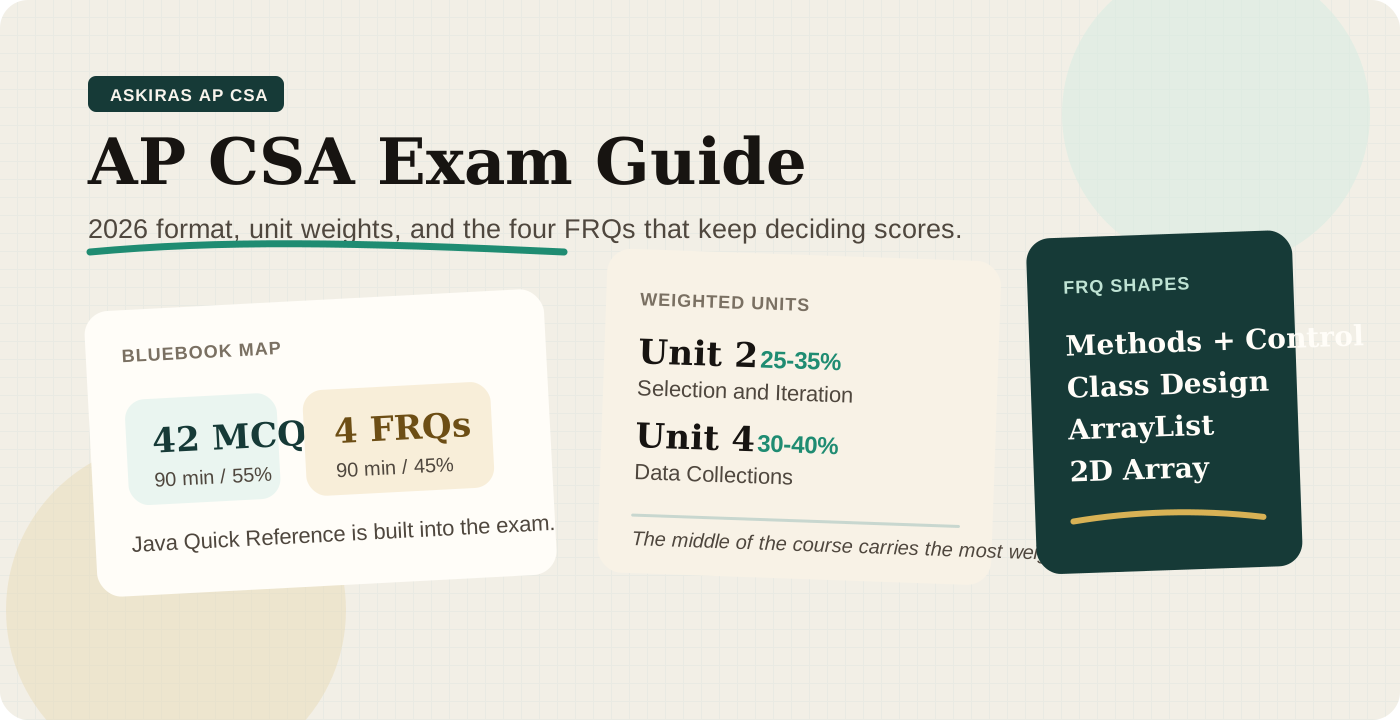
Start with tracing loops, conditionals, methods, ArrayLists, and 2D arrays before trying to write longer Java. The 2026 AP CSA exam is digital in Bluebook with 42 MCQs and four FRQs: methods/control, class design, ArrayList, and 2D array.
Quick answer: what to expect on AP CSA
The 2026 AP Computer Science A exam is a fully digital Bluebook exam with 42 multiple-choice questions and 4 free-response questions. The FRQs have four stable task families: Methods and Control Structures, Class Design, Data Analysis with ArrayList, and 2D Array. Practice should start with tracing state, loop bounds, method contracts, and collection traversal.
Source/update note: Last reviewed June 10, 2026 against College Board’s AP CSA exam page and AP CSA course page. The details below describe the May 2026 format; check College Board if you are planning for a later administration.
If AP CSA feels huge, start with the exam, not the course
AP Computer Science A can feel endless when it turns into one long stream of Java topics.
That is when students usually start doing things that feel productive but do not help much:
- rereading notes on syntax
- watching review videos instead of touching code
- treating every missed question like a random accident
The exam is not asking for all of Java. It is asking whether you can read code, trace code, and write short clean pieces of code under time.
A fast example of what AP CSA is really testing
Look at this:
int total = 0;
for (int i = 1; i <= 4; i++) {
    total += i;
}
System.out.println(total);
This is not a “hard Java” problem. It is a tracing problem.
If you can track:
- where the loop starts
- when it stops
- what changes each pass
you get the answer fast.
That is AP CSA in miniature.
The 2026 AP CSA exam format
For the May 2026 administration, College Board listed the AP Computer Science A exam as:
- fully digital in Bluebook
- Friday, May 15, 2026, at 12 PM local time
- 3 hours total
It has two sections.
Section I: Multiple Choice
- 42 questions
- 1 hour 30 minutes
- 55% of the exam score
The multiple-choice section mostly asks you to:
- predict output
- determine which code segment works
- spot a bug or bad assumption
- describe what a method or loop is doing
Section II: Free Response
- 4 questions
- 1 hour 30 minutes
- 45% of the exam score
The four FRQs have stable shapes:
- Methods and Control Structures
- Class Design
- Data Analysis with
ArrayList - 2D Array
You still do not know the exact prompt, but you usually know the kind of move you will need to make.
The course changed, and some older AP CSA advice is now stale
A lot of older AP CSA resources still talk about a 10-unit course and may spend real time on inheritance. That was the old setup.
For the current public AP CSA framework, College Board now groups the course into 4 units:
- Unit 1: Using Objects and Methods — 15% to 25%
- Unit 2: Selection and Iteration — 25% to 35%
- Unit 3: Class Creation — 10% to 18%
- Unit 4: Data Collections — 30% to 40%
The practical takeaway:
- loops and conditionals matter a lot
- arrays,
ArrayList, and 2D arrays matter a lot - class-writing still matters, but not as much as students often assume
And if your prep source is leaning hard on inheritance, it is not aligned to the current exam.
What AP CSA is really rewarding
It feels like a syntax test when you are rattled. It is really a pattern-recognition test built out of Java.
Across both sections, the exam keeps rewarding the same habits:
- trace one line at a time instead of guessing from the vibe
- pay attention to the method contract
- separate return values from side effects
- keep indexes, bounds, and loop direction under control
- use the right traversal for the data structure in front of you
If you lose control of the state, AP CSA gets noisy fast. If you can keep state organized, the exam gets much calmer.
Where practice usually pays first
Because the current public weighting is uneven, your study time should be uneven too.
Unit 2: Selection and Iteration
This is one of the heaviest parts of the course. You need to be comfortable with:
if,if-else, and chained conditionalsforandwhileloops- loop bounds
- counting, summing, filtering, and searching
- tracing conditions without skipping steps
If loops still feel slippery, do not move on politely. That is one of the main places the exam will keep charging you rent.
Unit 4: Data Collections
This is the other heavyweight. You need clean control of:
- arrays
ArrayList- 2D arrays
- traversal order
- mutation while iterating
size()versuslength
This is also central to the ArrayList and 2D-array FRQ shapes.
Unit 3: Class Creation
You still need it. You should know how to:
- choose fields
- write a constructor
- use
this - return the right type
- write short helper methods that match the spec
But if your study plan spends all week polishing class vocab while your loop tracing is shaky, the plan is upside down.
How to think about the multiple-choice section
The multiple-choice section is mostly about execution.
A good reader keeps asking:
- What are the variables right now?
- How many times does this loop really run?
- What changes after this line or method call?
The clean rule is:
Trace what the code does, not what you think it meant to do.
How to think about the FRQs
The FRQs feel harder because you have to produce code from scratch. But the shapes are predictable enough that you should know what kind of problem you are in.
Each question has a known family.
FRQ 1 and 2
These are the “read the spec closely” questions. Students lose points here by writing too early, returning the wrong thing, or blurring fields and parameters. For the specific moves that keep showing up here, see our walkthrough of AP CSA FRQ 1 and 2: methods and class design.
FRQ 3 and 4
These are the data-structure questions. Students lose points here by mutating a list carelessly or mixing up rows and columns in a grid. The clearer playbook is in AP CSA FRQ 3 and 4: ArrayList and 2D array strategy.
Pacing that actually fits the exam
Multiple choice
You have 90 minutes for 42 questions, which is a little over 2 minutes per question on average.
That is enough time if you do not keep restarting the trace.
The worst pacing habit is half-tracing, getting nervous, and restarting from the top. A better rhythm is:
- identify the task
- track the changing values
- check the answer against the actual code path
Free response
You have 90 minutes for 4 FRQs, which means roughly 22 minutes each, with some wiggle room.
Do not try to write immediately. Spend the first minute or two translating the prompt into a checklist:
- What is given?
- What must be returned or changed?
- What fields, parameters, or methods already exist?
- What edge case can break this?
That small pause usually saves more time than it costs.
If your study time is short, a structured pass through the course is usually a better use of it than rereading notes; the cleanest version of that is in how to study AP CSA without getting stuck in syntax.
If you are comparing AP exam formats, the AP Biology exam guide shows a hybrid digital/paper FRQ setup, while the AP Psychology exam guide shows another fully digital exam built around evidence and source reading.
A strong AP CSA study plan is not complicated
Each week should include:
- short code-tracing reps
- one or two focused multiple-choice sets
- at least one FRQ write-up
- mistake review by pattern
Sort misses like this:
- off-by-one
- wrong branch
- forgot to update state
- returned the wrong value
- mixed up
size()andlength - removed from a list incorrectly
- mixed up row and column
That is much more useful than writing “careless.”
What to do in the final stretch
In the last two weeks, do not try to become a different programmer. Try to become a cleaner AP CSA test taker.
Prioritize:
- tracing without an IDE
- short FRQ reps under time
- reviewing old misses until you can name the trap fast
- practicing with the Java Quick Reference so it feels familiar
You do not need to sound smart about computer science. You need to stay clear long enough to answer the available parts.
Frequently asked questions
Does AP CSA still test inheritance on the 2026 exam?
No. College Board revised AP CSA for the 2025-26 course and removed inheritance from the public exam framework. Older resources may still mention it, so check that your materials match the current exam.
Do I need perfect Java syntax to do well on AP CSA?
You do not need to write like a professional Java developer, but you do need reliable control of method headers, return values, conditionals, loops, and indexing. Most missed points come from small logic errors, not advanced syntax.
Should I spend more time on multiple choice or FRQs?
Treat them together. Multiple choice trains tracing and pattern recognition, while FRQs train clean code under pressure. A good AP CSA study week should include both.
Keep going in this exam
Other guides at Askiras
If you are also prepping another exam, these short guides cover the same "name the pattern, then practice" habit.