AP Biology Exam Guide: 2026 Format and FRQs
AP Biology exam guide to the 2026 hybrid digital format: 60 MCQs, 6 FRQs, unit weights, science practices, and what to practice first.
Read it to name the pattern, then practice while it is still fresh.
Prepared by Askiras editorial team. These guides stay short on purpose: one pattern, one worked example, one clear next step into practice. How we build guides.
Uses public AP course and exam context; does not reproduce protected College Board prompts.
College Board AP context, Askiras independence, and no unsupported outcome claims.
What should you practice first for AP Biology?
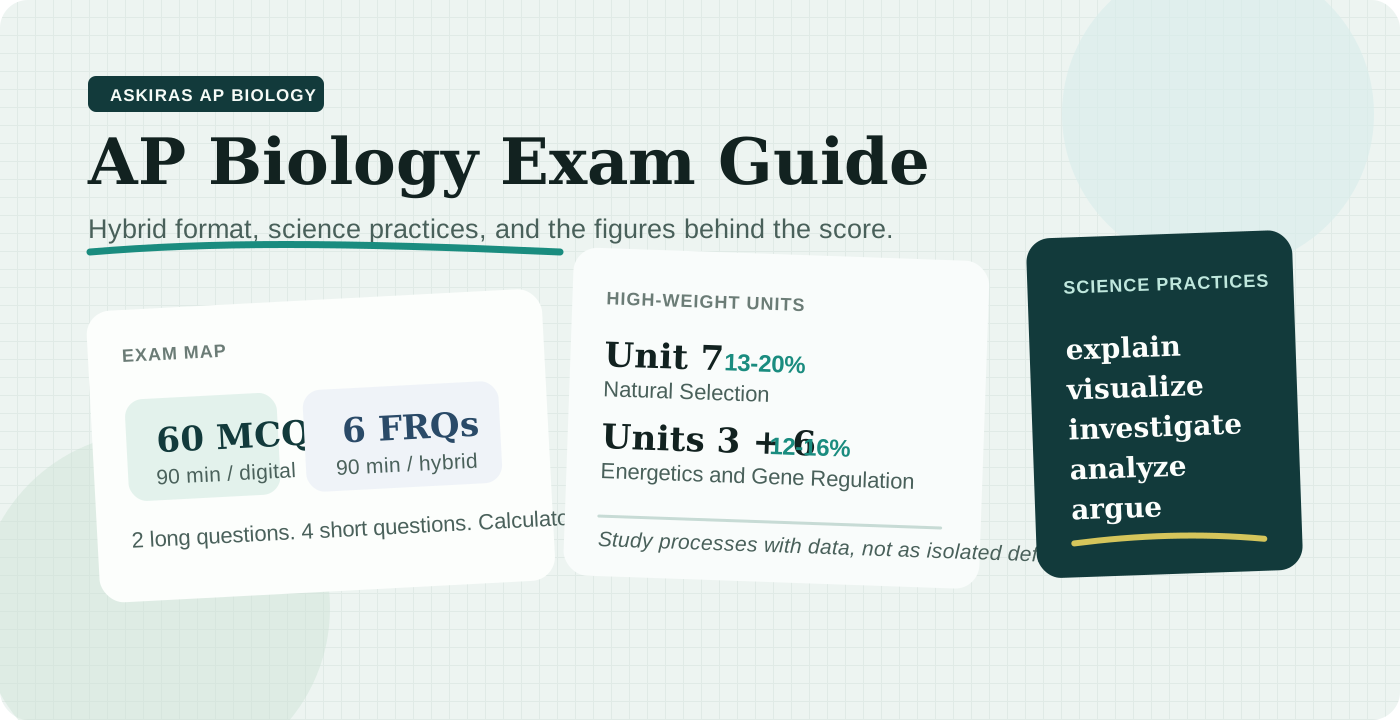
Start with graph and data interpretation, then connect each figure to the biological mechanism and FRQ command verb. The 2026 AP Biology exam has 60 MCQs and 6 FRQs in a hybrid digital format.
Quick answer: what to expect on AP Biology
The 2026 AP Biology exam is a hybrid digital exam: multiple choice is completed in Bluebook, free-response questions are viewed in Bluebook, and FRQ answers are handwritten in a paper booklet. The exam has 60 multiple-choice questions and 6 FRQs. Practice should start with graphs, experimental design, mechanism explanations, and short evidence-based writing.
Source/update note: Last reviewed June 10, 2026 against College Board’s AP Biology exam page and AP Biology course page. The details below describe the May 2026 format; check College Board if you are planning for a later administration.
AP Biology gets easier when it stops feeling like a second vocabulary class
AP Biology feels overwhelming when every chapter becomes the same job: more terms, more diagrams, more pathways, more review packets.
That is usually when students start working hard in the least useful way. They memorize definitions, underline notes, and still get stuck when a graph, model, or experiment shows up.
The exam is narrower than the course. It is not asking whether you have every fact on command at once. It is asking whether you can:
- explain a biological process clearly
- read evidence from a figure or data set
- reason through an experiment
- turn that reasoning into a short defensible answer
A fast example of what AP Biology is really testing
Imagine a graph where the rate of photosynthesis rises as light intensity increases, then levels off.
The move is not “remember everything about chloroplasts.” The move is:
- identify the pattern
- name the likely limiting factor
- explain why more light stops changing the outcome
That is AP Biology in miniature. Content matters, but answers get clearer when you can connect the content to evidence.
The 2026 AP Biology exam format
For the May 2026 administration, College Board listed the AP Biology exam as a hybrid digital exam on Monday, May 4, 2026, at 8 AM local time.
Section I
- 60 multiple-choice questions
- 90 minutes
- 50% of the exam score
This section is completed in Bluebook. Some questions are discrete. Others appear in short stimulus sets, usually with 4 to 5 questions tied to the same figure, data set, or setup.
Section II
- 6 free-response questions
- 90 minutes
- 50% of the exam score
The FRQs are viewed in Bluebook, but your answers are written in a paper response booklet. The section includes 2 long FRQs worth 9 points each and 4 short FRQs worth 4 points each.
A calculator is allowed, but AP Biology is not a math-heavy race. The calculator helps with quick arithmetic and graph-related cleanup. It does not replace scientific reasoning.
What AP Biology is really rewarding
Students often think AP Bio rewards who can memorize the most. It usually rewards who can do the following under pressure:
- explain how a process works
- interpret what a graph, table, or model actually shows
- distinguish a supported claim from a guessed claim
- describe an experiment in terms of variables, controls, and predictions
- use specific biological language without turning the answer into a glossary
The exam keeps pushing you toward evidence. If your answer sounds polished but never points to the figure, the table, or the mechanism, it usually stays thinner than it feels.
The units matter, but the science practices matter too
The official AP Biology units are not weighted equally. The heaviest multiple-choice areas are:
- Unit 3: Cellular Energetics at 12% to 16%
- Unit 6: Gene Expression and Regulation at 12% to 16%
- Unit 7: Natural Selection at 13% to 20%
Important but slightly lighter units include:
- Unit 1: Chemistry of Life at 8% to 11%
- Unit 2: Cells at 10% to 13%
- Unit 4: Cell Communication and Cell Cycle at 10% to 15%
- Unit 5: Heredity at 8% to 11%
- Unit 8: Ecology at 10% to 15%
That weighting matters. So do the science practices, because AP Biology is designed around ways of thinking, not just around content bins.
The recurring practices are:
- concept explanation
- visual representations
- questions and methods
- representing and describing data
- statistical tests and data analysis
- argumentation
This is why pure memorization stalls out. You can know the chapter and still lose points if you cannot read the graph, critique the method, or justify the claim.
How the sections feel in practice
Multiple choice
AP Bio multiple choice often gives you enough information to reason, but not enough time to wander.
A strong reader keeps asking:
- What variables am I looking at?
- What comparison actually matters?
- What biological idea explains this pattern?
- Which answer is supported by the evidence instead of sounding generally true?
Many misses happen because students jump from topic recognition to answer choice. They see “enzyme” or “DNA” or “ecosystem” and answer from memory before they read the figure closely.
Free response
The FRQs are where AP Biology stops pretending it is a vocabulary class.
The long questions often ask you to interpret results, work with a graph, or reason through an experimental setup. The short questions can ask for scientific investigation logic, conceptual analysis, model interpretation, or focused data analysis.
A good AP Bio FRQ answer is usually not long. It is specific, evidence-based, and small enough to score cleanly.
A better way to prepare
If the exam is in May and the class still feels messy, build review around three loops.
1. Learn the process, not just the term
If the topic is cellular respiration, gene regulation, osmosis, or natural selection, make sure you can narrate what is actually happening.
Not just: “I know the definition.”
But: “I can explain the direction of movement, the cause of the change, or the reason this variable affects the outcome.”
2. Pair every topic with evidence
For each unit, practice with:
- one graph
- one table
- one model or diagram
- one experimental setup
That keeps the biology tied to the form the exam uses.
3. Practice short written answers early
Do not wait until the final stretch to write FRQs. AP Biology feels much harder if your first real attempt at concise scientific writing happens two weeks before the exam.
Where to spend extra time if your prep window is short
If time is tight, prioritize the places where AP Bio combines heavy weighting with repeatable exam behavior:
- cellular energetics
- gene expression and regulation
- natural selection
- graph reading across all units
- experimental design and data interpretation
Those areas show up in more than one task shape. They help on multiple choice and FRQs at the same time.
What to do next
Do not respond to AP Biology by trying to reread the whole course from page one.
A better next move is to pick the part that currently costs you the most points:
- if graphs keep slowing you down, train graph reading directly
- if you know the content but freeze on FRQs, train short scientific writing
- if experiments feel vague, work on variables, controls, and predictions
AP Biology gets calmer when you stop asking, “How do I memorize all of this?” and start asking, “What kind of scientific job is this question really giving me?”
If you are taking multiple AP exams, compare this hybrid format with the fully digital AP Psychology exam guide and the Java-focused AP CSA exam guide.
Frequently asked questions
Is AP Biology mostly about memorizing vocabulary?
No. Vocabulary still matters, but the exam keeps asking you to explain mechanisms, interpret figures, evaluate experiments, and defend claims with evidence.
Do I need to know every classic AP Biology lab by name?
You do not need to memorize lab titles as trivia. You do need to recognize variables, controls, predictions, graph patterns, and what the data can or cannot support.
Which AP Biology units deserve the most time?
Units 3, 6, and 7 deserve extra time because they carry the heaviest official multiple-choice weight. But AP Bio is broad enough that you cannot safely abandon the lighter units.
Keep going in this exam
Other guides at Askiras
If you are also prepping another exam, these short guides cover the same "name the pattern, then practice" habit.