AP Biology Experimental Design: Variables, Controls, and Better FRQ Answers
AP Bio loves experiments that look simple until the variables blur. Learn how to define controls, predict outcomes, and explain what a design can actually show.
Read it to name the pattern, then practice while it is still fresh.
Prepared by Askiras editorial team. These guides stay short on purpose: one pattern, one worked example, one clear next step into practice. How we build guides.
Uses public AP course and exam context; does not reproduce protected College Board prompts.
College Board AP context, Askiras independence, and no unsupported outcome claims.
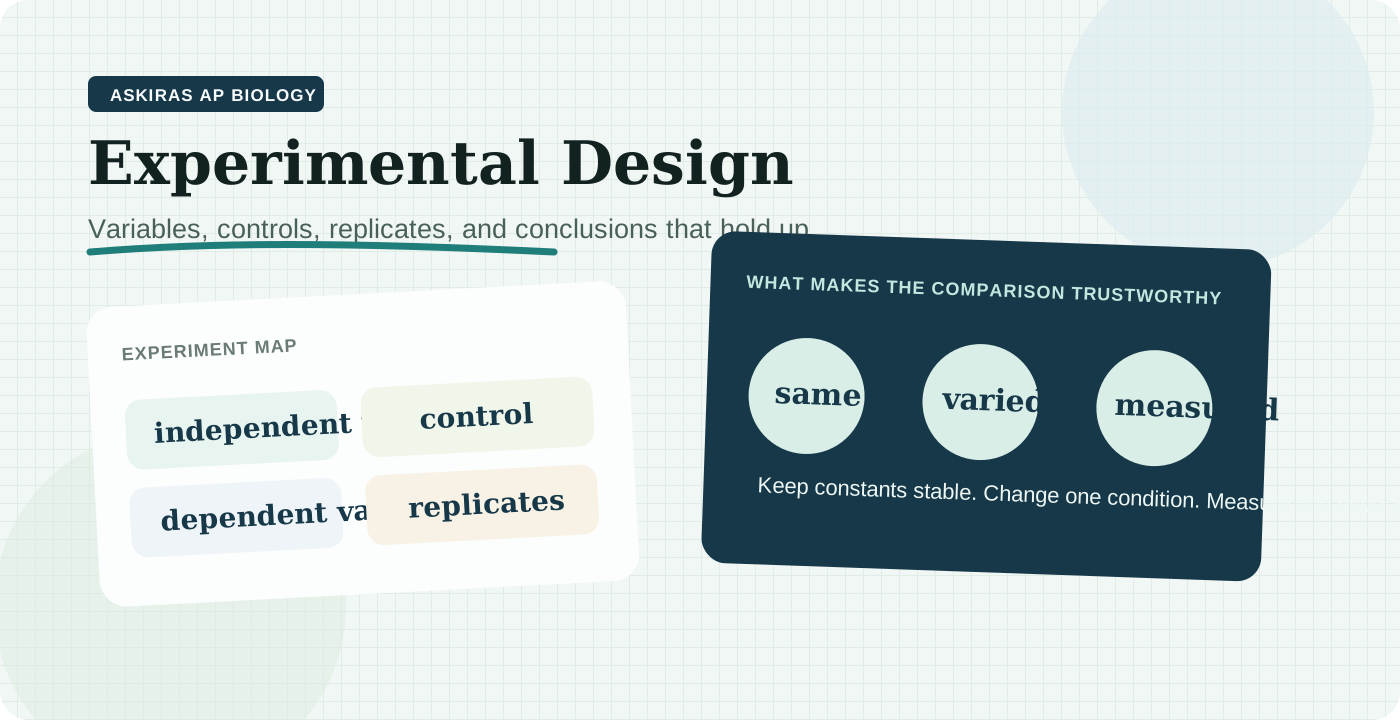
AP Biology does not just test experiments you have seen before
It tests whether you can think through an experiment that you have not seen before.
That is why experimental-design questions feel harder than they look. The vocabulary seems familiar:
- independent variable
- dependent variable
- control
- constant
- replicate
But on the actual exam, those words show up inside a live setup, and you have to decide what each one is doing.
The core question behind most AP Bio experiment prompts
Almost every experimental-design task is really asking:
What changed, what was measured, and what makes the comparison trustworthy?
If you can answer that, the prompt gets much smaller.
A clean design is really a clean comparison. Once that clicks, the vocabulary starts behaving.
A worked example
Suppose researchers want to test whether nitrate concentration affects duckweed growth. They place equal numbers of duckweed fronds into containers with different nitrate concentrations and measure the increase in frond number after seven days.
Here is the clean setup:
- independent variable: nitrate concentration
- dependent variable: change in duckweed frond number
- control group: the container with 0 mg/L added nitrate
- constants: same duckweed species, same starting number of fronds, same temperature, same light exposure, same water volume, same time interval
- replicates: multiple containers for each nitrate level
That is the language AP Biology wants. Not vague phrases like “the plants were tested.”
The experimental-design checklist
1. Name the independent variable precisely
The independent variable is what the researchers deliberately change.
Not: “the plants”
Not: “growth”
But: “nitrate concentration in the growth medium”
Precision matters because AP Bio often gives you setups with several moving pieces.
2. Name the dependent variable as something measurable
The dependent variable is what you measure.
Good AP Bio wording usually includes:
- a measurable outcome
- units or method if relevant
Examples:
- rate of oxygen production
- number of seeds germinated
- mean leaf area
- concentration of glucose
3. Separate controls from constants
This is where many otherwise solid students get loose.
- The control group is the comparison condition.
- The constants are the conditions kept the same.
If you say the temperature is the control, but it is actually being held constant across all groups, the answer loses precision.
That distinction matters a lot in AP Biology. Students often use the word “control” to mean anything that stayed the same. The exam usually wants you to separate the comparison group from the conditions that were held constant.
4. Use replicates for reliability
Replicates matter because biological systems vary.
One dish, one plant, or one trial can be weird. Multiple replicates let you compare averages and reduce the chance that your conclusion rests on noise.
5. Predict the pattern before you explain the mechanism
If the prompt asks for a prediction, answer in this order:
- what result you expect
- why biology supports that expectation
For the duckweed example:
“Duckweed in higher nitrate concentrations would be expected to show greater frond increase than the control, because nitrogen is required for synthesis of amino acids and nucleic acids that support growth.”
That is much stronger than: “The plants will do better because nitrate is important.”
Common AP Biology experiment traps
Calling the baseline condition “the dependent variable”
The control is a group. The dependent variable is the measured outcome. Do not blur them.
Forgetting what is actually being held constant
If light intensity changes between groups in a nitrate experiment, nitrate is no longer the only variable. That weakens what the design can show.
Writing a hypothesis that is not testable
A useful hypothesis ties the independent variable to the dependent variable.
Weak: “Nitrate is important for plants.”
Stronger: “Increasing nitrate concentration will increase duckweed growth, measured as mean frond increase after seven days.”
Overstating the conclusion
Sometimes the design supports:
- an effect of the treatment on the measured variable
- an association consistent with a mechanism
It does not always prove the whole pathway. AP Bio rewards students who make defensible claims instead of oversized ones.
What AP Bio usually wants in a better design
If the prompt asks how to improve a design, think about:
- more replicates
- better control of environmental conditions
- a clearer baseline group
- direct measurement of the dependent variable
- longer observation window if needed
- random assignment when appropriate
The improvement should match the weakness. Do not propose fancy equipment if the real problem is that the treatment and control were not comparable.
How this shows up in free responses
Experimental-design FRQs often ask you to:
- identify variables
- justify the control
- predict a result
- explain whether the data support a claim
- describe one improvement
A clean answer usually stays close to the design itself. If the prompt is about nitrate and duckweed, do not wander into a full essay on plant physiology. Explain only the biology needed to support the prediction or interpretation.
A fast way to practice this skill
For each experiment you review, force yourself to fill in five blanks:
- independent variable:
- dependent variable:
- control group:
- constants:
- one source of error or one useful improvement:
That sounds simple because it is. It is also very close to what the exam keeps rewarding.
What to remember on test day
Experimental-design questions get much easier when you make the setup concrete.
Ask:
- What did the researchers change?
- What did they measure?
- What are they comparing against?
- What had to stay the same?
- What conclusion can this design actually support?
That is the difference between waving at the experiment and actually answering it.
Frequently asked questions
Is the control group always the group with no treatment?
Usually it is the baseline group without the independent variable or with the standard condition. The point of the control is to make the treatment comparison meaningful.
Why do AP Biology prompts care so much about replicates?
Replicates reduce the chance that one odd result drives the conclusion. They make the data more reliable and help separate real patterns from random variation.
Can one experiment prove a mechanism by itself?
Often no. A single experiment may support a mechanism or be consistent with it, but AP Bio often rewards students who avoid overstating what one design can prove.
Keep going in this exam
Other guides at Askiras
If you are also prepping another exam, these short guides cover the same "name the pattern, then practice" habit.