AP Biology FRQ Strategy: Use the Data, Name the Mechanism, Move On
AP Bio FRQs reward precise evidence and short explanations, not lab-report sprawl. Learn how to answer long and short prompts without giving points away.
Read it to name the pattern, then practice while it is still fresh.
Prepared by Askiras editorial team. These guides stay short on purpose: one pattern, one worked example, one clear next step into practice. How we build guides.
Uses public AP course and exam context; does not reproduce protected College Board prompts.
College Board AP context, Askiras independence, and no unsupported outcome claims.
What is the simplest AP Biology FRQ strategy?
Answer the command verb first, cite the figure or data when the prompt gives one, then add the biological mechanism in one precise sentence. AP Bio FRQs reward task completion and evidence, not long lab-report prose.
AP Biology free responses are not mini lab reports
That is one of the biggest scoring shifts students need to make.
A lot of AP Bio FRQ answers go wrong in one of two directions:
- too vague to earn the point
- too long to stay controlled
The exam is not asking for elegant science prose. It is asking whether you can complete short scientific tasks accurately.
What the AP Biology FRQ section actually looks like
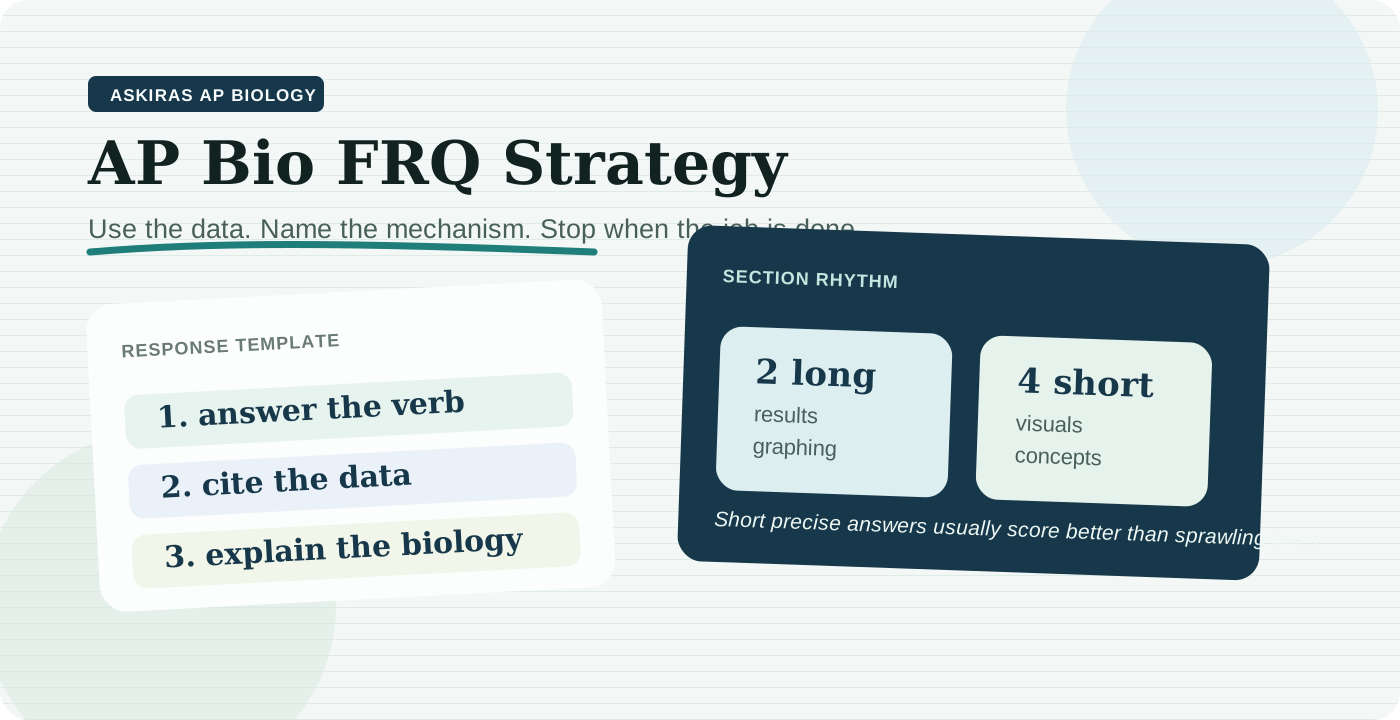
You get 6 FRQs in 90 minutes.
That includes:
- 2 long free-response questions
- 4 short free-response questions
The task types College Board highlights include:
- experimental results
- experimental results with graphing
- scientific investigation
- conceptual analysis
- model or visual analysis
- data analysis
That means AP Biology FRQs are built around evidence and reasoning. The wording changes. The job stays familiar.
The scoring is additive. That matters. One clean sentence can earn the point even if the rest of the part felt intimidating.
The simplest FRQ structure that keeps working
For many AP Bio parts, this is enough:
- answer the verb
- cite the evidence
- explain the biology
If the prompt says identify, identify. If it says describe, describe. If it says justify, you probably need evidence plus reasoning.
Students lose points when they answer the topic instead of the command word.
Mini rubric for a cleaner AP Bio FRQ answer
Use this before you compare your answer to a sample response:
| Point check | Your answer should show |
|---|---|
| Command verb | The first sentence does the exact task: identify, describe, explain, predict, justify, or calculate. |
| Evidence | If the prompt gives data, your answer names the group, trend, or value that supports the claim. |
| Mechanism | The biology sentence explains why the evidence makes sense without turning into a textbook dump. |
| Limit | The conclusion stays as strong as the experiment allows. No causation from a weak design. |
| Time control | The answer earns the point once, then stops instead of circling the same idea three ways. |
What to do today
Pick one FRQ part you already missed. Do not redo the whole question. Rewrite only that part as:
Verb answer. Evidence sentence. Mechanism sentence.
Then mark which mini-rubric row changed. If the answer still feels vague, go back to AP Bio graphs and data and tighten the evidence sentence first.
A worked example
Suppose the prompt gives a graph showing that a treated plant group produced a mean biomass of 12.4 g, while the control group produced 9.1 g. The question asks you to justify the claim that the treatment increased growth.
A weak answer says: “The treatment helped the plants grow more.”
A stronger answer says: “The treated plants had a higher mean biomass than the control plants, 12.4 g compared with 9.1 g, which supports the claim that the treatment increased plant growth.”
If the prompt then asks for a biological explanation, add one sentence:
“One possible explanation is that the treatment increased access to a resource needed for biosynthesis, allowing more biomass to accumulate.”
That is a good AP Bio rhythm:
- evidence
- then mechanism
Long FRQs: stay organized early
The long questions usually combine multiple jobs. You may have to interpret data, explain a process, justify a claim, and graph a result in the same question.
The best first move is not writing. It is labeling the jobs.
Before you answer, mark:
- where the prompt wants data
- where it wants explanation
- where it wants prediction
- where it wants a graph or design point
That one minute of control prevents the usual long-question drift.
Short FRQs: do not overwrite
Short FRQs often look harmless, which is why students waste time on them.
If the part asks for one prediction and one justification, give:
- one prediction
- one justification
Not three speculative mechanisms, a definition, and a paragraph of scene-setting. If a part only needs one supported sentence, one supported sentence is enough.
In AP Biology, extra writing is not neutral. It creates more ways to become vague.
How to use data well
When the prompt says use the results, that usually means:
- compare specific groups
- use actual values or clear trends
- avoid unsupported overclaim
Useful sentence frames:
- “Group A had a higher mean ___ than Group B.”
- “As ___ increased, ___ decreased.”
- “The control group showed ___, whereas the treatment group showed ___.”
- “These data support the claim that ___ because ___.”
The best FRQ evidence sentences sound plain. That is fine. Scoring cares about defensibility, not style points.
How to handle graphing on AP Biology FRQs
If a long question asks you to make a graph, do the simple things right:
- label both axes
- include units
- place the independent variable on the x-axis when appropriate
- choose a scale that uses the space well
- plot points carefully
- make sure the graph type matches the data
Students sometimes know the biology and still leak points because the graph itself is messy or incomplete.
The wording habits that usually earn points
Name the variable
Do not say: “It increased.”
Say: “The rate of oxygen production increased.”
Use the comparison
Do not say: “The treatment was higher.”
Say: “The treatment group had greater mean biomass than the control group.”
Explain the mechanism only as far as needed
If one sentence of biology completes the task, stop there.
A lot of AP Bio answers go off the rails because students keep explaining after the required point is already made.
A practical timing rule
Ninety minutes across six questions means you need to protect your pace.
A workable rhythm is:
- roughly 20 to 22 minutes total for each long question
- roughly 10 to 12 minutes total for each short question
That is not an official scoring rule. It is just a useful way to avoid letting one graph or one tricky part swallow the section.
How to review AP Bio FRQs after you finish one
Do not just ask whether the answer looked good.
Ask:
- Did I answer the actual verb?
- Did I use the data when the prompt required it?
- Did I name the biological process precisely?
- Did I overstate the conclusion?
- Did I waste time saying the same thing twice?
That kind of review makes the next FRQ cleaner.
What to remember on test day
AP Biology FRQs reward control.
Read the task. Use the evidence. Name the mechanism. Stop when the job is done.
That is not glamorous. It is how points get earned.
Frequently asked questions
How long should an AP Biology FRQ answer be?
Only as long as the task requires. AP Bio rewards accurate task completion, not impressive paragraph length. A short precise answer usually beats a sprawling one.
Should I write in bullets or full paragraphs?
Use the format that keeps the logic clear and matches the prompt directions. Many AP Bio parts can be answered cleanly in short sentences or labeled steps as long as the scientific reasoning is explicit.
Can I still get credit if my idea is biologically right but I never mention the data?
For data-based prompts, often not enough. If the task says use the figure, table, or results, your answer should point to the actual evidence rather than only to background knowledge.
Keep going in this exam
Other guides at Askiras
If you are also prepping another exam, these short guides cover the same "name the pattern, then practice" habit.