AP Psychology Exam Guide: 2026 Format and FRQs
AP Psychology exam guide to the 2026 digital format: 75 MCQs, AAQ and EBQ FRQs, unit weights, research methods, and what to practice first.
Read it to name the pattern, then practice while it is still fresh.
Prepared by Askiras editorial team. These guides stay short on purpose: one pattern, one worked example, one clear next step into practice. How we build guides.
Uses public AP course and exam context; does not reproduce protected College Board prompts.
College Board AP context, Askiras independence, and no unsupported outcome claims.
What is on the 2026 AP Psychology exam?
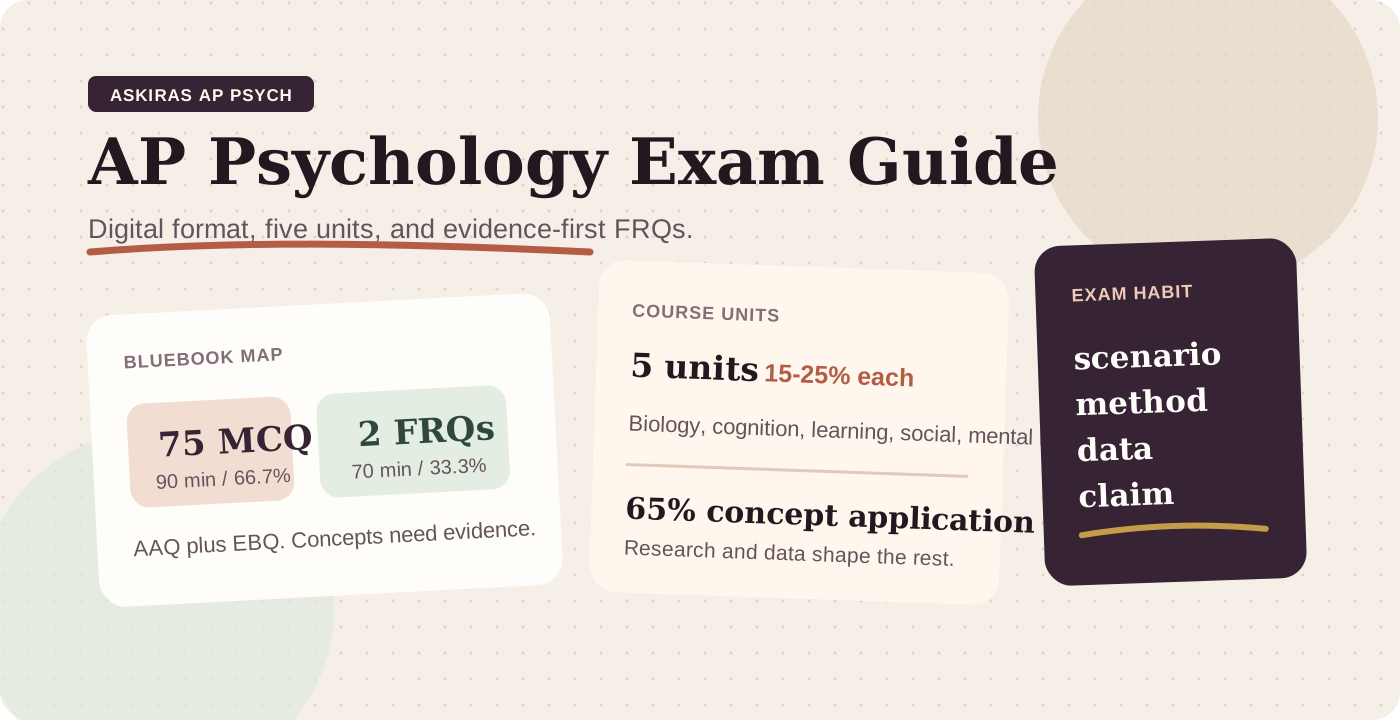
The 2026 AP Psychology exam is fully digital in Bluebook: 75 multiple-choice questions in 90 minutes and two free-response questions in 70 minutes. The FRQs are one Article Analysis Question and one Evidence-Based Question.
Quick answer: what to expect on AP Psychology
The 2026 AP Psychology exam is a fully digital Bluebook exam with 75 multiple-choice questions and 2 free-response questions. The two FRQs are the Article Analysis Question (AAQ) and the Evidence-Based Question (EBQ), so AP Psych prep should start with scenarios, research methods, data interpretation, and evidence sentences - not vocabulary cards by themselves.
Source/update note: Last reviewed June 10, 2026 against College Board’s AP Psychology exam page, AP Psychology course page, and 2025-26 exam clarifications. The details below describe the May 2026 format; check College Board if you are planning for a later administration.
Why AP Psych changed shape
AP Psychology is still a vocabulary-heavy class. The exam is not just a vocabulary check.
The current test keeps asking you to do a more specific job: take a human situation, identify the psychological construct, notice the research design, read the evidence, and stop before your conclusion gets too big.
That sounds abstract, so start with a small case.
A quick example of the new job
Suppose a student studies with flashcards for two hours, sleeps four hours, and then remembers fewer words than a classmate who studied for one hour and slept eight hours.
A weak answer says: “Sleep helps memory.”
A stronger AP Psych answer says: “The scenario connects sleep to memory consolidation. The outcome supports the idea that sleep after studying can improve later recall, but it does not prove sleep caused the difference unless the study controlled other variables.”
That is the exam in miniature:
- Scenario: two students study and sleep differently
- Construct: memory consolidation
- Evidence: one student recalls fewer words
- Limitation: the setup does not prove sleep caused the difference
The old mistake is stopping at the construct. The current exam keeps pushing one step further: what does the evidence actually let you say?
The 2026 AP Psychology exam format
For the May 2026 administration, College Board listed AP Psychology as a fully digital Bluebook exam on Tuesday, May 12, 2026, at 12 PM local time. The tested time is 2 hours and 40 minutes.
Because the exam runs in Bluebook, part of prep is learning the screen as well as the content. Use the built-in highlighter for source language in the FRQs, keep an eye on the timer, and practice moving through prompts without rewriting the whole study in your notes. AP Psychology does not allow calculator use, so the data work is about reading displays and interpreting statistics, not doing long computation.
Section I: Multiple choice
- 75 questions
- 90 minutes
- 66.7% of the exam score
Expect scenario-based questions, research-methods questions, and small data displays. You are not just picking definitions. You are deciding which concept fits the behavior or which conclusion fits the method.
The pacing is not frantic, but it is steady: 75 questions in 90 minutes gives you a little over a minute per question. You cannot write notes for every scenario. You need a fast mental routine:
- What is the person doing, feeling, remembering, deciding, or reporting?
- Which construct best explains that behavior or mental process?
- Is the question asking for a definition, an application, a research design detail, or a conclusion?
Many wrong answers are terms from the right unit but the wrong situation. If the scenario describes a student remembering the first items in a list, “primacy effect” may fit. If it describes remembering the last items, “recency effect” fits. Both terms are memory terms. Only one matches the evidence.
Section II: Free response
- 2 FRQs
- 70 minutes
- 33.3% of the exam score
- 7 points per question
The two FRQs are:
- Article Analysis Question (AAQ): analyze one summarized peer-reviewed source in 25 minutes, including a 10-minute reading period
- Evidence-Based Question (EBQ): build and justify an argument using three summarized peer-reviewed sources in 45 minutes, including a 15-minute reading period
The FRQ section is where research methods and argument language matter most. The AAQ can ask for the research method, variable, statistic interpretation, ethical guideline, generalizability, and argumentation or application. The EBQ asks for a claim, two pieces of evidence from the sources, and reasoning that uses AP Psychology content to justify the argument.
You should expect to spend different kinds of attention on them: the AAQ is closer to “read the study accurately,” while the EBQ is closer to “make the strongest claim the sources can support.”
The five units
The redesigned course has five units, and each one is weighted 15-25%:
- Unit 1: Biological Bases of Behavior
- Unit 2: Cognition
- Unit 3: Development and Learning
- Unit 4: Social Psychology and Personality
- Unit 5: Mental and Physical Health
Because each unit lives in the same broad range, you should not abandon one unit completely. The better move is to learn each unit through common scenario verbs:
- identify the concept
- explain the behavior
- connect the evidence
- notice the research limitation
The common student mistake is studying these as five separate notebooks. The exam blends them through scenarios. A question about test anxiety could involve cognition, stress, biological arousal, or social evaluation. Your job is to follow the prompt, not the chapter heading you wish it came from.
The practices tell you how to study
The multiple-choice science-practice weights are the clearest study map:
- Concept Application: 65%
- Research Methods and Design: 25%
- Data Interpretation: 10%
- Argumentation: FRQ only
That weighting does not mean “ignore data.” It means data is usually paired with a concept or research design. A graph question might also test operational definitions, correlation, sampling, or whether a conclusion goes too far.
It also means flashcards are useful only if they lead somewhere. A card that says “operant conditioning = learning through consequences” is a start. A better card says: “A student studies more after earning extra phone time for quiz scores. Identify the consequence and explain why this is positive reinforcement.” The second card trains concept application, not just recognition.
Common question traps
AP Psych wrong answers often come from five predictable traps.
The familiar-term trap
You pick a word you studied because it sounds relevant. A scenario about a child imitating a sibling might tempt “classical conditioning” because it is a learning term. But if the child copies observed behavior, the better construct may be observational learning.
The causation trap
The study finds that students with more social support report lower stress. That is association, not proof that social support caused lower stress. Unless the design manipulates the variable and controls the groups, causal language is risky.
The vague-evidence trap
An FRQ answer says “the study supports the claim because the results were better.” Better how? Which group? Which measure? Write the evidence sentence with the actual construct and result.
What to practice first
If you have a month or more, rotate through all five units and attach every term to a scenario.
If you have two weeks, spend less time rereading notes and more time doing mixed sets:
- 10 scenario MCQs
- 5 research-methods questions
- 1 short AAQ or EBQ outline
- review every miss by writing the better evidence sentence
If you have only a few days, prioritize:
- the five-unit map
- research methods vocabulary
- common study flaws
- AAQ structure
- EBQ claim and evidence sentences
For FRQs, outline more than you write full responses early on. A clean outline teaches you to separate construct, evidence, limitation, and claim before you worry about polish.
The scoring habit to build
For almost every AP Psych question, ask four things:
- What behavior or mental process is being described?
- What concept best explains it?
- What evidence is actually given?
- What can I conclude without overclaiming?
That last question matters. AP Psych punishes confident answers that outrun the study design.
If the study is correlational, do not write causal language. If the sample is narrow, do not generalize too broadly. If a graph shows a difference, say what changed and for whom.
Aim for plain, specific, careful answers: not “stress hurts memory,” but “participants in the high-stress condition recalled fewer words than participants in the low-stress condition.”
Where to go next
Use this guide for the map. Then read the AP Psych study strategy guide if you need a weekly plan, or go straight to research methods and data if you are losing points on studies.
If you are also taking other AP exams, compare this digital FRQ style with the hybrid science setup in the AP Biology exam guide and the code-tracing format in the AP CSA exam guide.
If your MCQ misses keep repeating, you probably need more scenario practice. If your FRQ misses keep repeating, you probably need tighter evidence sentences. Those are different problems. Treat them differently.
Frequently asked questions
Is AP Psychology still mostly a vocabulary test?
No. Vocabulary matters, but the current exam asks you to apply concepts to scenarios, evaluate research, interpret data, and build evidence-based arguments.
What are the two AP Psychology FRQ types?
The two FRQ types are the Article Analysis Question, or AAQ, and the Evidence-Based Question, or EBQ.
Which AP Psychology units are most important?
All five units are officially weighted 15-25%, so there is no safe skip. The better question is whether you can apply each unit to scenarios and research evidence.
Keep going in this exam
Other guides at Askiras
If you are also prepping another exam, these short guides cover the same "name the pattern, then practice" habit.