AP Psychology Research Methods and Data: The Checklist That Saves Points
AP Psych research-methods questions get easier when you separate variables, design, sampling, data, and conclusions before choosing an answer.
Read it to name the pattern, then practice while it is still fresh.
Prepared by Askiras editorial team. These guides stay short on purpose: one pattern, one worked example, one clear next step into practice. How we build guides.
Uses public AP course and exam context; does not reproduce protected College Board prompts.
College Board AP context, Askiras independence, and no unsupported outcome claims.
What research-methods skills does AP Psych test?
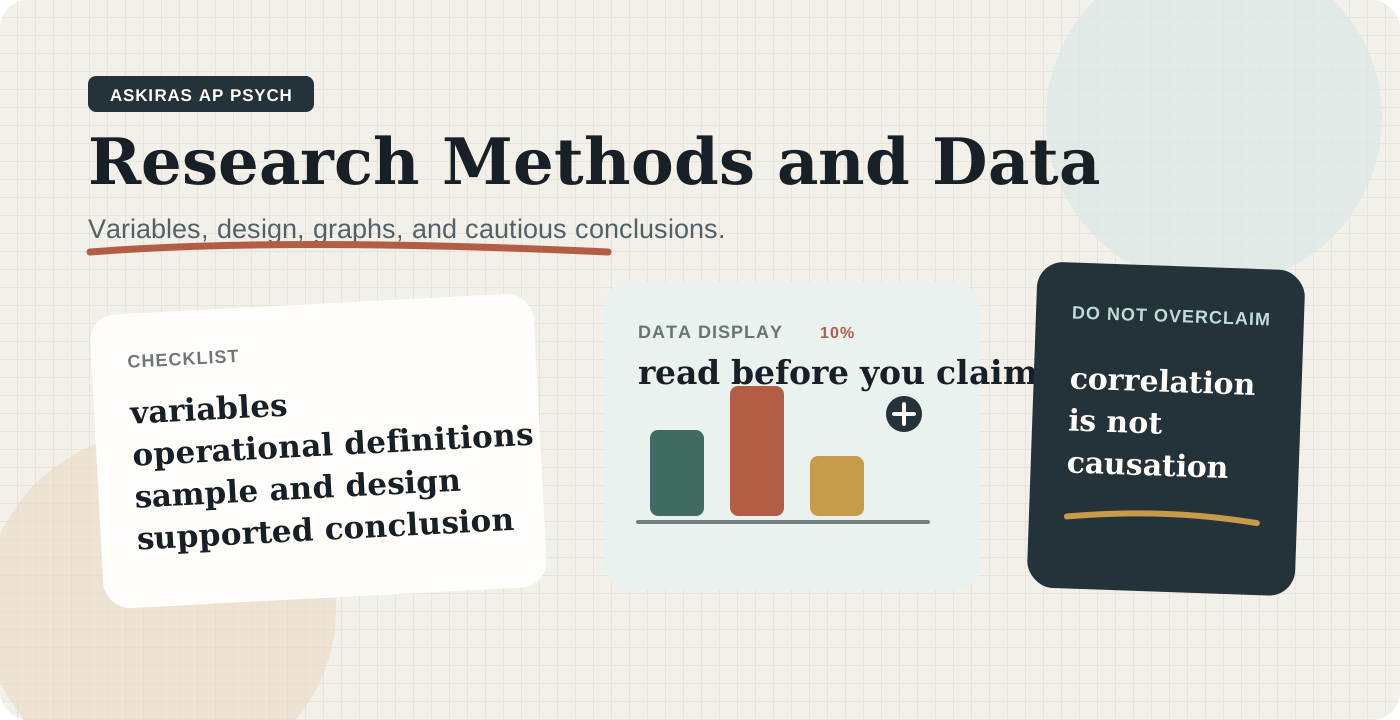
AP Psych tests whether you can identify variables, operational definitions, research methods, sampling, random assignment, ethics, data displays, statistics, and generalizability. The biggest scoring habit is restraint: do not make a causal or population-wide claim unless the study design supports it.
Research methods are not a side unit
On the current AP Psych exam, research methods are everywhere.
They show up in MCQs, data displays, and the Article Analysis Question. Officially, Research Methods and Design account for 25% of the multiple-choice science-practice weighting, and Data Interpretation adds another 10%.
That is too much to treat as a quick review night.
Research methods are also where students who “know the psych” lose easy points. They can explain conformity, stress, memory, or depression, but they overclaim from a weak study design. AP Psych keeps testing that exact restraint.
A worked example
A psychologist studies 80 high school students and finds that students who report higher sleep quality also report lower test anxiety.
Question: What conclusion is best supported?
Bad answer:
“Better sleep causes lower anxiety.”
Better answer:
“Higher reported sleep quality is associated with lower reported test anxiety, but the study does not establish causation.”
Why? The result is correlational. We do not know whether sleep quality changed anxiety, anxiety changed sleep, or a third variable affected both.
That one distinction saves points constantly.
Now change one detail.
Suppose researchers randomly assign students to a sleep-improvement program or a control group, then measure test anxiety after four weeks. If the sleep-program group reports lower anxiety, the causal claim is stronger because the researchers manipulated the independent variable and used random assignment.
Still, even here, be careful. You can say the program reduced reported test anxiety in this sample. You should not jump to “sleep fixes anxiety for everyone.”
That is the AP Psych balance: stronger design, still careful conclusion.
Use the five-part checklist
Before choosing an answer or writing an FRQ sentence, ask:
- Variables: what is being measured or changed?
- Operational definition: how exactly is it measured?
- Design: experiment, correlation, survey, case study, naturalistic observation?
- Sample: who was studied, and can we generalize?
- Conclusion: what does the evidence support, and what would go too far?
This checklist keeps you from jumping straight to the familiar term.
Use it in order. If you start with the conclusion, you will force the design to match the answer you want. If you start with variables and design, the conclusion usually becomes obvious.
Variables and operational definitions
AP Psych loves the difference between a concept and how it is measured.
“Stress” is a concept.
“Score on a 10-item self-report stress survey” is an operational definition.
“Memory” is a concept.
“Number of words recalled after a 10-minute delay” is an operational definition.
When a question asks for an operational definition, do not describe the theory. Describe the observable or measurable procedure.
Common wrong answer:
“Anxiety is when someone feels worried.”
Better operational definition:
“Anxiety is measured by the participant’s score on a 20-item self-report anxiety scale.”
Another common wrong answer:
“Aggression is hostile behavior.”
Better operational definition:
“Aggression is measured by the number of times a participant chooses to deliver a loud noise blast to another participant.”
The second version may sound less elegant, but it is measurable. That is the point.
Experiments versus correlations
An experiment manipulates an independent variable and measures a dependent variable. Random assignment helps create comparable groups.
A correlational study measures variables as they naturally occur. It can show association, but not cause and effect.
Use this language:
- experiment: “The manipulation may have caused the change if the design controlled confounds.”
- correlation: “The variables are associated, but causation is not established.”
If you write “caused” for a correlation, you are probably giving away a point.
Use these sentence frames:
- “X is positively correlated with Y” means both tend to increase together.
- “X is negatively correlated with Y” means one tends to increase as the other decreases.
- “X predicts Y” can still be correlational unless the design supports causation.
- “X causes Y” requires stronger experimental evidence.
Student mistake: “Because screen time predicts lower sleep quality, screen time causes poor sleep.”
Better: “Greater screen time is associated with lower reported sleep quality. The study does not rule out a third variable, such as stress or workload.”
That last sentence is not extra decoration. It is often the research-methods point.
Sampling and generalization
A sample is not a technical footnote. It controls how far your conclusion can travel.
If the study uses only 40 college students, be careful about claims about all adolescents, all adults, or all cultures.
If the study uses volunteers, consider volunteer bias.
If the study uses a random sample from the target population, generalization is stronger.
Random sampling helps with representation. Random assignment helps with causal comparison. Do not swap them.
Here is the clean distinction:
- Random sample: who gets selected for the study
- Random assignment: which condition each participant enters
A study can have one, both, or neither.
If a study randomly assigns 40 volunteers to two groups, it may support a causal claim within the study, but it may not generalize well to all students. If a survey uses a random sample of 1,000 students but does not manipulate anything, it may generalize better, but it still cannot prove causation.
How to read data displays
Use this order:
- title
- axes or columns
- groups
- direction
- size of difference
- conclusion
For a bar graph, compare groups. For a line graph, track change. For a scatterplot, describe direction and strength, not causation.
Write plain sentences:
“The treatment group recalled more words than the control group.”
“As screen time increased, reported sleep quality decreased.”
“The graph does not show whether screen time caused lower sleep quality.”
For scatterplots, label direction and strength: positive association, negative association, or little association. Do not write “sleep reduces stress” unless the design supports it. A scatterplot by itself is not a cause-and-effect machine.
For bar graphs, name both groups:
“Participants in the rehearsal condition recalled more words than participants in the distraction condition.”
Not:
“The first bar is higher.”
The first sentence says what the data mean in the study. The second only describes a shape.
Confounds and controls
A confounding variable is an outside factor that could explain the result. If morning-class students earn higher grades than afternoon-class students, the confound might be self-selection: morning students may differ in sleep habits, motivation, work schedules, or course difficulty.
A control is something the researcher keeps consistent or accounts for so the comparison is cleaner. Random assignment is one way to reduce confounds. Matching groups, standardized instructions, and consistent testing conditions can also help.
On the exam, do not just say “there is a confound.” Name the possible confound and explain how it could affect the dependent variable.
Ethics questions are usually practical
Know the basics:
- informed consent
- right to withdraw
- confidentiality
- debriefing
- protection from harm
- special care with deception
The exam often asks what the researcher should do, not just what the term means.
AP Psych ethics questions usually reward practical judgment, not moral panic. Deception can be acceptable when justified and not harmful, but the researcher still needs the right to withdraw, protection from harm, and debriefing afterward.
The point
Research-methods questions reward restraint.
Name the variable. Name the design. Read the data. Then stop at the conclusion the evidence can support.
That same restraint is what makes your AAQ and EBQ answers sound like psychology instead of guesswork.
If you remember only one thing, remember this:
The method controls the claim.
Do not let an interesting psychological explanation outrun the design that produced the evidence.
Frequently asked questions
Why are research methods so important on AP Psychology?
Research Methods and Design account for 25% of the multiple-choice science-practice weighting and also appear directly inside the Article Analysis Question.
What is the biggest AP Psych research-methods mistake?
The biggest mistake is using causal language for correlational evidence or making a conclusion broader than the study design supports.
How should I read AP Psychology graphs?
Read the title, axes, groups, and direction of the pattern before thinking about the psychology term. Then state only what the data show.
Keep going in this exam
Other guides at Askiras
If you are also prepping another exam, these short guides cover the same "name the pattern, then practice" habit.