AP Psychology AAQ Strategy: Read the Study Like a Scorer
The AP Psych Article Analysis Question is manageable when you read for variables, method, findings, limitations, and concept application.
Read it to name the pattern, then practice while it is still fresh.
Prepared by Askiras editorial team. These guides stay short on purpose: one pattern, one worked example, one clear next step into practice. How we build guides.
Uses public AP course and exam context; does not reproduce protected College Board prompts.
College Board AP context, Askiras independence, and no unsupported outcome claims.
How do I answer the AP Psych Article Analysis Question?
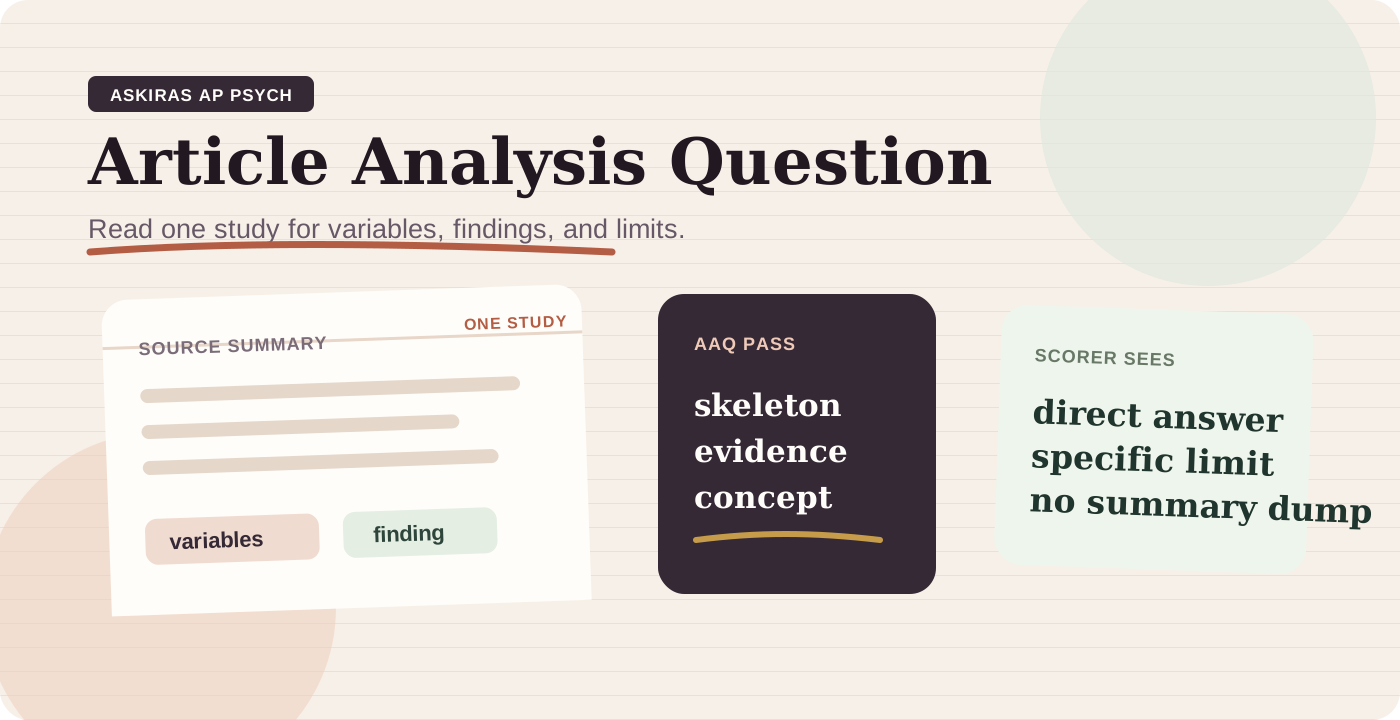
Answer the AP Psych Article Analysis Question by treating it as six narrow research-reading tasks, not one essay. Read the summarized source for the method, variables, results, ethical issue, generalizability limit, and psychology concept, then answer each part directly in the prompt's language.
The AAQ is a research-reading task
The AP Psych Article Analysis Question is not asking you to summarize every detail of an article.
It is asking whether you can read one study like a psychology student:
- what was studied?
- how was it studied?
- what did the results show?
- what concept explains the result?
- what conclusion is justified?
- what limitation matters?
That is a different skill from “write everything I know about the topic.” In fact, the more you know about the topic, the easier it is to wander away from the study. The AAQ rewards staying close to the source.
On the current format, the AAQ is a 25-minute task, including a 10-minute reading period, and it is worth up to 7 points across six parts. Those parts usually live in a tight set of jobs: identify the research method, identify or state a variable, interpret a statistic, apply an ethical guideline, evaluate generalizability, and use argumentation or concept application.
Treat those six parts as six narrow tasks, not one flowing essay. The prompt is the boss. If a part asks for the dependent variable, answer the dependent variable before you explain anything else.
A mini AAQ example
Study summary:
Researchers randomly assigned students to study word pairs either in silence or with instrumental music. After 20 minutes, students took a recall test. The silence group recalled an average of 18 word pairs. The music group recalled an average of 14 word pairs.
Good AAQ-style answers:
- Independent variable: study condition, silence or instrumental music.
- Dependent variable: number of word pairs recalled.
- Finding: students in silence recalled more word pairs on average.
- Supported conclusion: studying in silence was associated with better recall in this experiment.
- Concept application: divided attention may explain the lower recall in the music condition if music competed for cognitive resources.
Notice the style. Short, direct, tied to the study.
Now compare three answers to the same concept part.
Too vague:
“Music affected memory.”
Too definition-heavy:
“Divided attention is when attention is split between two or more tasks.”
Scoring-style:
“The music condition may have created divided attention because students had to process the music while studying the word pairs, which could reduce encoding and lower later recall.”
The last answer applies the construct to the method and finding. That is the move.
AP Psych AAQ examples: six parts, six direct answers
Here is a second practice source built for the Article Analysis Question format.
Study summary:
Researchers surveyed 300 high school students about nightly sleep and school-day attention. Students who reported sleeping fewer than six hours also reported more attention lapses during class. The study used self-report questionnaires and did not assign students to sleep conditions.
AAQ-style answers:
- Research method: correlational study or survey.
- Variable measured: nightly sleep, measured by self-reported hours.
- Another variable measured: attention lapses, measured by self-reported class attention problems.
- Finding: students who reported less sleep also reported more attention lapses.
- Limitation: because the study is correlational, it cannot show that less sleep caused the attention lapses.
- Generalizability concern: if the sample came from one school, the findings may not generalize to all high school students.
Notice how plain the answers are. They do not sound like a polished essay. They sound like a scorer can find the point quickly.
Use AAQ examples this way: cover the answers, identify the method and variables first, then write one limitation that matches the design. If every limitation you write says only “small sample,” you are probably not reading the study closely enough.
Read the source in three passes
Pass 1: Find the skeleton
Look for:
- participants
- independent variable or measured variables
- dependent variable
- design
- result
If you cannot identify those pieces, the details will feel louder than they are.
A good margin map might look like this:
- Participants: high school students
- IV: silence versus music
- DV: number of word pairs recalled
- Design: experiment with random assignment
- Finding: silence group recalled more
- Possible construct: attention or encoding
You do not need beautiful notes. You need handles.
Pass 2: Mark the evidence
Underline the result language:
- increased
- decreased
- no difference
- stronger association
- predicted
- compared with
Then translate it into one plain sentence.
“Group A scored higher than Group B.”
“Higher X was associated with lower Y.”
“The intervention changed the measured behavior.”
If the source gives numbers, use them. “The silence group recalled 18 pairs and the music group recalled 14 pairs” is stronger than “one group did better.” Numbers prevent vague evidence.
Pass 3: Attach the psychology
Only after the method and result are clear should you bring in the concept.
If the study is about attention, memory, learning, stress, prejudice, personality, or mental health, name the concept and explain how the evidence fits.
Do not dump a definition. Apply it to the study.
This is where many students lose the easiest point. They define the term correctly but never connect it to the participants, measure, or result.
Definition-only:
“Encoding is putting information into memory.”
Applied:
“The music may have interfered with encoding because students studying with music had fewer attentional resources available to process the word pairs.”
The applied version is not much longer. It is just pointed at the study.
Know the AAQ question families
The exact wording can vary, but most AAQ tasks pull from a small set of jobs.
Some parts ask for research pieces: method, variables, operational definitions, participants, or design. Others ask you to interpret a statistic, name an ethical guideline, evaluate generalizability, explain a finding, or apply a concept. Match the answer to the task. If the prompt asks for an operational definition, “number of word pairs recalled” is better than “memory.” If it asks how a concept applies, use this shape: “The concept is shown because [specific study detail] demonstrates [psychological process].”
The answer style that scores
Use sentence stems that stay close to the evidence:
- “The independent variable is…”
- “The dependent variable is measured by…”
- “The finding shows…”
- “This supports the claim that…”
- “The study does not show…”
- “A limitation is…”
This is not the place for a long intro or polished paragraph. Clarity beats style.
Also avoid pronouns that make the answer blurry. “It increased” is weaker than “the stress-management group reported lower anxiety.” The scorer should never have to infer which variable or group you mean.
Watch for overclaiming
The AAQ often tests whether you know what the study cannot prove.
Common limits:
- correlational design cannot show causation
- small or narrow sample limits generalization
- self-report can be biased
- operational definition may not capture the full construct
- confounding variables may explain the result
A limitation sentence should be specific:
“Because anxiety was measured by self-report, participants may have underreported symptoms.”
Not:
“The study could be biased.”
More examples:
- Specific: “Because the sample included only college students, the findings may not generalize to younger adolescents or older adults.”
- Specific: “Because participants knew they were being observed, demand characteristics may have affected their behavior.”
- Specific: “Because the study was correlational, it cannot show whether loneliness caused increased social media use.”
Each one names the design issue and explains the consequence.
What not to do on the AAQ
Do not write a mini essay about the whole article. If a part asks for the dependent variable, answer the dependent variable.
Do not import outside facts unless the question asks for a concept application. The source is the anchor.
Do not use causal language just because the topic sounds causal. “Predicts,” “is related to,” and “is associated with” are often safer for correlational evidence.
Do not assume a limitation is always sample size. Sometimes the issue is operational definition, self-report, lack of random assignment, ethics, or ecological validity.
Do not ignore “how” and “why” words. If the prompt asks how the concept applies, a label alone is not enough.
A simple AAQ timing plan
Use the 10-minute reading period to map the source, not to write a full answer in your head.
Then answer in direct chunks. If a part asks for a variable, give the variable. If it asks for a limitation, give one limitation and explain why it matters.
Do not make every answer a paragraph. The scorer is looking for the point.
A practical timing plan: read the prompt stems first, mark participants, variables, design, statistics, ethical details, and finding, answer identification parts quickly, then spend more time on explanation, generalizability, and application parts.
If you are stuck, write the most direct study-based answer you can. A clear partial answer beats a polished sentence that never names the variable.
Practice the AAQ with short studies
You do not need full journal articles to practice.
Use short study summaries and ask:
- What is the research question?
- What are the variables?
- What is the design?
- What did the data show?
- What concept explains it?
- What can the study not conclude?
That routine also improves research-methods MCQs, because it trains the same reading pattern.
That is the AAQ rhythm. Name the study pieces. State the finding. Keep the claim inside the design.
Frequently asked questions
What is the AP Psychology Article Analysis Question?
The AAQ gives you one summarized peer-reviewed source and asks six parts about the study: method, variable, statistic interpretation, ethics, generalizability, and argumentation or application.
How long should I spend reading the AAQ source?
The official allocation is 25 minutes, including a 10-minute reading period. Read actively, but do not rewrite the article in your head.
Does the AAQ require fancy writing?
No. It rewards precise, direct answers that connect the study details to research-methods and psychology concepts.
Keep going in this exam
Other guides at Askiras
If you are also prepping another exam, these short guides cover the same "name the pattern, then practice" habit.