How to Study AP Psychology Without Memorizing in Circles
A practical AP Psych study plan built around scenarios, retrieval, research design, data, and FRQ evidence instead of endless term review.
Read it to name the pattern, then practice while it is still fresh.
Prepared by Askiras editorial team. These guides stay short on purpose: one pattern, one worked example, one clear next step into practice. How we build guides.
Uses public AP course and exam context; does not reproduce protected College Board prompts.
College Board AP context, Askiras independence, and no unsupported outcome claims.
How do I study AP Psychology effectively?
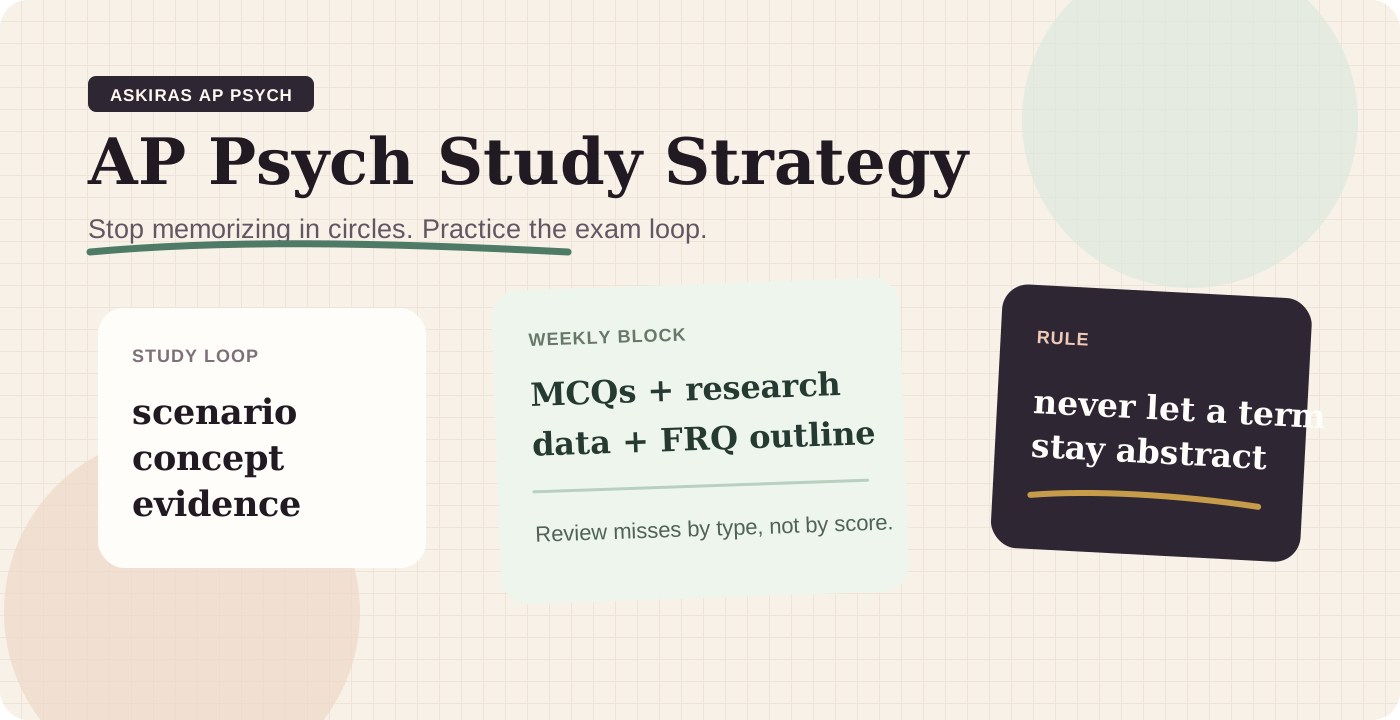
Study AP Psychology by moving past term-definition review. For each concept, practice a scenario, name the behavior, identify the construct, explain the evidence, and note what the study can or cannot conclude. Your miss log should separate vocabulary gaps from scenario, method, and evidence mistakes.
The trap is studying AP Psych like a glossary
AP Psych feels friendly at first because the terms are recognizable: memory, stress, learning, personality, bias, conformity.
Then practice questions get annoying. You know the word, but the scenario is weird. Or you understand the study, but two answer choices sound plausible.
That is the signal to change how you study.
The exam is not asking, “Have you seen this term?” It is asking, “Can you use this term without stretching it past the evidence?”
That difference changes the whole study plan.
A fast example
Definition-only card:
Availability heuristic: judging likelihood based on how easily examples come to mind.
Better AP Psych card:
A student thinks plane crashes are common after watching several news stories about them. What bias is operating, and why?
Answer:
The availability heuristic. The student is estimating risk based on examples that are easy to recall, not on actual base rates.
The second card is closer to the exam because it forces you to apply the term.
Now make it even better:
Follow-up: Why is “representativeness heuristic” tempting but wrong?
Answer: Representativeness is about judging by similarity to a prototype. The plane crash example is about recall being easy because the examples are vivid and recent.
That second layer is where scores move. Students often know the right term after seeing the answer. The useful review question is why the wrong term looked attractive.
Build every study block around four moves
Use this loop:
- Scenario: what is happening?
- Concept: what term or theory fits?
- Method: what kind of evidence would test it?
- Claim: what can you conclude without overclaiming?
That one loop covers most of the exam. It helps MCQs, AAQs, and EBQs because it makes you practice the same reasoning in different shapes.
Use the loop with every unit. The words change. The work stays the same: identify the behavior, name the construct, connect the evidence, and limit the claim.
A weekly plan that actually matches the exam
Day 1: Unit review with scenarios
Pick one unit. Read your notes quickly, then turn 15 terms into tiny examples.
Do not write “classical conditioning = learning by association.” Write:
“A song played before every team win later makes fans feel excited by itself.”
Then name UCS, UCR, CS, and CR.
Do the same with one non-learning term so you do not overfit to easy examples:
“A student remembers the beginning of a vocabulary list better than the middle.”
Name the construct: primacy effect.
Then explain it in plain language: early items received more rehearsal, so they were more likely to enter long-term memory.
If your explanation is only the term repeated in different words, it is not ready.
Day 2: Multiple-choice application
Do a short MCQ set. For every miss, write one sentence:
“I missed this because I chose the definition I remembered, but the scenario was really testing…”
That sentence matters more than the raw score.
Add one more sentence for tempting answers:
“Choice B was tempting because it is also a memory term, but the scenario described retrieval failure, not encoding.”
That habit builds discrimination. AP Psych MCQs often separate two nearby constructs, not one obvious right answer from four nonsense choices.
Day 3: Research methods
Review variables, operational definitions, sampling, random assignment, ethics, correlation, experiments, and common graphs.
Then attach them to the unit you are studying. If the unit is social psychology, ask how you would test conformity. If the unit is cognition, ask how you would measure memory.
Example:
Weak study idea: “Test whether stress affects students.”
Better study idea: “Randomly assign students to a timed or untimed arithmetic task, then measure the number of problems solved correctly and self-reported stress on a 1-10 scale.”
Now you have an independent variable, dependent variables, and operational definitions. You also have limits: a timed math task may not capture all forms of stress.
Day 4: Data and limitations
Use any small chart, table, or result summary. Practice writing:
- what increased or decreased
- which group differed
- what conclusion is supported
- what conclusion would go too far
Use exact wording. Do not write “the first group did better” if the display says the treatment group recalled 18 words and the control group recalled 12. Write the comparison. The AP Psych scorer cannot award precision you leave implied.
Day 5: FRQ outline
Alternate AAQ and EBQ practice.
For an AAQ, outline the study: variables, method, result, limitation.
For an EBQ, outline the argument: claim, two evidence pieces, explanation, counter-limit.
If you are short on time, do not write a beautiful intro. Write the claim and evidence link:
“The evidence supports the claim that effort-based feedback can increase persistence because students praised for effort chose more challenging tasks after failure.”
That sentence is not fancy. It is useful.
How to review missed questions
Do not only mark the right answer.
Sort misses into buckets:
- Term miss: you did not know the concept
- Scenario miss: you knew the concept but did not apply it
- Method miss: you confused the design or variable
- Evidence miss: you made a claim the data did not support
- Choice miss: you picked a too-broad or too-extreme answer
Most students discover they have fewer term misses than they think.
Here is what each bucket needs:
- Term miss: make a simple definition card, then add a scenario.
- Scenario miss: write why the correct term fits the behavior.
- Method miss: rewrite the design using independent variable, dependent variable, sample, and conclusion.
- Evidence miss: copy the exact data pattern and write what it does not prove.
- Choice miss: write why the tempting answer is too broad, too causal, or the wrong construct.
Do not review every miss the same way. A vocabulary problem and an overclaiming problem need different fixes.
How to use flashcards without getting stuck
Flashcards are fine for first contact. They are bad as the whole plan.
Use three card types:
- Definition card: “What is negative reinforcement?”
- Scenario card: “A driver buckles a seat belt to stop the alarm. What principle is shown?”
- Contrast card: “Why is this negative reinforcement, not punishment?”
The contrast card is the most valuable. It forces you to separate constructs that students often blend together.
Try this set:
- Negative reinforcement increases behavior by removing an unpleasant stimulus.
- Punishment decreases behavior by adding or removing a consequence.
- In the seat belt example, buckling increases because it removes the alarm. That is negative reinforcement.
That is the level of clarity you want before timed practice.
What to do two weeks before the exam
Keep rotating through all five units because each is weighted 15-25%.
But change the unit review format:
- 20 minutes: scenario cards
- 20 minutes: mixed MCQs
- 20 minutes: research/data cleanup
- 20 minutes: one FRQ outline or paragraph
That is better than spending 80 minutes rereading a chapter.
The point is not perfect coverage. The point is repeated contact with content, methods, data, and writing.
The simplest rule
Never let a term stay abstract.
If you review “external locus of control,” immediately create a student, patient, athlete, or participant who shows it. If you review “random assignment,” immediately say what it does and does not fix.
AP Psych rewards the student who can turn vocabulary into evidence-based explanation.
The sign your studying is working is that you can look at a new scenario and say, “This is the construct, this is the evidence, and this is the conclusion I am allowed to make.”
Frequently asked questions
How should I study AP Psychology if I know the terms but miss questions?
Shift from definition review to scenario practice. For each miss, write the behavior, the concept, the evidence, and the reason the tempting answer is wrong.
How much time should I spend on AP Psych research methods?
Research Methods and Design are 25% of the multiple-choice science-practice weighting, so they should appear in nearly every study session, even when you are reviewing content units.
Should I make AP Psychology flashcards?
Flashcards can help with first-pass vocabulary, but they should quickly become application cards with a mini-scenario, not just term-definition pairs.
Keep going in this exam
Other guides at Askiras
If you are also prepping another exam, these short guides cover the same "name the pattern, then practice" habit.