AP Psychology EBQ Strategy: Build a Claim the Evidence Can Support
The AP Psych Evidence-Based Question is less scary when you choose a defensible claim, use the sources precisely, and explain the psychology.
Read it to name the pattern, then practice while it is still fresh.
Prepared by Askiras editorial team. These guides stay short on purpose: one pattern, one worked example, one clear next step into practice. How we build guides.
Uses public AP course and exam context; does not reproduce protected College Board prompts.
College Board AP context, Askiras independence, and no unsupported outcome claims.
How do I write the AP Psych Evidence-Based Question?
Write the AP Psych Evidence-Based Question by making a claim the sources can actually support, using two specific pieces of source evidence, and explaining the psychology that connects each source to the claim. Keep the conclusion narrow; overclaiming can weaken both the claim and the reasoning.
The EBQ is not a vibe check
The Evidence-Based Question asks you to make an argument with psychology evidence.
That sounds broad, but the job is specific:
- make a claim
- select relevant evidence
- explain how the evidence supports the claim
- keep the conclusion inside the limits of the sources
If your answer is just “Source A says…” and “Source B says…”, you are listing. The EBQ wants reasoning.
Think of the EBQ as a small research argument, not an opinion paragraph. The sources are not decorations. They are the boundary of the claim.
On the current format, the EBQ gives you three summarized peer-reviewed sources on a common topic. It is a 45-minute task, including a 15-minute reading period, and it is worth up to 7 points across three jobs: make a claim, provide two pieces of evidence from the sources, and explain why the evidence supports the claim using AP Psychology content.
A mini EBQ example
Prompt idea:
Can social feedback affect a student’s motivation to persist on difficult tasks?
Source A says students praised for effort attempted more challenging puzzles later.
Source B says students praised for being smart avoided difficult puzzles after failure.
Weak claim:
“Praise affects students.”
Better claim:
“Effort-based feedback is more likely than ability-based feedback to support persistence after difficulty.”
Evidence sentence:
“Source A supports this because students praised for effort chose harder later tasks, which suggests the feedback encouraged persistence rather than protecting an image of being smart.”
That is the EBQ pattern: claim, source, explanation.
Now add a second source sentence:
“Source B qualifies the claim because students praised for being smart avoided harder puzzles after failure, suggesting that some types of positive feedback can reduce persistence when they make students protect an identity.”
That sentence does two things at once. It uses the source and narrows the claim. Strong EBQ answers often qualify instead of exaggerating.
AP Psych EBQ examples: claim, evidence, reasoning
Use this example when you need the Evidence-Based Question to feel less abstract.
Prompt idea:
Can spaced retrieval improve learning compared with rereading?
Source A says students who took short retrieval quizzes after studying remembered more terms one week later than students who only reread the same material.
Source B says retrieval practice helped most when students received feedback after incorrect answers.
Source C says the benefit was smaller when the final test used essay questions instead of term recall.
Defensible claim:
Spaced retrieval can improve later recall compared with rereading, especially when students receive feedback, but the benefit may be strongest for recall tasks rather than every kind of writing task.
Evidence and reasoning:
Source A supports the claim because students who practiced retrieval remembered more terms after one week, which suggests that actively pulling information from memory strengthened later recall more than rereading did.
Source B strengthens the claim because feedback after incorrect answers helped students correct retrieval mistakes, which could improve later encoding and reduce repeated errors.
Boundary:
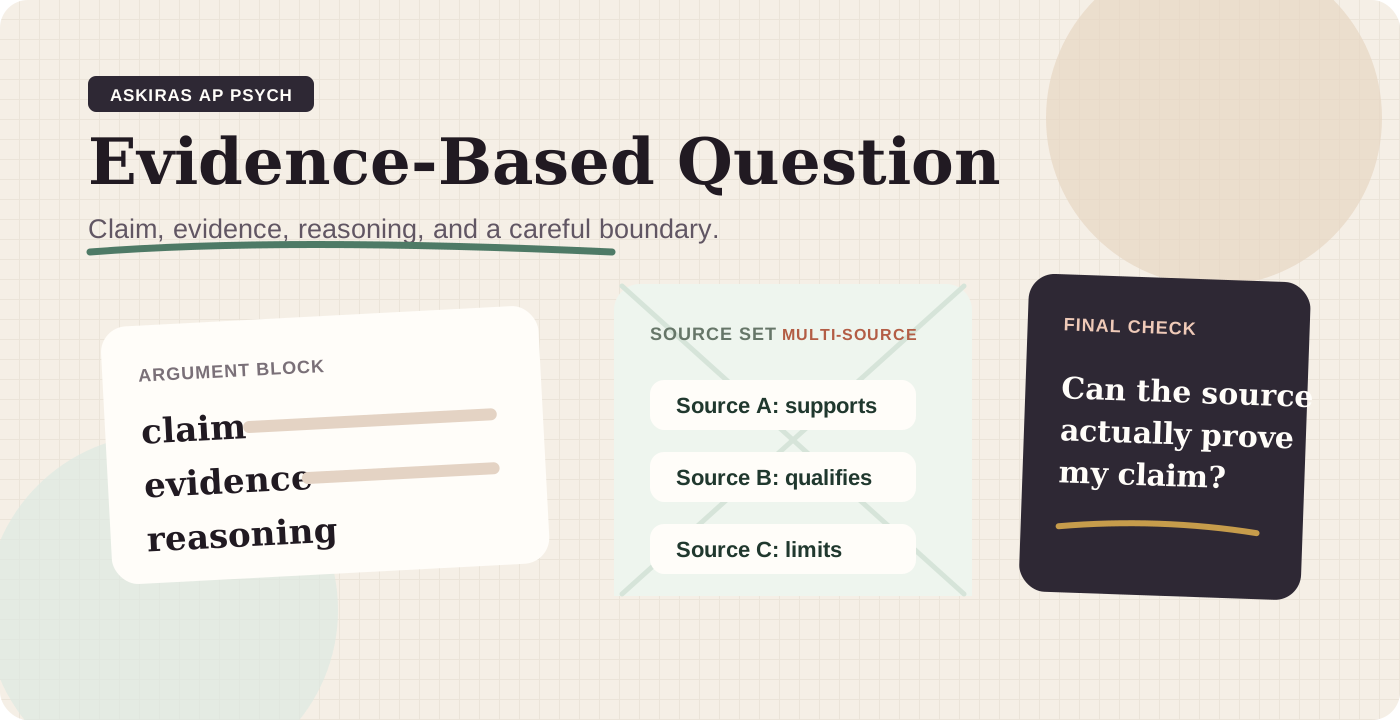
Source C limits the claim because the effect was smaller on essay questions, so the sources support a claim about recall more directly than a claim about all academic performance.
That is the whole EBQ move: make a claim the sources can carry, use specific evidence, explain the psychology, and stop before the conclusion gets too broad.
Start with the claim, but let the sources control it
Your claim should be:
- specific
- psychological
- defensible
- not broader than the evidence
Avoid claims like:
“Social media is bad.”
“Stress always hurts performance.”
“Therapy works.”
Those are too broad. Better claims sound like:
“High perceived social support may buffer stress responses in some adolescents.”
“A growth-mindset intervention can increase persistence when feedback emphasizes effort and strategy.”
“Exposure to a feared stimulus may reduce avoidance when paired with gradual, repeated practice.”
Notice the words “may,” “can,” and “when.” Those words are not weak. They make the claim match the evidence. AP Psych arguments usually get stronger when they are specific enough to be true.
Weak claim:
“Memory is affected by stress.”
Better claim:
“Acute stress may impair recall on a memory task when it divides attention during encoding.”
The better claim gives you something to prove. It names the construct, the behavior, and the condition.
Read each source for one usable job
During the reading period, give each source one usable job. Ask:
- What did the researchers study?
- What was the main finding?
- Which part of my claim can this support?
- What limitation should keep me from overclaiming?
You do not need to love every source equally. Some sources are better for the main claim. Others might qualify the claim or show a boundary.
Try assigning each source a role: main support, mechanism, qualification, or counterweight. This prevents the common “Source A, Source B, Source C” list. Your paragraph should sound like an argument, not a roll call.
Explain, do not just cite
The scoring difference often lives in the “why.”
Thin:
“Source B supports my claim because students avoided hard puzzles.”
Stronger:
“Source B supports my claim because students praised for being smart avoided hard puzzles after failure, suggesting that ability-based praise can make students protect their self-image instead of persisting.”
The stronger sentence uses the evidence and the psychology.
Use this formula when you are stuck:
“Source [letter] supports [part of claim] because [specific finding], which shows [psychological reasoning].”
Example:
“Source A supports the claim that effort feedback can increase persistence because students praised for effort chose more difficult puzzles, which shows that feedback focused on strategy may encourage students to keep working after challenge.”
The formula is not meant to sound fancy. It is meant to keep you from forgetting the “because.”
Handle conflicting evidence
EBQ source sets may not all point in the same direction. That is not a problem. It is the point.
If one source says social support is linked to lower stress, and another says the effect is smaller for students with heavy workloads, your claim should not be “social support always reduces stress.”
Better:
“Social support may reduce reported stress, but its effect may be limited when academic workload remains high.”
Then use the sources in different roles:
- Source A supports the main relationship.
- Source B qualifies the relationship by showing a boundary.
This is more persuasive than pretending every source says the same thing.
Use limitations without weakening yourself
A limitation does not mean your claim is wrong. It means your claim is careful.
Good limitation language:
- “This source supports the claim for this sample, but not necessarily for all students.”
- “Because the study measured self-reported stress, the evidence may not capture physiological stress.”
- “The sources show an association, so the claim should avoid causal language unless an experimental design supports it.”
Careful claims sound stronger, not weaker.
Here is the difference:
Weak limitation:
“The study had limitations.”
Useful limitation:
“Because the study used self-reported stress, the evidence may reflect how stressed participants said they felt rather than their physiological stress response.”
Useful limitation with argument:
“That limitation means the sources support a claim about perceived stress more directly than a claim about biological stress.”
The last version turns the limitation into a cleaner claim.
Common EBQ mistakes
Do not lock the thesis before reading the sources. Do not paraphrase a source without explaining why it supports the claim. Do not use psychology words as decoration. And do not turn a prompt about stress, therapy, phones, or parenting into a moral opinion. Keep the answer psychological and let the design decide how strong the evidence is.
A quick EBQ outline
Use this structure before writing:
- Claim: one sentence
- Evidence 1: source and result
- Reasoning 1: why that result supports the claim
- Evidence 2: source and result
- Reasoning 2: why that result supports or qualifies the claim
- Boundary: what the evidence does not prove
That outline prevents the common problem of writing a paragraph that sounds thoughtful but never earns the evidence point.
A boundary sentence is not optional polish. It protects the argument from overreach: “These sources support claims about puzzle-task persistence, not all school motivation.”
That does not mean “boundary sentence” is a separate rubric point. It is a practical safeguard: it keeps your claim and reasoning inside what the evidence can actually support.
The final check
Before moving on, ask:
- Did I answer the actual prompt?
- Did I use psychological language?
- Did I explain how the source supports the claim?
- Did I avoid causal language unless the evidence allows it?
The EBQ rewards a student who can argue like a cautious researcher: clear claim, precise evidence, restrained conclusion.
One final useful habit: underline your claim, then underline every sentence that directly supports it. If a sentence does not connect to the claim, cut it or rewrite it.
AP Psych EBQ writing should feel controlled. Make a claim the sources can carry. Use the evidence. Explain the psychology. Stop before the conclusion gets too big.
Frequently asked questions
What is the AP Psychology Evidence-Based Question?
The EBQ gives you three summarized peer-reviewed sources and asks you to make and justify a psychological argument using evidence from those sources.
What makes an AP Psych EBQ claim strong?
A strong claim is specific, defensible, and narrow enough that the provided sources can actually support it.
Should I use every source in the EBQ?
Use the sources the prompt requires. You need two pieces of evidence, but the scoring move is explaining why that evidence supports the claim.
Keep going in this exam
Other guides at Askiras
If you are also prepping another exam, these short guides cover the same "name the pattern, then practice" habit.