AP Euro Exam Guide: Format, Skills, and What to Practice
AP Euro feels dense when every ruler and reform blurs together. Start with the digital format, the recurring skills, and the study moves that actually pay off.
Read it to name the pattern, then practice while it is still fresh.
Prepared by Askiras editorial team. These guides stay short on purpose: one pattern, one worked example, one clear next step into practice. How we build guides.
Uses public AP course and exam context; does not reproduce protected College Board prompts.
College Board AP context, Askiras independence, and no unsupported outcome claims.
How should I start studying AP Euro?
Start with the recurring skills: source reading, contextualization, change over time, and evidence-backed argument. AP Euro gets easier when you study repeated political, religious, intellectual, and social conflicts instead of memorizing isolated rulers.
AP Euro starts making sense when you stop treating it like one giant textbook
AP European History can feel denser than AP World for a simple reason: the cast keeps coming back.
You keep seeing the same states, churches, elites, and movements under new conditions. If you study it as one long list of rulers and reforms, the course turns muddy fast.
A better start is to learn the shape of the exam first, then study the recurring fights underneath it:
- who should rule
- what religion should do in public life
- how ideas unsettle old authority
- how class, labor, and nationalism reorder Europe
That makes the course smaller and the writing sections much less mysterious.
The 2026 AP European History exam at a glance
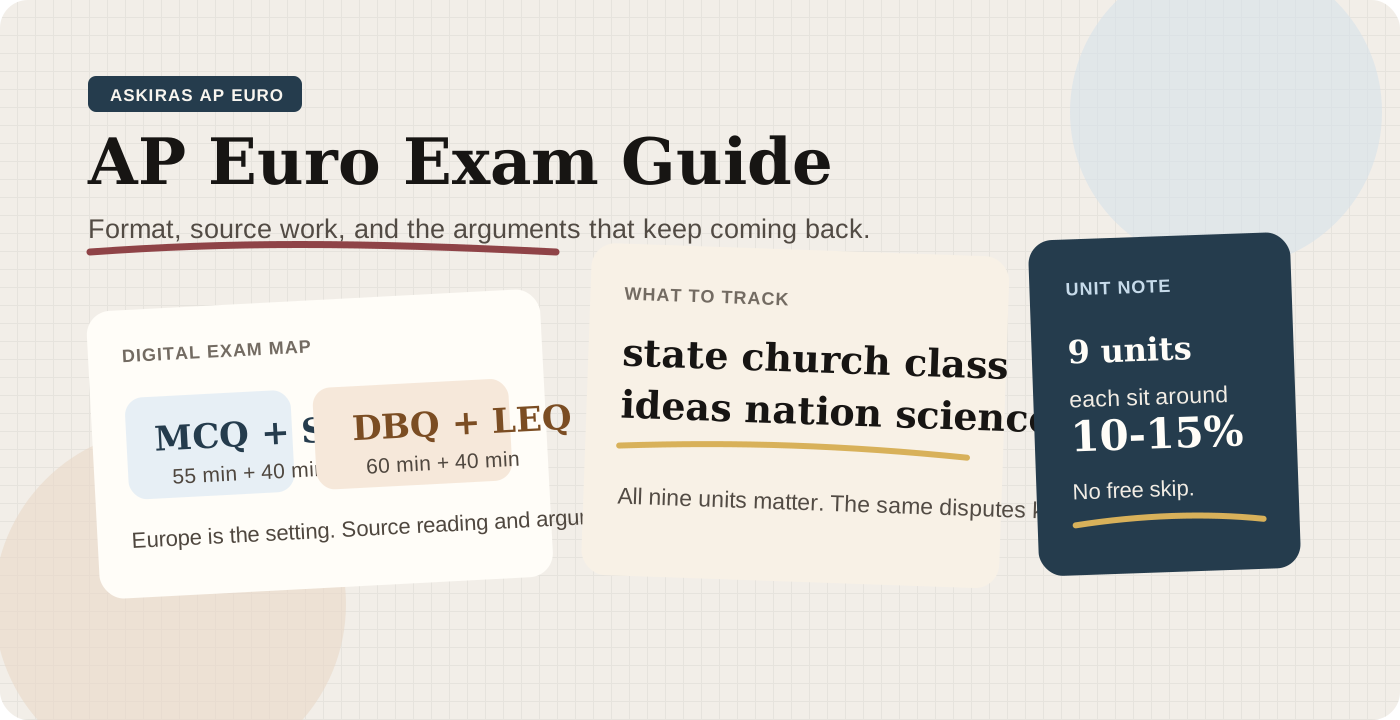
The current 2026 AP European History exam is fully digital and splits into two sections.
Section I
- Multiple Choice: 55 questions in 55 minutes, worth 40% of the score
- Short Answer: 3 questions in 40 minutes, worth 20%
Section II
- Document-Based Question (DBQ): 1 question in 60 minutes, worth 25%
- Long Essay Question (LEQ): 1 question in 40 minutes, worth 15%
That means AP Euro is not just a content test. It is a source-reading test and an argument-writing test.
You need to move between excerpts, paintings, political cartoons, charts, and prompts without losing the century, the conflict, or the claim.
What AP Euro is really rewarding
Students often think AP Euro rewards who remembers the most. It usually rewards who can do four things cleanly:
- place a source inside the right historical fight
- explain change or continuity across periods
- connect specific evidence to a defensible argument
- write without turning every answer into a fact dump
That last part matters. AP Euro punishes vague elegance.
A sentence that clearly explains why the Reformation weakened religious unity or why industrialization changed class politics scores better than a page of names with no line of reasoning.
Unlike AP World, every unit really matters
One of the most useful AP Euro facts is also one of the calmest: all nine units sit in the 10-15% range on the multiple-choice section.
That means there is no obvious “skip these early units and pray” strategy.
The official unit map is:
- Unit 1: Renaissance and Exploration
- Unit 2: Age of Reformation
- Unit 3: Absolutism and Constitutionalism
- Unit 4: Scientific, Philosophical, and Political Developments
- Unit 5: Conflict, Crisis, and Reaction in the Late 18th Century
- Unit 6: Industrialization and Its Effects
- Unit 7: 19th-Century Perspectives and Political Developments
- Unit 8: 20th-Century Global Conflicts
- Unit 9: Cold War and Contemporary Europe
The good news is that AP Euro is more coherent than it first looks. Most later units are replies to earlier ones.
If you understand how Renaissance humanism sets up Reformation debates, how absolutism collides with constitutionalism, and how Enlightenment thought destabilizes inherited power, the later chapters stop feeling random.
Use the themes to keep details from floating away
The official theme buckets are useful because they force the content into lanes.
- Interaction of Europe and the World
- Economic and Commercial Developments
- Cultural and Intellectual Developments
- States and Other Institutions of Power
- Social Organization and Development
- National and European Identity
- Technological and Scientific Innovation
You do not need to chant those names. You do need to use them.
When a topic starts to blur, ask:
- is this mainly about state power?
- a fight over belief?
- a new economic order?
- a shift in identity?
- a scientific or intellectual break?
That question usually gets you back on the rails faster than rereading another page of notes.
How the sections feel in practice
Multiple choice
AP Euro multiple choice is rarely about a naked fact. It is usually about reading a source correctly.
That source might be:
- a royal edict
- a philosopher’s excerpt
- a political cartoon
- a painting
- a chart or table
The challenge is to identify the argument, not just the topic.
Short answer
SAQs reward compressed clarity. One claim, one specific example, one clear explanation is usually enough.
Students lose time here when they start writing tiny essays.
DBQ
The DBQ rewards planning more than fluency. If you sort the documents into usable groups during the reading period, the essay usually settles down. If you do not, it turns into a parade of summaries.
LEQ
The LEQ is where students expose whether they can actually organize evidence. The best prompt is not the one with the fanciest topic. It is the one where you can make a clear argument and support it in two or three solid chunks.
A better way to study AP Euro
Think in three layers.
Layer 1: build the chronology spine
Know the order of the big turns:
- Renaissance
- Reformation
- absolutism and constitutionalism
- Enlightenment and new political thought
- revolution
- industrialization
- nationalism and mass politics
- world wars
- Cold War and contemporary Europe
Layer 2: track the recurring debates
AP Euro keeps circling a few major arguments:
- church versus state
- monarchy versus representation
- tradition versus reform
- hierarchy versus equality
- empire versus nation
Layer 3: practice the actual tasks
Once the map exists, move into:
- source-based MCQs
- short, direct SAQs
- DBQ planning
- LEQ outlining
That is the part many students delay too long. They know the chapter better than the score shows because they never trained the exam form.
What to do near the exam
In the final stretch, stop trying to “cover Europe” one more time. Do shorter, tighter jobs:
- one source-reading set
- one SAQ or LEQ outline
- one DBQ plan
- one targeted review of a weak period
AP Euro gets easier when you keep naming the dispute underneath the details.
That is the real job of the course and the exam: not to remember Europe as a pile, but to explain how its ideas, states, and social orders kept remaking one another.
Frequently asked questions
Is AP Euro mostly about memorizing names and dates?
No. You need factual control, but the exam rewards whether you can place a source in context, explain change over time, and build a historical argument with evidence.
Can I safely skip a few AP Euro units if I am short on time?
Not really. Unlike some exams with heavier middle units, AP Euro spreads the multiple-choice weight across all nine units, so weak spots can show up almost anywhere.
What should I improve first if AP Euro writing feels weak?
Start with argument clarity. A cleaner thesis, tighter sourcing, and more specific evidence usually raise DBQ and LEQ scores faster than trying to sound more academic.
Keep going in this exam
Other guides at Askiras
If you are also prepping another exam, these short guides cover the same "name the pattern, then practice" habit.