AP Euro LEQ Strategy: Build One Defensible Argument
The AP Euro LEQ rewards clear argument and period thinking. Pick the prompt you can actually prove, then build two or three clean evidence blocks.
Read it to name the pattern, then practice while it is still fresh.
Prepared by Askiras editorial team. These guides stay short on purpose: one pattern, one worked example, one clear next step into practice. How we build guides.
Uses public AP course and exam context; does not reproduce protected College Board prompts.
College Board AP context, Askiras independence, and no unsupported outcome claims.
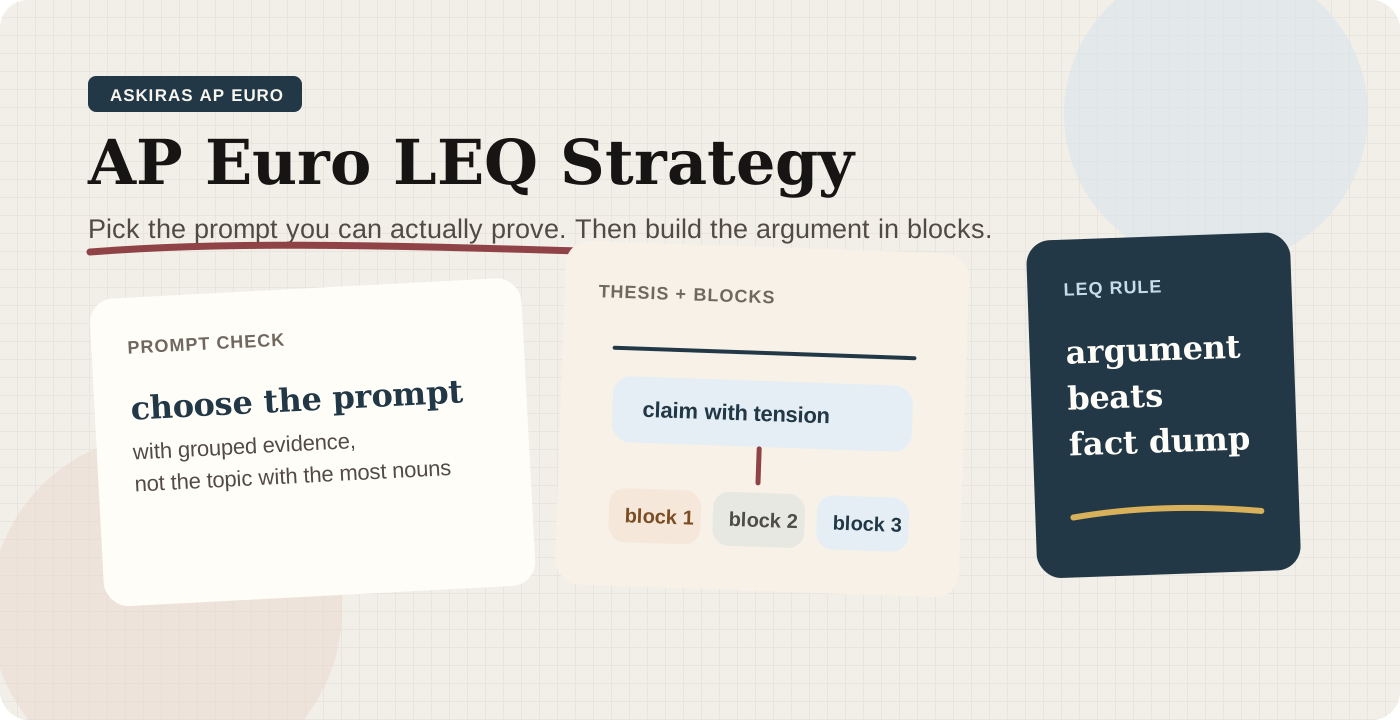
The LEQ goes better when you stop trying to pour the whole chapter into it
The AP Euro LEQ punishes a very specific habit: students remember a lot, panic, and try to unload all of it.
That usually produces a busy essay with weak control.
The cleaner move is simpler. Choose the prompt you can actually prove, build one argument with two or three evidence blocks, and stay loyal to the historical period the question names.
This is not the section for showing everything you know. It is the section for showing that you can organize what you know.
Start with the prompt choice
The LEQ becomes much easier the moment you stop asking, “Which topic do I know best?”
Ask instead:
- Which prompt can I argue, not just describe?
- Which prompt gives me evidence I can group?
- Which prompt lets me keep the period boundaries clear?
Suppose one prompt asks about the effects of the French Revolution and another asks about the causes of the Scientific Revolution.
If you know ten facts about the French Revolution but cannot organize them, that is not automatically the better choice. If the Scientific Revolution prompt gives you a clear causal chain you can explain, pick that.
Build a thesis with tension, not wallpaper
Take a prompt like:
Evaluate the extent to which the French Revolution changed politics in Europe from 1789 to 1848.
A weak thesis:
The French Revolution changed Europe a lot.
A better thesis:
The French Revolution transformed European politics by spreading new expectations about citizenship, sovereignty, and legal equality, but its effects were uneven because conservative regimes still restored hierarchy and tried to contain mass political participation after Napoleon.
That thesis already tells you what the essay will do:
- change in political expectations
- continuity or backlash from conservative restoration
Now the body has structure.
Think in evidence blocks, not in sentences
Before you draft, decide what the two or three main blocks of proof are.
For the French Revolution prompt, they might be:
- abolition of feudal privilege and new political language
- Napoleonic reforms and the spread of legal or administrative change
- Congress of Vienna and conservative attempts to restore order
That is enough.
Each block should answer the same question: How does this evidence help prove my thesis?
If the block cannot answer that, it probably does not belong.
Match the evidence to the reasoning task
LEQ prompts usually ask for one of a few reasoning jobs:
- causation
- comparison
- continuity and change over time
Do not write the same essay shape for all three.
If it is causation
Show the chain. What pressures, ideas, policies, or conflicts produced the outcome?
If it is comparison
Use shared categories. Do not just discuss one case and then the other.
If it is continuity and change
Name what shifted and what stayed durable. Both matter.
Students often lose control because they know the content but never adapt the structure to the prompt type.
Keep period boundaries visible
This matters more in AP Euro than students think.
If the prompt says 1648 to 1815, do not drift carelessly into the later nineteenth century just because you know useful related facts. If the prompt stops at 1848, keep the argument anchored there.
One of the easiest ways to make an LEQ look stronger is to make the chronology feel disciplined.
That means:
- early evidence belongs early
- turning points are named clearly
- later evidence is used only if the prompt allows it
The best body paragraphs feel almost mechanical
That is a compliment.
A strong paragraph usually does this:
- makes a claim tied to the thesis
- gives specific evidence
- explains why the evidence proves the claim
For example:
Revolutionary politics changed Europe by making citizenship and legal equality harder to contain. In France, the abolition of feudal privilege and the Declaration of the Rights of Man challenged older assumptions about inherited status. Even after revolutionary violence and regime change, those ideas remained difficult for later governments to erase entirely.
That paragraph is not fancy. It is useful.
The LEQ mistakes that keep repeating
1. Fact pile with no argument
Real evidence appears, but the essay never tells the reader what the evidence adds up to.
2. Vague comparison words
Students write “similarly” or “in contrast” without actually comparing the same category.
3. Prompt drift
The essay starts on one reasoning task and ends on another.
4. Overbuilt introduction
You do not need a dramatic opening. You need a thesis with a line of reasoning.
5. No explanation after the example
Evidence alone does not score its own point. You still have to show why it matters.
A short practice method that works
You do not need to write a full LEQ every study session.
A strong shorter drill is:
- read one prompt
- choose a thesis in two sentences
- list three evidence blocks
- write only one body paragraph
If that paragraph is clean, the rest of the essay usually follows.
Good AP Euro LEQs do not feel encyclopedic. They feel controlled.
That is the target: one defensible argument, one usable structure, and evidence that keeps doing work instead of sitting there like proof you took the class.
Frequently asked questions
Should I choose the LEQ prompt with the topic I recognize fastest?
Not automatically. Choose the prompt where you can make a specific claim and support it with organized evidence, not just the one with the most familiar nouns.
How much evidence does one AP Euro LEQ really need?
Usually two or three strong blocks of evidence are enough if each block clearly supports the thesis. A shorter argument with real analysis beats a sprawling list.
What is the biggest LEQ mistake in AP Euro?
Turning the essay into a fact dump. Students often know the period, but they never make the evidence serve one clear line of reasoning.
Keep going in this exam
Other guides at Askiras
If you are also prepping another exam, these short guides cover the same "name the pattern, then practice" habit.