How to Solve SAT Linear Equation Word Problems
A step-by-step recipe for SAT linear equation word problems, with four fully worked examples and the mistakes that quietly cost the most points.
Read it to name the pattern, then practice while it is still fresh.
Prepared by Askiras editorial team. These guides stay short on purpose: one pattern, one worked example, one clear next step into practice. How we build guides.
Uses public Digital SAT format and practice-strategy context; does not reproduce protected College Board questions.
College Board Digital SAT context, Askiras independence, and no unsupported outcome claims.
Why these problems feel harder than they are
A SAT linear equation word problem usually looks like a short paragraph of context followed by a single ask. The math is rarely advanced. The setup is the part that costs points.
Most students can solve 3x + 7 = 22 in under ten seconds. The same students will read three sentences about a cell-phone plan and freeze. The algebra did not change. The translation did.
If you’re scanning the broader SAT math pattern catalog, start with our SAT math patterns guide. This page goes deep on linear-equation word problems specifically — the workflow, the worked examples, and the most common mistakes.
The rest of this guide is a step-by-step recipe, four fully worked examples, the three mistakes that quietly cost the most points, and a short diagnostic flow for when you’re stuck.
The 3-step recipe for any linear word problem
Almost every SAT linear word problem yields to the same three-step routine. The trick is to not skip step 3, which is where most missed points hide.
Step 1 — Translate the words into a single equation (or system)
Before you write any math, write two short sentences on scratch paper:
- What does my variable represent? (Include units.)
- What is the question actually asking for?
Then write the equation, moving slowly through the words. Phrases like “per”, “each”, and “for every” usually mark a coefficient. Phrases like “starting”, “fixed fee”, or “initial” usually mark a constant. Phrases like “more than” and “less than” reverse the order you might expect — see Mistake 2 below.
Two unknowns almost always need two equations — one per relationship the problem describes.
Step 2 — Solve mechanically
Once the equation is written, the algebra should feel routine: combine like terms, isolate the variable, simplify. If you find yourself doing anything clever, double-check step 1. Linear word problems rarely require clever moves.
For systems, prefer elimination if a combined value (like x + y) is what’s being asked. Prefer substitution if one variable is already isolated. Desmos solves these instantly with the intersection feature when you can type both equations cleanly — see SAT Desmos Strategy: When to Graph vs. Solve by Hand for when that’s worth it.
Step 3 — Sanity-check against the question wording
This is the SAT’s favorite trap, and it deserves its own step.
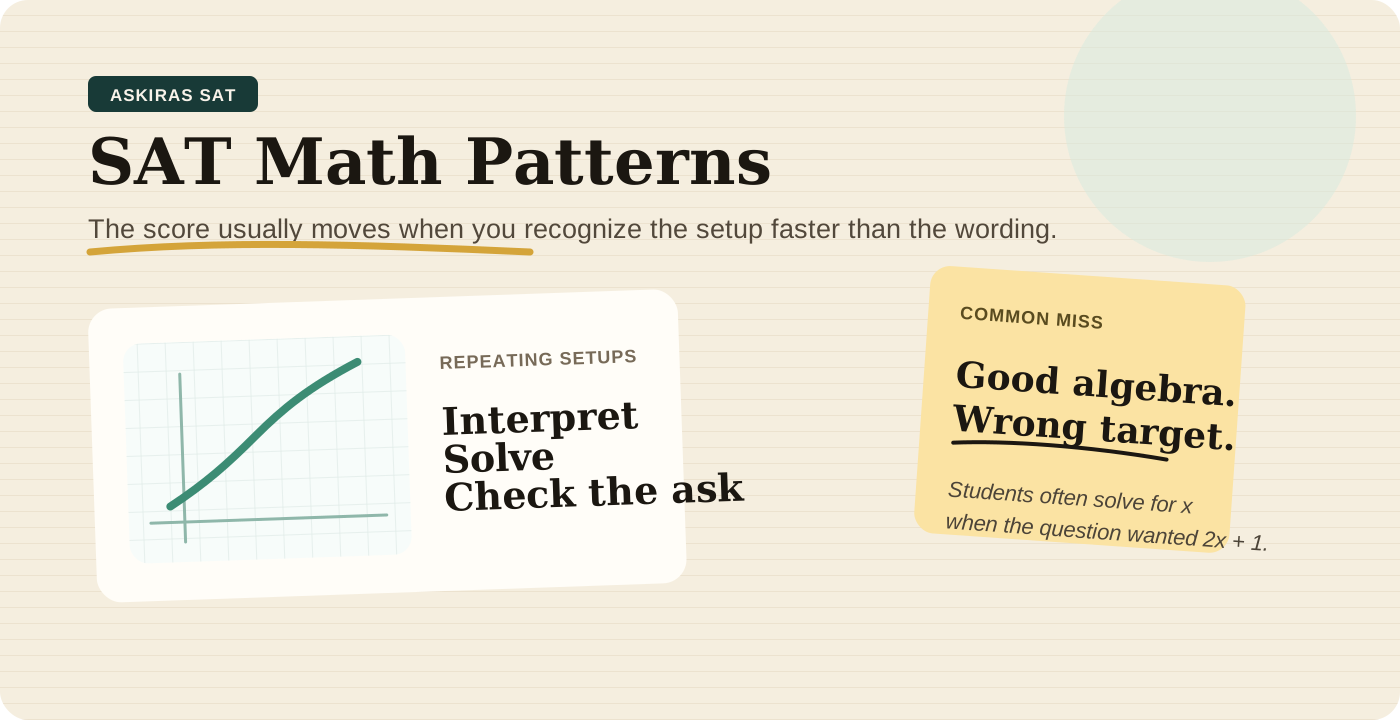
You solved for x. Now read the question one more time. Did it ask for x, or for 2x + 3? For the cost after one month, or for the monthly rate? For the number of adult tickets, or for the total revenue? If the question’s ask doesn’t match what you computed, you are about to lose the point even though your algebra was perfect.
The full check is shorter than it sounds:
- Reread the last sentence of the question.
- Confirm units (dollars, hours, students, gallons).
- Confirm whether the answer should be a single variable, an expression, or a numeric value at a specific input.
- Then bubble in.
Four worked examples
These four cover the four flavors that show up most often on the Digital SAT: a rate problem, a mixture problem, a linear growth problem, and a geometry-based linear setup.
Example 1 — Rate problem (two pipes filling a tank)
Pipe A fills a tank at a constant rate of 4 gallons per minute. Pipe B fills the same tank at a constant rate of 6 gallons per minute. The tank holds 250 gallons and is empty at the start. If both pipes run together for
tminutes, after how many minutes will the tank be exactly half full?
Step 1 — translate. Let t = the number of minutes both pipes have been running. The combined rate is 4 + 6 = 10 gallons per minute. The tank is half full at 250 / 2 = 125 gallons.
The equation:
10t = 125
Step 2 — solve. Divide both sides by 10:
t = 12.5
Step 3 — sanity check. The question asked “after how many minutes,” so the answer is in minutes, and the answer is t itself. Confirm: at t = 12.5, the tank holds 10 × 12.5 = 125 gallons, which is half of 250. Correct.
Why this is a SAT-flavored problem: The combined-rate move (4 + 6 = 10) is the only move that requires care. When two rates act on the same target at the same time, add them and treat them as one rate. If the problem had asked instead “how many gallons does pipe A contribute by the time the tank is half full?” the answer would be 4 × 12.5 = 50, not 12.5. That’s the wrong-target trap, covered in Mistake 1 below.
Example 2 — Mixture problem (coffee blend)
A café blends two types of coffee. Blend X is 30% Colombian beans by weight, and Blend Y is 70% Colombian beans by weight. The owner wants to make a 100-pound batch of a new blend that is 50% Colombian beans by weight. How many pounds of Blend X should be used?
Step 1 — translate. Let x = pounds of Blend X. Then pounds of Blend Y = 100 - x, since the total batch is 100 pounds.
The Colombian beans contributed by each blend, in pounds:
- From Blend X:
0.30x - From Blend Y:
0.70(100 - x)
The total Colombian beans must equal 50% of 100 pounds, which is 50:
0.30x + 0.70(100 - x) = 50
Step 2 — solve. Distribute:
0.30x + 70 - 0.70x = 50
Combine like terms:
-0.40x + 70 = 50
Subtract 70:
-0.40x = -20
Divide:
x = 50
Step 3 — sanity check. The question asked for pounds of Blend X. That’s x. So the answer is 50 pounds. Plug it back: 50 pounds of X contribute 0.30 × 50 = 15 pounds of Colombian. The other 50 pounds (Y) contribute 0.70 × 50 = 35. Total: 50 pounds, which is 50% of 100. Correct.
Why this is a SAT-flavored problem: Mixture problems reward writing the “concentration × amount” expression cleanly for each component before combining. Students who try to set it up in one mental step often forget to convert percentages to decimals, or they multiply the percentages directly (a Mistake 3 — units / conversion). Desmos solves this in seconds, but the algebra above is faster if you’re confident with decimals.
Example 3 — Linear growth problem (tree height)
A young oak tree is 36 inches tall when planted. It grows at a constant rate of 8 inches per year. Let
hrepresent the tree’s height, in inches, afteryyears. If the tree continues to grow at this rate, in how many years will it reach a height of 132 inches?
Step 1 — translate. This is linear growth, not exponential. The tree adds the same number of inches every year, regardless of its current height. That distinction matters: an exponential growth problem (“grows by 8% per year”) would use a multiplier, not a constant addition. The SAT tests both, and mixing them up is a common setup error.
The linear model:
h = 8y + 36
The question asks for the value of y when h = 132:
8y + 36 = 132
Step 2 — solve. Subtract 36:
8y = 96
Divide by 8:
y = 12
Step 3 — sanity check. The question asked “in how many years,” so units are years, and the target is y. Plug it back: 8 × 12 + 36 = 96 + 36 = 132. Correct.
Why this is a SAT-flavored problem: The SAT will sometimes phrase the same scenario with percent language (“grows by 8% per year”) to test whether you can tell the two apart. If the rate is a fixed amount per period, it’s linear and you add. If the rate is a fixed percent per period, it’s exponential and you multiply. When in doubt, check two consecutive periods from the problem’s data: a constant difference means linear, a constant ratio means exponential.
Example 4 — Geometry problem (perimeter of a rectangle)
The length of a rectangle is 5 inches more than twice its width. The perimeter of the rectangle is 64 inches. What is the length, in inches, of the rectangle?
Step 1 — translate. Let w = the width in inches. Then the length is 2w + 5. Note the trap: the phrase “5 inches more than twice its width” means 2w + 5, not 2(w + 5) and not 5 + 2w (it’s the same number, but novice translators sometimes write (2w) + 5 while computing 2(w + 5)). See Mistake 2 below.
The perimeter formula for a rectangle is 2 × length + 2 × width:
2(2w + 5) + 2w = 64
Step 2 — solve. Distribute:
4w + 10 + 2w = 64
Combine like terms:
6w + 10 = 64
Subtract 10:
6w = 54
Divide:
w = 9
Step 3 — sanity check. The question asked for the length, not the width. The length is 2w + 5 = 2(9) + 5 = 23. So the answer is 23 inches.
If you stopped at w = 9 and bubbled in 9, you would lose the point even though every line of your algebra was correct. This is the classic SAT wrong-target trap — covered in detail in Mistake 1.
Why this is a SAT-flavored problem: The geometry is minimal — one perimeter formula. The point of the question is the translation in step 1 and the wrong-target trap in step 3. The SAT often disguises a pure linear word problem as a geometry problem because the disguise costs more time than the math itself.
The top 3 mistakes that cost the most points
These three are the highest-frequency, highest-cost errors on linear word problems. They are not exotic — they are the everyday misses that quietly drop a math score by 30 to 60 points.
Mistake 1 — Solving for the wrong variable
The SAT’s favorite trap. Students do correct algebra, find x, and bubble in x — when the question asked for the length (2x + 5), or the cost after a specific number of months, or the total revenue.
Example 4 is the textbook case: w = 9 is correct, but the answer is the length, which is 23.
The fix is mechanical. In step 3, reread the last sentence of the question before you bubble. If the ask is an expression, plug your value into the expression. If the ask is a value at a specific input, evaluate the model at that input. Never assume the ask is the variable you happened to solve for.
Mistake 2 — Mis-translating “more than”, “less than”, and “twice as many”
These phrases are asymmetric. English order does not match math order:
- “5 more than
x” meansx + 5. The 5 lands second in the math, even though it came first in English. - “5 less than
x” meansx - 5. Not5 - x. The variable comes first in subtraction. - “Twice as many
xasy” meansx = 2y. Noty = 2x. The thing being described (x) is on the left; the thing being compared to (y) gets the multiplier.
That last one is what Example 4 leaned into: “the length is 5 inches more than twice its width” maps to length = 2w + 5. Read too quickly, “twice its width plus 5” can flip into 2(w + 5), which is 2w + 10. The fix is to translate one phrase at a time, written down, before composing them.
Mistake 3 — Forgetting to convert units
Common on rate and mixture problems, but it can hit any word problem:
- The problem gives a rate in miles per hour but asks for an answer in minutes.
- The problem gives a percentage (30%) but you write it as 30 instead of 0.30.
- The problem gives a price per ounce but asks about pounds.
- The problem gives weeks but asks about years.
The fix: in step 1, write units next to your variable. If t is minutes, write “t = minutes”. If a rate is dollars per hour, write “$/hr” next to it. When units match across the equation, the algebra works. When they don’t, the equation is wrong even if every algebraic step is right.
When you’re stuck — a 5-step diagnostic flow
If you’ve stared at a linear word problem for 30 seconds and have nothing on the page, run this sequence in order. Stop as soon as a step gives you a foothold.
-
Name the variable in plain English, with units. “Let
m= the number of months.” If you can’t even do this, the problem is asking about something you haven’t named yet — reread for what’s varying. -
Underline what the question is actually asking for. Last sentence. Is it a single variable, an expression, a value at a specific input, or a comparison? This step alone prevents Mistake 1 from wrecking your work later.
-
Write the relationships, one at a time, in plain math. Don’t try to compose the full equation in your head. Translate “the cost is $50 per month plus a $25 fee” into
cost = 50m + 25as its own line. Translate each relationship the same way, then look at them together. -
Count unknowns and relationships. Two unknowns need two relationships. If you only have one, the missing piece is usually hiding in a phrase like “the total is” or “twice as many”.
-
If still stuck, plug in. Pick a small number for your variable (1, 2, or 10), compute what the problem describes, and check whether the result matches any answer choice. Slow, but reliable — answer choices on linear problems are constrained. Desmos can also make the answer visible in seconds; see SAT Desmos Strategy: When to Graph vs. Solve by Hand.
If none of those five unstick the problem in another 30 seconds, mark it, move on, and come back. Linear word problems are the wrong place to burn three minutes you could spend on three other questions.
How to practice this without burning out
Don’t do twenty linear word problems in a row. Do four, then review each one against the 3-step recipe and the three mistakes above:
- Did you write the variable definition before the equation?
- Did you reread the question’s last sentence before bubbling?
- Did you check units?
- Did the mistake (if you made one) match Mistake 1, 2, or 3?
If the same mistake category shows up twice in a row, that’s the one to drill until it stops appearing. The recipe becomes automatic with reps. The specific problems do not — each one looks different. The recipe is what stays the same.
See also
- SAT Math: The Patterns That Keep Showing Up — the strategic catalog of recurring SAT math question shapes.
- The Digital SAT, Explained — format, scoring, and what to focus on when you start preparing.
- SAT Desmos Strategy: When to Graph vs. Solve by Hand — when graphing solves a linear word problem faster than algebra, and when it slows you down.
Frequently asked questions
What is the fastest way to set up a SAT linear equation word problem?
Define the variable in plain English first, then write down what the question is actually asking for. Building the equation is much easier once those two sentences are on the page.
Why do students miss SAT linear word problems even when their algebra is correct?
The most common reason is solving for the wrong variable. The SAT often asks for an expression like 2x + 3 or for a value at a specific input, not for x itself.
Are SAT linear word problems the same as exponential growth problems?
No. Linear word problems involve a constant rate of change. Exponential problems involve a constant percent change. Mixing them up is one of the most common SAT setup errors.
Keep going in this exam
Other guides at Askiras
If you are also prepping another exam, these short guides cover the same "name the pattern, then practice" habit.